• HOME
  • NEWS
  • EXPLORE
    • CAREER
      • Companies
      • Jobs
    • EVENTS
    • iGEM
      • News
      • Team
    • PHOTOS
    • VIDEO
    • WIKI
  • BLOG
  • COMMUNITY
    • FACEBOOK
    • INSTAGRAM
    • TWITTER
Tuesday, May 12, 2026
BIOENGINEER.ORG
No Result
View All Result
  • Login
  • HOME
  • NEWS
  • EXPLORE
    • CAREER
      • Companies
      • Jobs
        • Lecturer
        • PhD Studentship
        • Postdoc
        • Research Assistant
    • EVENTS
    • iGEM
      • News
      • Team
    • PHOTOS
    • VIDEO
    • WIKI
  • BLOG
  • COMMUNITY
    • FACEBOOK
    • INSTAGRAM
    • TWITTER
  • HOME
  • NEWS
  • EXPLORE
    • CAREER
      • Companies
      • Jobs
        • Lecturer
        • PhD Studentship
        • Postdoc
        • Research Assistant
    • EVENTS
    • iGEM
      • News
      • Team
    • PHOTOS
    • VIDEO
    • WIKI
  • BLOG
  • COMMUNITY
    • FACEBOOK
    • INSTAGRAM
    • TWITTER
No Result
View All Result
Bioengineer.org
No Result
View All Result
Home NEWS Science News Chemistry

Why does COVID-19 impact only some organs, not others?

Bioengineer by Bioengineer
August 11, 2020
in Chemistry
Reading Time: 3 mins read
0
IMAGE
Share on FacebookShare on TwitterShare on LinkedinShare on RedditShare on Telegram

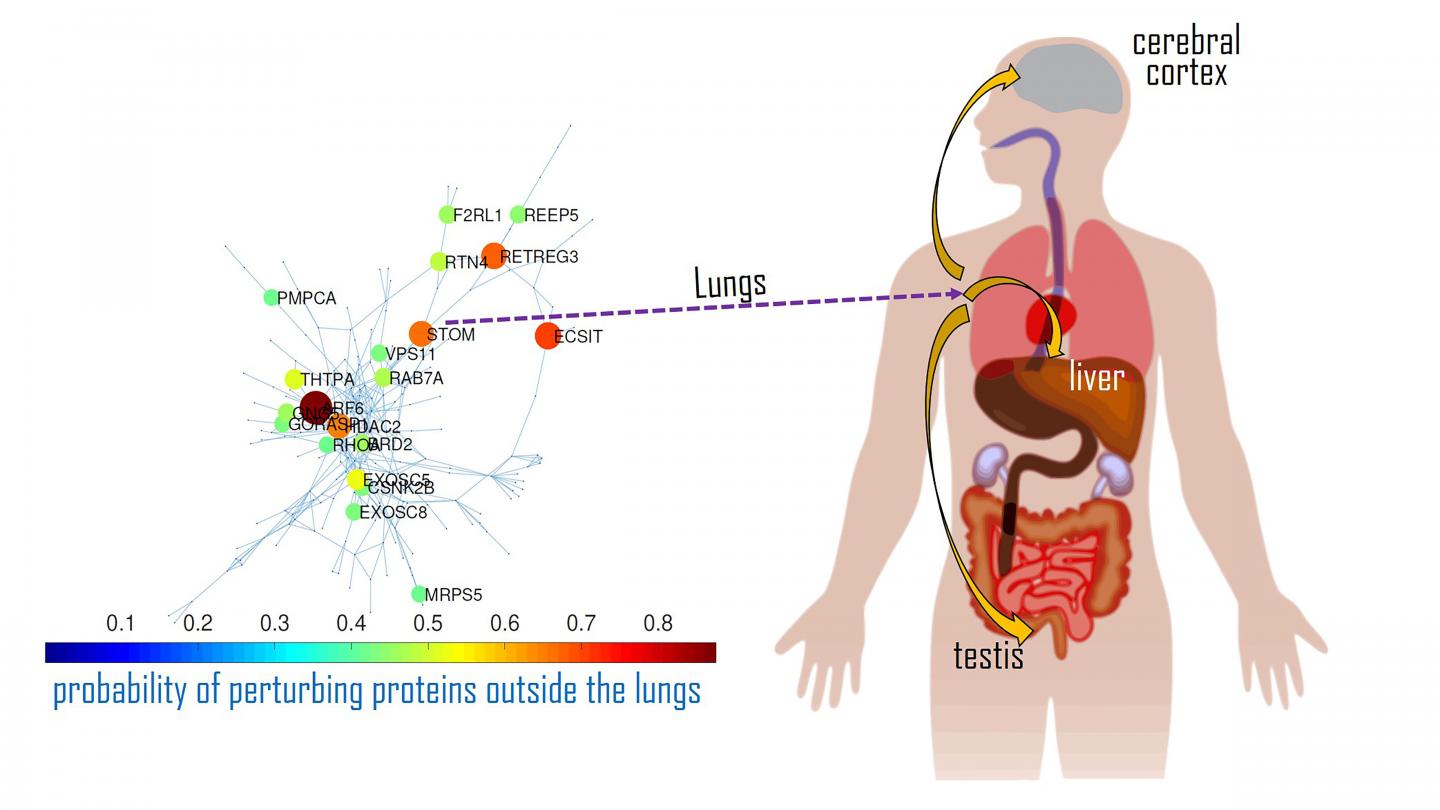
COVID-19 proliferates through a receptor present in most of the human body; but if the receptor is so pervasive, why does the virus seem to target only specific organs?
IMAGE

Credit: Ernesto Estrada

WASHINGTON, August 11, 2020 — In severe cases of COVID-19, damage can spread beyond the lungs and into other organs, such as the heart, liver, kidney and parts of the neurological system. Beyond these specific sets of organs, however, the virus seems to lack impact.

Ernesto Estrada, from the University of Zaragoza and Agencia Aragonesa para la Investigación Foundation in Spain, aimed to uncover an explanation as to how it is possible for these damages to propagate selectively rather than affecting the entire body. He discusses his findings in the journal Chaos, from AIP Publishing.

In order to enter human cells, the coronavirus relies on interactions with an abundant protein called angiotensin-converting enzyme 2.

“This receptor is ubiquitous in most human organs, such that if the virus is circulating in the body, it can also enter into other organs and affect them,” Estrada said. “However, the virus affects some organs selectively and not all, as expected from these potential mechanisms.”

Once inside a human cell, the virus’s proteins interact with those in the body, allowing for its effects to cultivate. COVID-19 damages only a subset of organs, signaling to Estrada that there must be a different pathway for its transmission. To uncover a plausible route, he considered the displacements of proteins prevalent in the lungs and how they interact with proteins in other organs.

“For two proteins to find each other and form an interaction complex, they need to move inside the cell in a subdiffusive way,” Estrada said.

He described this subdiffusive motion as resembling a drunkard walking on a crowded street. The crowd presents obstacles to the drunkard, stunting displacement and making it difficult to reach the destination.

Similarly, proteins in a cell face several crowded obstacles they must overcome in order to interact. Adding to the complexity of the process, some proteins exist within the same cell or organ, but others do not.

Taking these into account, Estrada developed a mathematical model that allowed him to find a group of 59 proteins within the lungs that act as the primary activators affecting other human organs. A chain of interactions, beginning with this set, triggers changes in proteins down the line, ultimately impacting their health.

“Targeting some of these proteins in the lungs with existing drugs will prevent the perturbation of the proteins expressed in organs other than the lungs, avoiding multiorgan failure, which, in many cases, conduces the death of the patient,” Estrada said.

How the affected proteins travel between organs remains an open question that Estrada is dedicating for future studies.

###

The article, “Fractional diffusion on the human proteome as an alternative to the multi-organ damage of SARS CoV-2,” is authored by Ernesto Estrada. The article will appear in Chaos on Aug. 11, 2020 (DOI: 10.1063/5.0015626). After that date, it can be accessed at http://aip.scitation.org/doi/full/10.1063/5.0015626.

ABOUT THE JOURNAL

Chaos is devoted to increasing the understanding of nonlinear phenomena in all areas of science and engineering and describing their manifestations in a manner comprehensible to researchers from a broad spectrum of disciplines. See https://aip.scitation.org/journal/cha.

Media Contact
Larry Frum
[email protected]

Related Journal Article

http://dx.doi.org/10.1063/5.0015626

Tags: Algorithms/ModelsBiologyBiomechanics/BiophysicsEpidemiologyInfectious/Emerging DiseasesMathematics/StatisticsMedicine/HealthVirology
Share16Tweet10Share3ShareShareShare2

Related Posts

Humans and Zebra Finches Share Similar Speech Learning Techniques #ASA190 — Chemistry

Humans and Zebra Finches Share Similar Speech Learning Techniques #ASA190

May 11, 2026
Unveiling Dark Matter Through Molecular Insights — Chemistry

Unveiling Dark Matter Through Molecular Insights

May 11, 2026

From Touch to Sight: A Bioinspired Multisensory Framework Endows Robots with Human-Like Perception

May 11, 2026

Announcing the 2026 Carbon Future Young Investigator Award Winners

May 11, 2026
Please login to join discussion

POPULAR NEWS

  • Research Indicates Potential Connection Between Prenatal Medication Exposure and Elevated Autism Risk

    841 shares
    Share 336 Tweet 210
  • New Study Reveals Plants Can Detect the Sound of Rain

    728 shares
    Share 290 Tweet 182
  • Salmonella Haem Blocks Macrophages, Boosts Infection

    62 shares
    Share 25 Tweet 16
  • Breastmilk Balances E. coli and Beneficial Bacteria in Infant Gut Microbiomes

    57 shares
    Share 23 Tweet 14

About

We bring you the latest biotechnology news from best research centers and universities around the world. Check our website.

Follow us

Recent News

Humans and Zebra Finches Share Similar Speech Learning Techniques #ASA190

New Study Uncovers How Fungal Parasites Attack Strawberries and Raspberries

City of Hope Researchers to Present Groundbreaking Immunotherapy and Precision Medicine Advances Across Multiple Cancer Types at ASCO 2026

Subscribe to Blog via Email

Enter your email address to subscribe to this blog and receive notifications of new posts by email.

Join 82 other subscribers
  • Contact Us

Bioengineer.org © Copyright 2023 All Rights Reserved.

Welcome Back!

Login to your account below

Forgotten Password?

Retrieve your password

Please enter your username or email address to reset your password.

Log In
No Result
View All Result
  • Homepages
    • Home Page 1
    • Home Page 2
  • News
  • National
  • Business
  • Health
  • Lifestyle
  • Science

Bioengineer.org © Copyright 2023 All Rights Reserved.