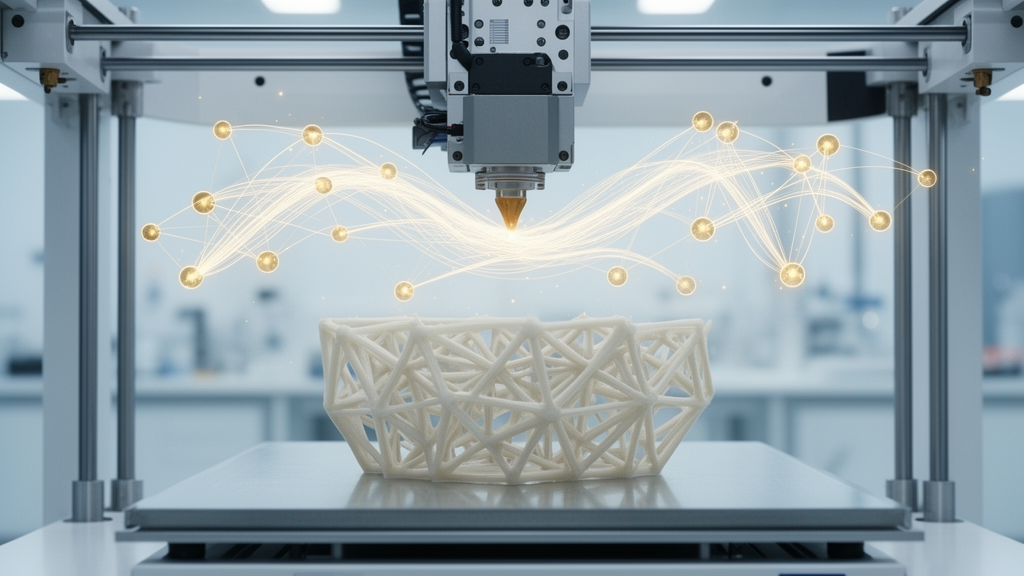
An explainable artificial intelligence approach applied to production planning in a ubiquitous manufacturing system composed of 3D printing facilities improved fuzzy priority derivation accuracy by 54 percent and increased load balancing effectiveness by 66 percent. The fuzzy evolving deep-learning and explainable artificial intelligence framework was developed to address centralized production planning mechanisms that are deep and insufficiently transparent to participating manufacturers, an operational deficiency that damages participant trust in ubiquitous manufacturing platforms.
The centralized production planning mechanism of a ubiquitous manufacturing system is often deep and not transparent enough for participating manufacturers, damaging their trust in the system. To resolve this trust issue, researchers designed a fuzzy evolving deep-learning explainable artificial intelligence approach that pairs rigorous multi-criteria optimization with transparent, interpretable feedback mechanisms.
Under the proposed framework, the process of selecting suitable manufacturers is formulated as a fuzzy analytic hierarchy process problem. Improving the accuracy of fuzzy priority derivation through the proposed fuzzy mixed integer-nonlinear programming model and genetic algorithm ensures the operational correctness of subsequent stages in the production planning workflow.
Once suitable manufacturers are evaluated and ranked, the system administrator distributes the specific quantity required for an incoming order across multiple manufacturing facilities for simultaneous production. This simultaneous allocation is executed using the fuzzy technique for order preference by similarity to the ideal solution. The structured multi-criteria approach balances workloads across distributed facilities, and the system demonstrated a 66 percent improvement in the effectiveness of load balancing during operational deployment.
To make the combined analytic hierarchy, nonlinear programming, genetic algorithm, and order preference pipeline transparent, the architecture constructs a random forest model that explains both the underlying mechanism and the resulting planning decisions. The authors contrast this design with prior explainable artificial intelligence studies, observing that most past research has constructed linear regression equations to approximate deep neural networks. In this study, the researchers outline their rationale for adopting a random forest approximator within the local interpretable model-agnostic explanations framework instead of linear models.
Using the trained random forest model, the system generates a local explanation tailored specifically to an individual manufacturer, clarifying how its evaluation was derived. In addition, the research establishes a systematic procedure to generate contrastive explanations.
The fuzzy evolving deep-learning explainable artificial intelligence framework was validated on the production planning operations of a ubiquitous manufacturing system composed of 3D printing facilities. In addition to delivering a 54 percent gain in priority derivation accuracy and a 66 percent gain in load balancing effectiveness, the local and contrastive explanations generated by the random forest were directly provided to participating manufacturers, enabling them to understand and trust the centralized operations of the ubiquitous manufacturing network.
Subject of Research: Explainable artificial intelligence for ubiquitous manufacturing production planning
Article Title: A fuzzy evolving DL-XAI approach for explainable and trustworthy production planning in ubiquitous manufacturing systems
Article References: Wang, Y.-C., Chen, T., Lin, Y.-C., & Huang, C.-H. (2026). A fuzzy evolving DL-XAI approach for explainable and trustworthy production planning in ubiquitous manufacturing systems. Complex & Intelligent Systems. https://doi.org/10.1007/s40747-026-02577-w
Image Credits: AI Generated
DOI: 10.1007/s40747-026-02577-w
Keywords: ubiquitous manufacturing, production planning, explainable artificial intelligence, deep learning, fuzzy analytic hierarchy process, fuzzy mixed integer-nonlinear programming, genetic algorithm, FTOPSIS, random forest, local interpretable model-agnostic explanations, contrastive explanations, local explanations, load balancing, 3D printing facilities, fuzzy priority derivation, manufacturer trust, simultaneous production
News Source: Denise Maddox. (November 16, 2026). Explainable AI Boosts Planning Accuracy and Load Balancing in 3D Printing Systems. Scienmag.