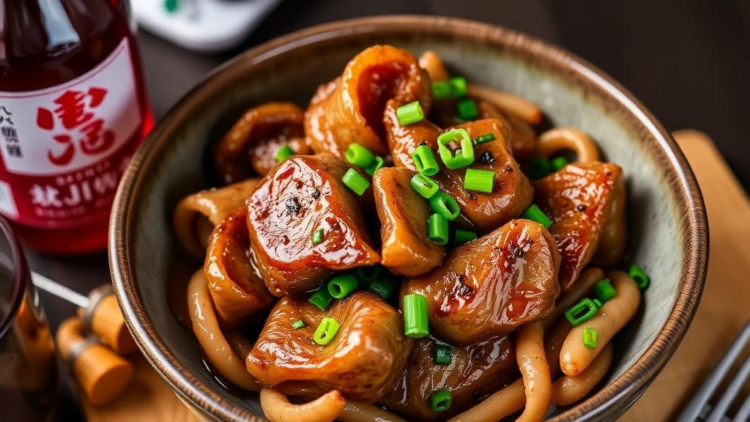
For centuries, cooks across China have reached for a splash of Baijiu, the country’s iconic distilled spirit, before tossing lamb into a blazing wok. The practice is so embedded in the preparation of Sautéed Lamb Slices with Scallion, one of the most celebrated dishes in Chinese cuisine, that few have ever asked precisely why it works. Now a team of food scientists has traced the chemistry behind the tradition, revealing at the molecular level how different aroma types of Baijiu strip away the gamey off-odors that keep many consumers from enjoying lamb, while simultaneously boosting juiciness, umami, and antioxidant protection during cooking.
The problem the researchers set out to solve is well known. Lamb is prized for its tender texture and nutritional value, yet it carries a distinctive unpleasant flavor that limits its popularity in many Asian countries. The culprit is a cocktail of branched-chain fatty acids, including 4-methylnonanoic acid and 4-ethyloctanoic acid, along with a suite of aldehydes and ketones such as hexanal, heptanal, nonanal, and 3-methylbutanal that multiply when high-temperature stir-frying drives lipid oxidation. Worse still, many of these off-odor molecules bind tightly to muscle proteins, hiding in the meat matrix and surviving even prolonged cooking. Baijiu, with more than 2,700 identified flavor compounds, seemed a promising antidote, but no systematic mechanistic study had compared how its different aroma types perform.
To close that gap, the team marinated lamb tenderloin with five commercially distinct Baijiu varieties: a sauce-aroma type (Huaizhuang), two strong-aroma types (Erqu, a single-grain spirit, and Jianzhuang, a multi-grain spirit), and two light-aroma types (Fenjiu and Jiangjin). Each was added at 3 percent by weight, a level consistent with traditional culinary practice, while a control group received distilled water. The marinated lamb was then cooked into the finished dish using a standardized stir-fry protocol at 165 degrees Celsius, and every sample was subjected to an arsenal of analytical techniques including gas chromatography-ion mobility spectrometry, low-field nuclear magnetic resonance, Fourier transform infrared spectroscopy, molecular docking simulations, and a trained thirty-member sensory panel.
The volatile compound analysis told a striking story. Gas chromatography detected 79 volatile organic compounds in raw lamb and 70 in the cooked dish, and Baijiu treatment reshaped this chemical landscape dramatically. In the raw meat, ethanol acted as a polar solvent, dissolving aldehydes such as nonanal, the principal gamey odor compound in meat, and releasing off-odor precursors trapped inside fat cells. Intriguingly, the levels of most off-odor components actually rose in the raw, Baijiu-treated meat, because ethanol disrupted the non-covalent bonds tethering these molecules to myofibrillar proteins and flushed them out of hiding. The real magic happened during cooking: as the volatile ethanol evaporated, it carried the liberated off-odor compounds up and out of the wok with it.
Among the five aroma types, the multi-grain strong-aroma Baijiu Jianzhuang emerged as the standout deodorizer. In the finished dish it reduced nonanal by 61.11 percent, hexanal by 45.50 percent, 1-octen-3-ol by 20.58 percent, and (E)-2-heptenal by 24.80 percent relative to the control. Hexanal, which lends a grassy, oily taint derived from oxidized unsaturated fatty acids, fell to its lowest level in the Jianzhuang group, while that same spirit enriched the dish with citrus and herbal notes from compounds such as (−)-myrtenol and butyl pentanoate. Meanwhile, the light-aroma Fenjiu delivered the strongest antioxidant punch, producing the lowest malondialdehyde score, a marker of lipid oxidation, at just 0.117 milligrams per 100 grams, likely because its small-molecule esters and organic acids penetrate deep into the myofibrillar matrix and quench lipid peroxyl radicals directly.
To explain why Jianzhuang performed so well, the researchers turned to the protein itself. Molecular docking simulations using lamb myosin, which accounts for roughly 55 to 60 percent of myofibrillar protein, showed that six key off-odor compounds bind spontaneously within the protein’s hydrophobic pocket, with binding energies ranging from −4.33 to −5.62 kilocalories per mole. Nonanal, hexanal, and 2-octanone each anchored to the amino acid lysine 272 through hydrogen bonds, reinforced by hydrophobic contacts with residues such as isoleucine 480 and leucine 269. Crucially, aromatic esters and terpenes from Baijiu, such as myrcene with a binding energy of −6.2 kilocalories per mole, bind more strongly than the off-odors do, meaning they can competitively displace the gamey molecules from their protein binding sites and set them free to evaporate.
Spectroscopic evidence confirmed this mechanism in the actual cooked meat. Infrared spectra showed that the broad hydroxyl absorption band shifted to higher wavenumbers in all Baijiu-treated samples, with Jianzhuang producing the largest shift, from 3416 to 3435 inverse centimeters, indicating that ethanol-induced denaturation had weakened the hydrogen bond network that normally locks off-odor compounds onto the protein. Analysis of the amide I band revealed a secondary-structure transition: random coil and alpha-helix content dropped while beta-sheet and beta-turn fractions rose, unfolding the protein, exposing hydrophobic groups, and loosening its grip on volatile molecules. Gel electrophoresis added further support, showing pronounced degradation of the myosin heavy chain in the Jianzhuang-treated samples, which destroyed the original binding sites altogether.
The benefits extended well beyond deodorization. Low-field NMR showed that Baijiu redistributed water within the meat, shifting bound water toward more mobile fractions and increasing the free-water proportion in most treated groups, a change directly linked to perceived juiciness, since highly mobile extra-myofibrillar water is released during chewing. Free amino acid analysis found that total amino acid content rose in every Baijiu group, from 64.58 milligrams per 100 grams in the control to 77.03 in the Fenjiu group, with umami glutamate and sweet arginine climbing significantly. The sensory panel confirmed the instrumental data, rating Baijiu-treated dishes substantially lower in fishy intensity and higher in alcoholic, sweet, sour, spicy, and meaty attributes, with the strong-aroma spirits delivering the greatest sweetness, attributed to their abundant esters.
The study, published in Food Chemistry: X, transforms an ancient culinary instinct into actionable food science. Because each Baijiu aroma type excels at a different task, sauce-aroma spirits contribute organic acids and spicy depth, strong-aroma spirits lead in deodorization and fruity complexity, and light-aroma spirits maximize antioxidant protection and juiciness, chefs and food manufacturers can now select spirits rationally rather than by habit. The authors note that the upstream lipid oxidation pathways regulated by Baijiu remain to be fully mapped, and future work will apply high-resolution lipidomics to trace those networks. For now, the humble splash of Baijiu in the wok stands revealed as a sophisticated multi-target intervention: a solvent, a protein denaturant, a competitive binding agent, and an antioxidant all at once.
Subject of Research: Mechanisms by which different aroma types of Baijiu reduce gamey off-odors and improve flavor quality in stir-fried lamb
Article Title: Elucidating the quality improvement mechanism of classic-aroma Baijiu in sautéed lamb slices with scallion via molecular sensory science and flavor chemistry
Article References: Jia, X., Wang, X., Zhao, Z., Wang, C., Shen, C., Ao, Z., Liu, Y., Nie, X., & Zhou, G. (2026). Elucidating the quality improvement mechanism of classic-aroma Baijiu in sautéed lamb slices with scallion via molecular sensory science and flavor chemistry. Food Chemistry: X, 39, Article 104545. https://doi.org/10.1016/j.fochx.2026.104545
Image Credits: AI Generated
DOI: 10.1016/j.fochx.2026.104545
Keywords: Baijiu, lamb, flavor chemistry, deodorization, myosin, molecular docking, GC-IMS, lipid oxidation, free amino acids, volatile compounds, food science, Chinese cuisine
Cite Scienmag News
APA MLA Chicago
Bethany Barker. (October 3, 2026). Why Chinese Baijiu Makes Stir-Fried Lamb Taste Better: Scientists Decode the Chemistry. Scienmag. https://scienmag.com/why-chinese-baijiu-makes-stir-fried-lamb-taste-better-scientists-decode-the-chemistry/
Bethany Barker. “Why Chinese Baijiu Makes Stir-Fried Lamb Taste Better: Scientists Decode the Chemistry.” Scienmag, 3 October 2026, https://scienmag.com/why-chinese-baijiu-makes-stir-fried-lamb-taste-better-scientists-decode-the-chemistry/. Accessed 3 October 2026.
Bethany Barker. “Why Chinese Baijiu Makes Stir-Fried Lamb Taste Better: Scientists Decode the Chemistry.” Scienmag. October 3, 2026. https://scienmag.com/why-chinese-baijiu-makes-stir-fried-lamb-taste-better-scientists-decode-the-chemistry/
Copy citation Download RIS
Tags: antioxidant effectsaroma compoundsbaijiuChinese BaijiuChinese cuisineculinary chemistrydeodorizationflavor chemistryfood sciencefree amino acidsGC-IMSlamblipid oxidationmeat flavor enhancementmolecular dockingmolecular gastronomymyosinoff-odor removalstir-fried lambtraditional Chinese cuisineumami boostvolatile compounds