Some unexpected shark strandings and subsequent surprises following autopsies have, ironically, taken marine biologists millions of years back in time as they look to the future with concern. Adding chapters to an evolutionary tale involving the infamous megalodon shark (the “Meg”), they think their work suggests there are more warm-blooded sharks out there than previously believed, and – based on the Meg’s demise – these species may be at great risk from warming seas.
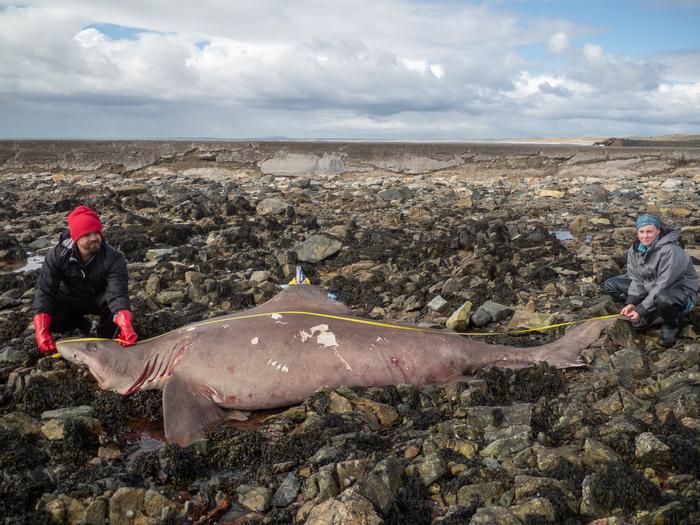
Credit: Dr Jenny Bortoluzzi and Kevin Purves.
Some unexpected shark strandings and subsequent surprises following autopsies have, ironically, taken marine biologists millions of years back in time as they look to the future with concern. Adding chapters to an evolutionary tale involving the infamous megalodon shark (the “Meg”), they think their work suggests there are more warm-blooded sharks out there than previously believed, and – based on the Meg’s demise – these species may be at great risk from warming seas.
Some of the most famous sharks, like the white shark or the extinct megalodon, are unusual in being among the mere ~1% of shark species to be considered warm-blooded or “regional endotherms”.
It had always been thought warmer muscles help fish be powerful and athletic, with regional endothermy only seen in apex predators like the great white or giant tuna. But there has also been some debate about when regional endothermy evolved, and whether extinct species like the megalodon was warm bodied.
In a new study led by Trinity College Dublin, researchers have found that a relatively ancient (but still-living) shark species – the smalltooth sand tiger, thought to have diverged from the Meg at least 20 million years ago – has anatomic features suggesting it is a regional endotherm. Coming hot on the fins of a similar shock that slow-moving, filter-feeding basking sharks are also regional endotherms, the researchers now believe there are more warm-blooded sharks than science thought, and that warm bloodedness evolved quite a long time ago.
Dr Nicholas Payne from Trinity’s School of Natural Sciences was senior author of the study, published this week in Biology Letters. He said:
“We think this is an important finding, because if sand tiger sharks have regional endothermy then it’s likely there are several other sharks out there that are also warm-bodied.
“We used to think regional endothermy was confined to apex predators like the great white and extinct megalodon, but now we have evidence that deep water ‘bottom dwelling’ sand tigers, and plankton-eating basking sharks also are warm bodied. This raises plenty of new questions as to why regional endothermy evolved, but it might also have important conservation implications.”
The research team (including scientists from University of Pretoria, ZSL, University of Zurich, Swansea University, Smithsonian Tropical Research Institute and University College Dublin College of Agriculture Food Science and Veterinary Medicine) undertook dissections of dead smalltooth sand tiger sharks that washed up in Ireland and the UK in making their discoveries.
Dr Haley Dolton, also from Trinity, was lead author of the study. She said:
“Our understanding of science continually grows and it’s becoming clear that whenever regional endothermy evolved in the past it has been retained in a growing number of shark species with very different life styles. When we first realised that the smalltooth tigers have traits associated with regional endotherms I thought ‘here we go again!’, but the next time we see it in another species I might be a little less shocked.
“The discovery itself is very interesting for a marine biologist, but it also has major implications from a conservation perspective for regional endotherms. We believe changing environments in the deep past was a major contributor to the megalodon’s extinction, as we think it could no longer meet the energetic demands of being a large regional endotherm. We know the seas are warming at alarming rates again now and the smalltooth tiger that washed up in Ireland was the first one seen in these waters. That implies its range has shifted, potentially due to warming waters, so a few alarm bells are ringing.”
Journal
Biology Letters