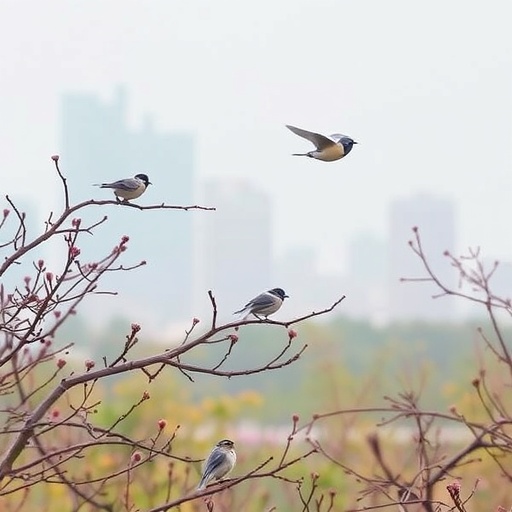
Beijing’s Urban Parks Harbor 68 Bird Species—and Threatened Migrants
As Beijing continues to expand, four urban parks in the city’s Chaoyang District are emerging as important refuges for birdlife, including species listed as endangered or vulnerable on China’s national conservation list. A year-long survey has recorded 68 bird species across Olympic Forest Park, Chaoyang Park, Dongba Country Park and Wenyu River Park, showing that carefully designed green spaces can support much more than recreation. The researchers found that the parks differed significantly in the composition of their bird communities, with Wenyu River Park supporting the greatest number of species. Its wetlands, river corridor and layered habitats appear to provide the combination of food, shelter and open water that resident birds and seasonal migrants need in an increasingly built-up landscape. The results suggest that urban biodiversity depends not simply on how much green space a city contains, but on the ecological quality and structural variety of that space.
The study focused on Chaoyang District, an approximately 478-square-kilometer area in eastern Beijing where around 70 percent of the land is urbanized. The district includes dense commercial zones, diplomatic compounds, residential neighborhoods and a network of public parks. Its remaining semi-natural features are concentrated around waterways such as the Liangma and Tonghui rivers, which are partly canalized but retain stretches of vegetation along their banks. The four surveyed parks differ in their history and design. Olympic Forest Park opened in 2008, Chaoyang Park was established in 1984, Dongba Country Park developed in the early 2000s, and Wenyu River Park was created along the Wenyu River corridor, where habitats were restored and improved from around 2007. Together, the parks offered a natural experiment in how age, water, vegetation and habitat arrangement influence urban bird communities.
From April 2023 through March 2024, the researchers established 80 permanent sampling plots, 20 in each park. The plots were selected using a systematic random design based on a 200-by-200-meter grid, with a fixed point-count station placed within each grid cell. Each station had a 50-meter observation radius, and stations were separated by roughly 150 to 200 meters to reduce the possibility of counting the same bird repeatedly. Observers surveyed the sites primarily between 7 and 10 a.m., when birds are generally most active, and also conducted supplementary afternoon sessions between 3 and 4 p.m. These later counts were particularly useful for detecting waders and waterfowl around Wenyu River Park’s wetlands, although the researchers acknowledged that afternoon surveys may underestimate some passerine species. Each park was surveyed repeatedly across the four seasons, allowing the team to distinguish year-round residents from birds appearing mainly during migration.
Birds were identified through a combination of visual observations, binoculars and vocal recordings compared with reference sounds. The approach was designed to detect species that might be missed by relying on sight alone, especially in dense vegetation. At the same plots, the researchers measured habitat structure using vegetation quadrats at several scales. Trees were recorded in 10-by-10-meter quadrats, shrubs in 5-by-5-meter quadrats, and grasses and herbs in 1-by-1-meter quadrats. The team documented plant species, height, canopy cover and ground cover, creating a detailed picture of the vegetation available to birds. Poplars were common along riparian zones, while ginkgo, pine, ornamental plantings and exotic turf grasses contributed additional layers of habitat. Temperature, humidity and wind speed were also recorded with data loggers, because local microclimates can influence bird activity, detectability and habitat use.
Across the four parks, the number of bird species ranged from 23 to 41, with Wenyu River Park recording the highest total. The overall community was dominated by adaptable urban species, led by the Eurasian magpie, which accounted for 21.9 percent of observations, followed by the Eurasian tree sparrow at 17.9 percent and the common blackbird at 14 percent. Carrion crows represented 13.5 percent, while azure-winged magpies accounted for 9.8 percent. Other frequently observed birds included crested mynas, vinous-throated parrotbills, spotted doves and silver-throated bushtits. Species such as the tree sparrow, Eurasian magpie, great spotted woodpecker and common blackbird appeared regularly in all seasons and parks. Their success reflects traits that make urban generalists effective: tolerance of people, flexible diets and the ability to exploit food and nesting opportunities in modified landscapes.
Yet the most conservation-significant discoveries were concentrated around Wenyu River Park’s wetlands. The researchers detected the bar-headed goose, listed as endangered in the national conservation classification used in the study, and the Chinese reed warbler, listed as vulnerable. Black-crowned night herons, little egrets and northern shovelers were also observed there. Some species appeared only at particular times of year or in specific habitats. The Chinese reed warbler and grey heron, for example, were recorded at Wenyu River Park during spring and summer, while the Amur falcon, northern shoveler and common cuckoo were seen mainly during spring and autumn. These seasonal patterns coincide with the periods when migratory birds move through East Asia. The parks may therefore function as temporary sources of food and shelter within the urban matrix, although the researchers caution that the observations alone cannot prove that the birds were using the sites as migration stopovers. Demonstrating stopover use would require tracking, capture-recapture studies, or measurements of body condition.
To test whether the parks supported distinct bird communities, the researchers used two complementary statistical methods. Non-metric multidimensional scaling, or NMDS, converts complex species-abundance data into a visual map in which plots with similar communities appear close together and plots with different communities appear farther apart. The analysis produced low stress values, approximately 0.06 to 0.083, indicating that the two-dimensional representation retained the main patterns in the original data without substantial distortion. The team then applied permutational multivariate analysis of variance, known as PERMANOVA, to determine whether differences among parks were greater than would be expected from random variation. Park identity explained 10.78 percent of the variation in community composition, with an F value of 3.06 and a probability value of 0.001. Although most variation occurred within parks, the differences among parks were statistically significant. Pairwise comparisons also remained significant after Bonferroni correction, confirming that each park contained a measurably different mix of birds.
The statistical results do not identify a single cause for the differences, but the ecological pattern points toward habitat complexity. Wetlands provide aquatic insects, fish, amphibians, emergent vegetation and shallow feeding areas that are unavailable in heavily landscaped lawns. Trees and shrubs at multiple heights create nesting sites, concealment and foraging opportunities, while open spaces allow ground-feeding birds and waterfowl to move and feed. A park containing water, mature trees, dense understory and less intensively managed edges can therefore support species with very different ecological requirements. Wenyu River Park’s higher richness is consistent with this habitat-heterogeneity effect. However, the researchers did not formally integrate vegetation measurements as statistical predictors in the current analysis, so the role of specific plant structures, water coverage or microclimatic conditions remains to be tested directly. The modest park-level R² also shows that conditions within individual parks are highly variable and may be as important as differences between parks.
The findings highlight both the promise and the limits of urban parks as conservation sites. A city park cannot replace an intact wetland, woodland or rural landscape, particularly for species that require quiet nesting areas or extensive territories. Artificial light, traffic noise, visitors, dogs and routine mowing can disrupt breeding and favor birds that tolerate human disturbance. The absence of ground-nesting species in the survey may reflect their natural rarity in the region, but it could also indicate that heavily used or intensively maintained parkland offers unsuitable conditions. The dominance of urban generalists may signal biotic homogenization, in which the same adaptable species become common across cities while habitat specialists decline. The researchers did not calculate a formal beta-diversity index, so they do not claim to have demonstrated homogenization directly. Still, the results suggest that preserving wetlands, native vegetation and connected river corridors could prevent urban parks from becoming ecologically interchangeable.
The study also underscores the need for more sophisticated and longer-term monitoring. Point counts can miss nocturnal birds, concealed species and canopy dwellers, while short observation windows cannot reveal whether threatened birds are breeding, merely passing through, or using a park as a population source or sink. Acoustic sensors could provide continuous records of vocal species, drones could map habitat structure, and environmental DNA could detect organisms from traces left in water or soil. Citizen-science platforms such as eBird could expand the geographic and seasonal coverage of observations. For Beijing’s planners, the immediate message is that biodiversity-friendly urban design should emphasize ecological function rather than ornamental greenery alone. Protecting wetlands, retaining native plants, creating natural greenways, reducing artificial light and noise, and limiting disturbance during sensitive seasons could transform parks into a connected network of habitat. As cities continue to grow, these measures may determine whether urban landscapes support only a small set of resilient species—or remain living corridors for a much richer community of resident and migratory birds.
Subject of Research: Bird species richness, seasonal dynamics and habitat associations in four urban parks in Beijing’s Chaoyang District
Subject of Research: Biology
Article Title: Urban Parks Act as Refuges for Avian Biodiversity in Chaoyang District, Beijing (China)
Article References: Ur Rahman, A., Bosso, L., Ahmad, S., Ullah, N., Zahid, M., & Ismaili, R. R. R. (2026). Urban Parks Act as Refuges for Avian Biodiversity in Chaoyang District, Beijing (China). Ecology and Evolution, 16(7), Article e73953. https://doi.org/10.1002/ece3.73953
Image Credits: AI Generated
DOI: 10.1002/ece3.73953
Keywords: urban biodiversity, Beijing parks, bird conservation, migratory birds, urban wetlands, avian ecology, habitat heterogeneity, Chaoyang District
Cite Scienmag News
APA MLA Chicago
SCIENMAG. (August 28, 2026). Beijing’s Chaoyang District Urban Parks Provide Refuges for Diverse Birdlife. https://scienmag.com/beijings-chaoyang-district-urban-parks-provide-refuges-for-diverse-birdlife/
SCIENMAG. “Beijing’s Chaoyang District Urban Parks Provide Refuges for Diverse Birdlife.” Scienmag, 28 August 2026, https://scienmag.com/beijings-chaoyang-district-urban-parks-provide-refuges-for-diverse-birdlife/. Accessed 28 August 2026.
SCIENMAG. “Beijing’s Chaoyang District Urban Parks Provide Refuges for Diverse Birdlife.” Scienmag. August 28, 2026. https://scienmag.com/beijings-chaoyang-district-urban-parks-provide-refuges-for-diverse-birdlife/
Copy citation Download RIS
Tags: Beijing Chaoyang District green spacesBeijing Chaoyang District parksbird species survey Beijing parksbird species survey in Beijing parksecological quality of city green spacesecological quality of urban green spacesendangered bird species in Beijing parksimpact of urbanization on birdlife in Beijingimportance of habitat diversity for urban birdsimportance of structural variety in urban parkslayered habitats for urban birdslayered habitats supporting bird diversitymigratory bird habitats Beijingmigratory bird refuges in Chinaprotected bird species in Beijingrole of artificial wetlands in bird conservationurban biodiversity hotspotsurban biodiversity in Chinaurban bird conservationurban park design for bird conservationurbanization impact on bird populationswetland habitats in Beijingwetlands supporting bird diversity