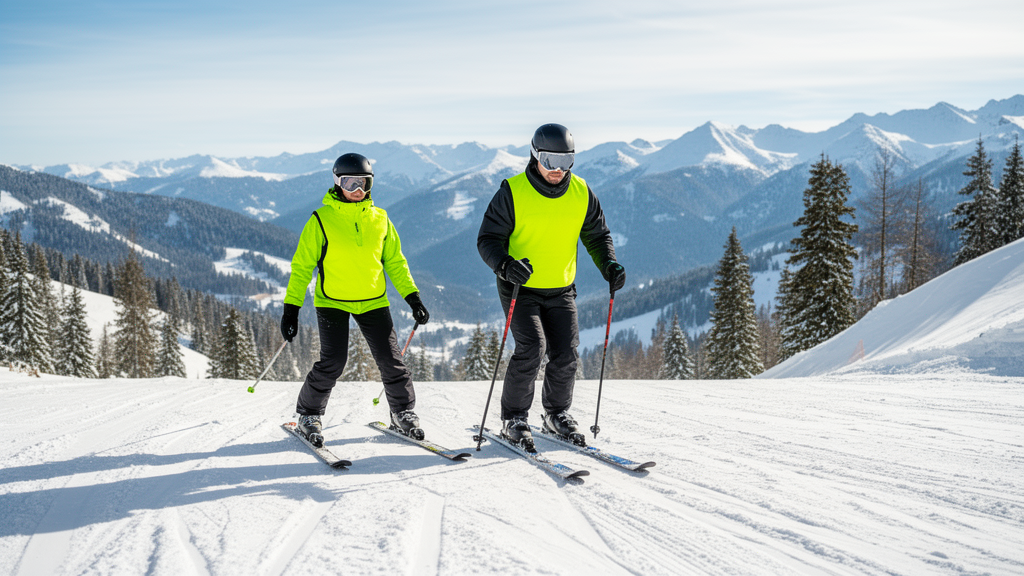
On a groomed blue slope somewhere in the Alps or Scandinavia, a skier who cannot see the piste beneath their boots carves turn after turn, following nothing but a voice. For blind and severely visually impaired skiers, that voice is everything: it replaces the eyes, maps the terrain, and dictates every turn. Now, for the first time, scientists have measured exactly how the physical position of that voice changes the way these athletes hold their bodies on the skis, and the results could reshape how ski schools, clubs, and Paralympic programs teach blind skiing around the world.
A team of researchers led by Iris Steineck and Nicolas Kurpiers of the University of Hildesheim, together with Uwe G. Kersting of the German Sport University Cologne, set out to test a suspicion that ski guides had long whispered about but never verified. Instructors in the German inclusive skiing program Snow & Eyes had repeatedly noticed that blind skiers seem to lean toward the acoustic signal of their guide. Skiers guided from the front appeared to lean forward; skiers guided from behind seemed to sit back on their skis. If true, this would matter enormously, because a backward-leaning position in alpine skiing is not merely a stylistic quirk. It is a known ingredient in some of the sport’s most dangerous knee injury mechanisms.
The two dominant guiding strategies in visually impaired alpine skiing are known as Front Guide and Rear Guide. In the Front Guide variant, the guide skis ahead and calls the line, with the visually impaired skier chasing the sound from a distance of roughly one to two and a half ski lengths. In the Rear Guide variant, the roles reverse: the guide skis behind, shouting commands toward the back of the skier’s head. Competitive Para alpine racing under the International Ski and Snowboard Federation mandates the Front Guide setup at World Championships and World Cup events, but in recreational skiing the choice varies by club, ski school, and personal preference, and the community has debated the merits of each variant for decades without hard data.
To settle the question, the researchers recruited 18 skiers, twelve of them fully blind and six severely visually impaired under German legal criteria, meaning a visual acuity of 0.05 or lower. The participants ranged from 15 to 60 years old, from absolute beginners to experts with up to 500 days of skiing experience, and some had learned to ski before losing their sight while others learned with their impairment already present. Each skier was tested in both guiding conditions on the same day, on the same groomed blue slope with a maximum inclination of 25 percent, in Norway, Austria, Germany, or Switzerland, with temperatures between minus 8 and plus 2 degrees Celsius and stable, calm weather throughout.
The measurement technology was a full-body inertial motion capture system: a suit embedding 17 inertial measurement units sampling at 240 hertz, worn beneath the skier’s clothing. Such wearable IMU systems have emerged in recent years as robust tools for field biomechanics, capable of reconstructing a skier’s center of mass and joint angles outside the laboratory. Calibration posed its own challenge, since standard procedures require standing still with straight knees, which is difficult for blind participants balancing in rigid ski boots. The team’s solution was to unbuckle the boots entirely during the reference pose, allowing participants to straighten their legs for the roughly ten seconds required, and only calibration files rated highly by the system’s internal quality classification were used.
From the motion data, the researchers calculated a single elegant metric they called Cpos: the horizontal distance between the skier’s center of mass and the midpoint between the two ankle joints, projected onto the direction of travel. A positive value means the center of mass sits ahead of the feet, a forward lean; a negative value means it trails behind. Six rhythmic, consistent turns per run were averaged for each guiding variant, and the data were fed into a linear mixed-effects model that accounted for repeated measurements within each participant while testing the effects of guiding variant, accustomed technique, skiing experience, blindness severity, and whether the impairment was congenital or acquired.
The headline result confirmed the guides’ intuition. The center of mass sat significantly more backward during Rear Guide skiing than during Front Guide skiing, with a mean difference of 4.8 centimeters between the conditions. That may sound modest, but it is the same order of magnitude as the six-centimeter forward-lean difference the same research group previously measured between skiing in soft versus stiff ski boot shafts, a difference large enough to change how a skier loads and controls the skis. Intriguingly, individual responses varied widely, from minus 3 to plus 18 centimeters, suggesting that some skiers are far more sensitive to the location of their guide’s voice than others. Neither the guiding variant a skier was accustomed to nor total skiing experience had a significant effect, meaning the posture shift appears even in veterans with decades of muscle memory.
The model also uncovered two subtler effects. Skiers with residual vision showed more forward center-of-mass positions than fully blind skiers, plausibly because they can still extract visual cues from the terrain and therefore depend less on orienting their bodies toward the guide’s acoustic signal. And skiers with congenital impairments leaned less forward than those whose impairment was acquired, which the authors interpret as a matter of trust: without a lifetime of visually acquired movement representations to draw on, adopting a committed forward lean over the ski tips may demand a greater leap of faith. Notably, the effect of guiding variant itself did not differ by severity or onset of impairment, and whether the guide used a speaker system or an unamplified voice made no measurable difference in the Rear Guide condition.
Why does the voice pull the body? The most plausible explanation is that skiers orient toward the source of the sound they depend on for survival on the slope. In the Front Guide setup, the acoustic signal arrives from ahead, from relative azimuth angles spanning roughly plus or minus 120 degrees around the skier’s heading, and the skier follows it, tilting the head and trunk forward. In the Rear Guide setup, commands arrive from behind, and the body seems to rotate backward toward that crucial information stream. Earlier work supports the idea: researchers have described upper-body lean changing in visually impaired long jumpers as they approach an acoustic signal, and ski instructors have observed blind skiers abandoning optimal posture when commands originate from a poorly chosen position. The new study turns these anecdotes into numbers.
The safety implications are what make the finding potentially viral within the skiing community. Backward lean is implicated in the classic skiing knee injury mechanisms, including the so-called phantom foot pattern, in which a backward position combined with internal rotation of the tibia tears the knee, and the boot-induced anterior drawer, in which a flexed knee and backward position lever the tibia forward and threaten the anterior cruciate ligament. Because blind skiers cannot anticipate changes in slope or snow conditions the way sighted skiers can, they must react in real time, and a forward-ready position is considered central to that reactive capacity. The authors are careful to note that actual injury outcomes were not assessed and that a residual confounding effect of the audio equipment cannot be fully excluded, since all Front Guide trials used speaker amplification. Still, the alignment with established biomechanical reasoning is striking, and the team argues that the Front Guide variant may help skiers develop and maintain an adequate position on the skis, particularly during the learning stages.
The study is the first scientific investigation of its kind, and its authors are candid about the hurdles: recruiting blind skiers willing to ski with sensors and strangers took three years, four countries, and meticulous planning, including indoor rehearsal sessions and special training for helpers. But the payoff is a first quantitative foundation for what has until now been a matter of tradition and anecdote. For the roughly small population of blind and severely visually impaired skiers, their guides, their families, and the organizations that train them, the message is concrete: where the guide skis is not neutral. The voice that leads the skier down the mountain also, quite literally, leans their body toward safety or away from it, and choosing that position may be one of the simplest, cheapest interventions available for making the slopes more accessible to everyone.
Subject of Research: Effects of front versus rear acoustic guiding methods on the ski-specific body posture of blind and severely visually impaired skiers
Article Title: The effects of different guiding methods on ski-specific body posture of severely visually impaired and blind skiers
Article References: Steineck, I., Kersting, U. G., & Kurpiers, N. (2026). The effects of different guiding methods on ski-specific body posture of severely visually impaired and blind skiers. Sports Engineering, 29(2), Article 34. https://doi.org/10.1007/s12283-026-00566-3
Image Credits: AI Generated
DOI: 10.1007/s12283-026-00566-3
Keywords: visually impaired skiing, blind skiers, alpine skiing, guiding methods, body posture, center of mass, inertial measurement units, biomechanics, Paralympic sport, knee injury prevention, acoustic orientation, adaptive sports
News Source: Denise Maddox. (October 9, 2026). Where the Guide Skis Changes How Blind Skiers Stand on Their Skis. Scienmag.