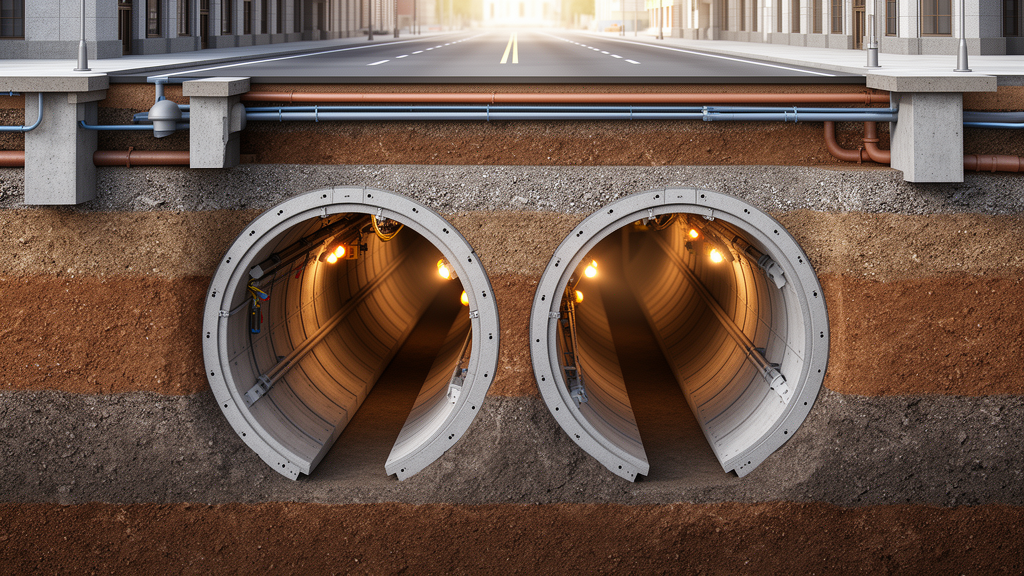
Beneath the streets of Shiraz, Iran, two parallel tunnel boring machines have carved out one of the country’s most ambitious metro systems, and the ground above them has been quietly telling engineers a story about how cities deform when their foundations are hollowed out. A new numerical study published in Results in Engineering has now translated that story into a comprehensive parametric framework, running roughly 400 finite element simulations to determine which factors matter most when twin tunnels squeeze the life out of the soil between them. The findings offer urban planners and tunnel designers a practical roadmap for predicting and limiting the settlement that threatens buildings above underground rail lines worldwide.
The research, led by Ali M. Rajabi, Jahangir Esfandiarinasab, and Reza Khajevand, focuses on Shiraz Metro Line 1, a 24.2-kilometer underground network that includes 15 kilometers of parallel twin tunnels. In the studied section, two tunnel boring machines excavated profiles with a cutting wheel diameter of 6.9 meters, lined with 30-centimeter-thick concrete segments installed behind the shield. The center-to-center spacing between the two tunnels ranges from 13 to 17 meters, and the tunnels sit approximately 23 meters below the surface. The geology along the route consists mainly of weak clay above the tunnels, with alternating layers of clay, sand, and silt beneath, and groundwater levels fluctuating between 6 and 9 meters along the alignment.
What makes the study particularly valuable is its grounding in real field data. The researchers deployed control points at 10-meter intervals along the tunnel alignment, monitoring surface settlement from three days before excavation began until one month after completion. Their two-dimensional finite element model, built in PLAXIS under plane strain conditions, was validated against these measurements using soil stratigraphy from borehole BH-A-9. The comparison produced a root mean square error of just 0.67 millimeters, a mean absolute error of 0.60 millimeters, and a mean absolute percentage error of 3.80 percent, with a coefficient of determination of 0.91. These metrics indicate that the model reproduces both the magnitude and the characteristic double-trough shape of the settlement profile with impressive fidelity.
The settlement mechanism itself is a fascinating piece of geotechnical physics. When a tunnel is excavated, the soil that once supported the removed material must find a new equilibrium, and stress redistributes around the opening in a pattern engineers describe as arching. With twin tunnels, the individual stress redistribution zones overlap, concentrating deformation in the soil pillar between the two crowns. The study’s displacement contours reveal that maximum settlement occurs precisely in this intermediate zone, producing a settlement trough that is wider and flatter than the classical Gaussian profile associated with single tunnels. A localized zone of heave even appears beneath the tunnel inverts, a signature of stress relief following excavation. This amplified settlement in the central region represents the most critical area for potential structural damage in densely built environments.
Among the geometric parameters, tunnel diameter emerged as a dominant driver of surface deformation. At constant depth, settlement rose from approximately 1.9 millimeters for a 3-meter-diameter tunnel to about 8.5 millimeters for a 9-meter tunnel, a consequence of the larger excavated volume and the expanded zone of ground relaxation. Burial depth works in the opposite direction: deeper tunnels benefit from greater overburden confinement, which attenuates deformation before it reaches the surface. The researchers found that increasing the burial depth of a 7-meter tunnel from 30 to 90 meters at a friction angle of 30 degrees reduced settlement from 6.1 to 5.1 millimeters, a 16.4 percent decrease. The normalized depth-to-diameter ratio, they emphasize, governs how effectively the ground absorbs and dissipates excavation-induced stress release.
Soil properties proved equally consequential, and here the study delivers one of its most instructive insights. Within the Mohr-Coulomb framework used in the analyses, cohesion plays a more dominant role than the internal friction angle in limiting settlement, because cohesion contributes directly to available shear strength at the relatively low confining stresses found near tunnel boundaries. Increasing cohesion reduced settlement by roughly 1.4 millimeters across the tested range, while raising Poisson’s ratio from 0.1 to 0.4 increased settlement by a more modest 0.1 millimeters. The normalized cohesion-to-elastic-modulus ratio consistently outperformed the friction angle as a predictor of deformation behavior, suggesting that designers should pay particular attention to the cohesive component of soil strength when assessing tunneling risk in urban clay deposits.
The interaction between surface structures and the underlying tunnels adds another layer of complexity. Contrary to the intuitive assumption that heavier, stiffer buildings might brace the ground against deformation, the simulations showed that settlement increases with the number of stories when foundation width remains fixed, reaching approximately 3.7 millimeters at the highest load level of ten stories. Because the footprint stays constant, additional weight simply concentrates vertical stress over the same area rather than improving structural stiffness. Wider foundations, however, do help: increasing the building width-to-tunnel-diameter ratio reduced settlement by about 3 percent through better load dispersion. The critical zone of maximum deformation was identified within roughly 20 meters of the midpoint between the tunnel axes, and settlement directly above individual tunnels proved slightly greater than at the midpoint itself.
Perhaps the study’s most sobering comparison involves the classical empirical and analytical methods that have guided tunnel design for decades. When the researchers benchmarked their finite element predictions against the formulations of Peck, Atkinson, and Lee, the numerical results were consistently higher. At a tunnel depth of 30 meters, Atkinson’s method predicted 4.8 millimeters of settlement while the PLAXIS model produced 8.2 millimeters, roughly 58 percent more. The discrepancy stems from the fact that most empirical formulas were developed for single tunnels under simplified greenfield conditions and cannot capture tunnel-tunnel interaction, stress superposition, or the influence of nearby structures. Among the analytical solutions tested, Bobet’s approach agreed best with the numerical results, while the Loganathan and Poulos solution showed discontinuities attributable to its simplifying assumptions.
A perturbation-based sensitivity analysis crystallized the hierarchy of influence. Tunnel depth, tunnel diameter, and soil cohesion produced the largest relative changes in settlement response within the investigated parameter ranges, while Young’s modulus, Poisson’s ratio, and building-related variables played comparatively smaller roles. The authors caution that this ranking is specific to their chosen parameter ranges and modeling assumptions, and that the two-dimensional plane strain formulation, while computationally efficient and validated against field data, cannot capture three-dimensional effects such as tunnel face advancement, construction sequencing, and longitudinal stress redistribution. Groundwater flow and consolidation processes were also excluded, meaning the results represent long-term drained conditions rather than short-term undrained behavior.
For the rapidly growing number of cities building metro networks through soft, shallow ground, the message is clear: settlement prediction in twin-tunnel environments demands a coupled view of geometry, geology, and the built environment above. Optimizing tunnel depth and diameter, improving soil stiffness where feasible, and carefully evaluating surface loading conditions can meaningfully reduce settlement-related risk. The Shiraz Metro case demonstrates that even relatively small predicted settlements, on the order of a few millimeters, become intelligible only when the full soil-tunnel-structure system is analyzed together. As underground space becomes an increasingly precious urban resource, studies of this kind transform the invisible mechanics beneath our feet into actionable engineering knowledge, helping ensure that the trains of tomorrow can run beneath our cities without cracking the world above them.
Subject of Research: Numerical parametric analysis of ground settlement induced by twin-tunnel metro excavation in Shiraz, Iran
Article Title: Parametric analysis of twin tunnel-induced ground settlement: a numerical study of Shiraz Metro
Article References: Rajabi, A. M., Esfandiarinasab, J., & Khajevand, R. (2026). Parametric analysis of twin tunnel-induced ground settlement: a numerical study of Shiraz Metro. Results in Engineering, 32, Article 113291. https://doi.org/10.1016/j.rineng.2026.113291
Image Credits: AI Generated
DOI: 10.1016/j.rineng.2026.113291
Keywords: twin tunnels, ground settlement, Shiraz Metro, finite element analysis, PLAXIS, geotechnical engineering, urban tunneling, soil-structure interaction, Mohr-Coulomb model, tunnel diameter, burial depth, soil cohesion
News Source: Denise Maddox. (October 9, 2026). Twin Metro Tunnels Reshape the Ground Beneath Cities, New Study Shows. Scienmag.