• HOME
  • NEWS
  • EXPLORE
    • CAREER
      • Companies
      • Jobs
    • EVENTS
    • iGEM
      • News
      • Team
    • PHOTOS
    • VIDEO
    • WIKI
  • BLOG
  • COMMUNITY
    • FACEBOOK
    • INSTAGRAM
    • TWITTER
Wednesday, February 4, 2026
BIOENGINEER.ORG
No Result
View All Result
  • Login
  • HOME
  • NEWS
  • EXPLORE
    • CAREER
      • Companies
      • Jobs
        • Lecturer
        • PhD Studentship
        • Postdoc
        • Research Assistant
    • EVENTS
    • iGEM
      • News
      • Team
    • PHOTOS
    • VIDEO
    • WIKI
  • BLOG
  • COMMUNITY
    • FACEBOOK
    • INSTAGRAM
    • TWITTER
  • HOME
  • NEWS
  • EXPLORE
    • CAREER
      • Companies
      • Jobs
        • Lecturer
        • PhD Studentship
        • Postdoc
        • Research Assistant
    • EVENTS
    • iGEM
      • News
      • Team
    • PHOTOS
    • VIDEO
    • WIKI
  • BLOG
  • COMMUNITY
    • FACEBOOK
    • INSTAGRAM
    • TWITTER
No Result
View All Result
Bioengineer.org
No Result
View All Result
Home NEWS Science News Biology

Where do the gender differences in the human pelvis come from?

Bioengineer by Bioengineer
March 25, 2021
in Biology
Reading Time: 2 mins read
0
IMAGE
Share on FacebookShare on TwitterShare on LinkedinShare on RedditShare on Telegram

A comparison with chimpanzees provides surprising insights
IMAGE

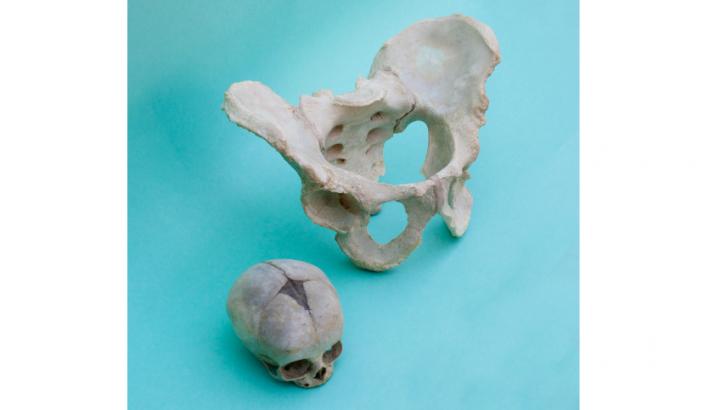
Credit: Photo of a female human pelvis and skull of a newborn baby. (© Barbara Fischer)

Fossil remains of the human pelvis are rare because the pelvic bones do not preserve very well. Therefore, it has remained unclear when human sex differences in the pelvis evolved: jointly with upright walking, or later, together with the large human brains. “We have discovered that the pattern of sex differences in the human pelvis is probably much older than previously thought”, says evolutionary biologist Barbara Fischer.

A team of biologists from the University of Vienna, the KLI for Evolution and Cognition Research, and the University of Calgary compared pelvic sex differences in humans with those in chimpanzees, the most closely-related living species to modern humans. Chimpanzees have much easier births than humans, because their fetuses are smaller. “We analyzed 3D data of pelves for these two species and found that they show the same pattern of sex differences, despite large overall species differences,” says Fischer. Yet, the magnitude of the differences was only half as large in chimpanzees, compared to humans. The striking similarity of the pattern of pelvic sex differences in humans and chimpanzees strongly suggests that it was already present in the common ancestor of the two species. This implies that all the extinct hominin (human-like) species, including e.g., the Neandertals, probably had the same pattern.

Many mammals give birth to larger fetuses, relative to the birth canal of their mothers, compared to humans, e.g., bats and certain primates. These animals possess adaptations in their pelves to facilitate birth of large babies. At the same time, there are other mammals with tiny neonates, e.g., cats and opossums, which also have subtle sex differences in their pelves that resemble the human pattern. This suggests that these similarities in the pattern of pelvic sex differences reflect an old and evolutionarily conserved mammalian pattern. “We think that modern humans did not evolve this pattern de novo, but that we inherited it from earlier mammals that faced the same problem, namely having to give birth to relatively large fetuses,” says Fischer. When our brains became increasingly large over the course of human evolution, the magnitude of pelvic sex differences was therefore able to increase rather rapidly, as the pelvic pattern and the underlying genetic and developmental machinery were already in place and did not have to evolve anew.

###

Publication in Nature Ecology & Evolution:

Barbara Fischer, Nicole D.S. Grunstra, Eva Zaffarini, Philipp Mitteroecker (2021)

Sex differences in the pelvis did not evolve de novo in modern humans. Nature Ecology & Evolution, in print.

DOI: 10.1038/s41559-021-01425-z

Media Contact
Dr. Barbara Fischer
[email protected]

Related Journal Article

http://dx.doi.org/10.1038/s41559-021-01425-z

Tags: BiologyEvolutionPaleontology
Share12Tweet8Share2ShareShareShare2

Related Posts

Sugar Molecules Offer Promising New Approach to Combat Drug-Resistant Bacteria

Sugar Molecules Offer Promising New Approach to Combat Drug-Resistant Bacteria

February 4, 2026
Unlocking History: Genetic Study of Deep Maniot Greeks Unveils a Unique Balkan Time Capsule

Unlocking History: Genetic Study of Deep Maniot Greeks Unveils a Unique Balkan Time Capsule

February 4, 2026

Enhancing ssDNA Templates for CRISPR Gene Editing

February 4, 2026

Adaptive Decision-Making in Naïve Animals: A Novel Unsupervised Model Inspired by Baby Chicks, Turtles, and Insects

February 4, 2026
Please login to join discussion

POPULAR NEWS

  • Enhancing Spiritual Care Education in Nursing Programs

    158 shares
    Share 63 Tweet 40
  • Robotic Ureteral Reconstruction: A Novel Approach

    81 shares
    Share 32 Tweet 20
  • Digital Privacy: Health Data Control in Incarceration

    63 shares
    Share 25 Tweet 16
  • Study Reveals Lipid Accumulation in ME/CFS Cells

    57 shares
    Share 23 Tweet 14

About

We bring you the latest biotechnology news from best research centers and universities around the world. Check our website.

Follow us

Recent News

How Triterpenoids Block Fungal β-Glucan Synthases

Decoding Neural Population Geometry in Shared Tasks

Missing Key Symptoms Linked to Kawasaki Heart Risks

Subscribe to Blog via Email

Enter your email address to subscribe to this blog and receive notifications of new posts by email.

Join 73 other subscribers
  • Contact Us

Bioengineer.org © Copyright 2023 All Rights Reserved.

Welcome Back!

Login to your account below

Forgotten Password?

Retrieve your password

Please enter your username or email address to reset your password.

Log In
No Result
View All Result
  • Homepages
    • Home Page 1
    • Home Page 2
  • News
  • National
  • Business
  • Health
  • Lifestyle
  • Science

Bioengineer.org © Copyright 2023 All Rights Reserved.