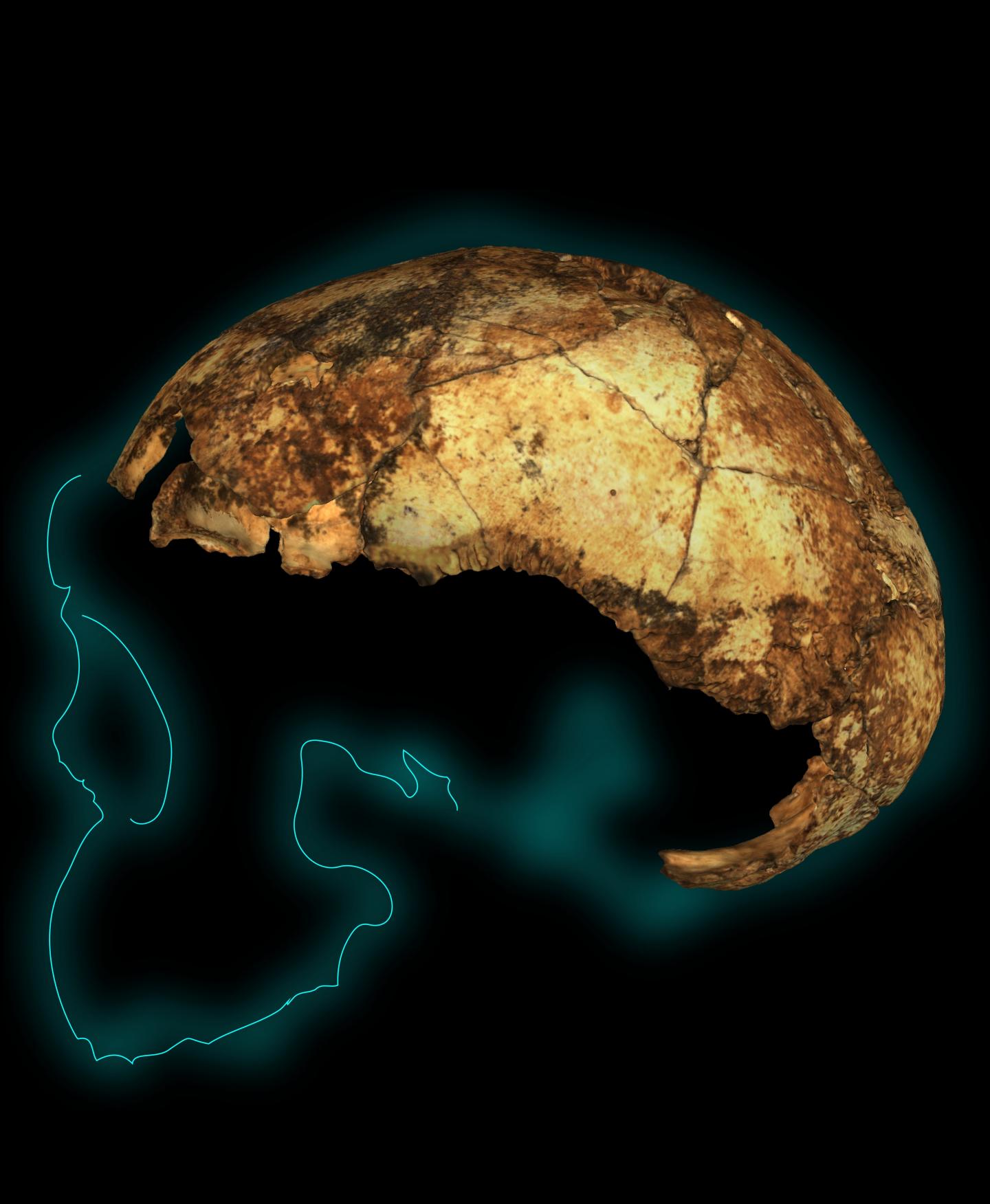
Credit: Angeline Leece.
An international team, including Arizona State University researcher Gary Schwartz, have unearthed the earliest known skull of Homo erectus, the first of our ancestors to be nearly human-like in their anatomy and aspects of their behavior.
Years of painstaking excavation at the fossil-rich site of Drimolen, nestled within the Cradle of Humankind (a UNESCO World Heritage site located just 40 kilometers or around 25 miles northwest of Johannesburg in South Africa), has resulted in the recovery of several new and important fossils. The skull, attributed to Homo erectus, is securely dated to be two million years old.
Published this week in Science, the international team of nearly 30 scientists from five countries shared details of this skull — the most ancient fossil Homo erectus known — and other fossils from this site and discuss how these new finds are forcing us to rewrite a part of our species’ evolutionary history.
The high-resolution dating of Drimolen’s fossil deposits demonstrates the age of the new skull to pre-date Homo erectus specimens from other sites within and outside of Africa by at least 100,000 to 200,000 years and thus confirms an African origin for the species.
The skull, reconstructed from more than 150 separate fragments, is of an individual likely aged between three and six years old, giving scientists a rare glimpse into childhood growth and development in these early human ancestors.
Additional fossils recovered from Drimolen belong to a different species — in fact, a different genus of ancient human altogether — the more heavily built, robust human ancestor Paranthropus robustus, known to also occur at several nearby cave sites preserving fossils of the same geological age. A third, distinctive species, Australopithecus sediba, is known from two-million-year old deposits of an ancient cave site virtually down the road from Drimolen.
“Unlike the situation today, where we are the only human species, two million years ago our direct ancestor was not alone,” said project director and lead researcher from La Trobe University in Australia, Andy Herries.
Gary Schwartz, a paleoanthropologist and research associate with ASU’s Institute of Human Origins, participated in the excavations and recovery of the new cranium, and as an expert in the evolution of growth and development, is continuing his work with the research team to analyze the many infant and juvenile specimens found at the site.
“What is really exciting is the discovery that during this same narrow time slice, at just around two million years ago, there were three very different types of ancient human ancestors roaming the same small landscape,” said Schwartz.
“We don’t yet know whether they interacted directly, but their presence raises the possibility that these ancient fossil humans evolved strategies to divvy up the landscape and its resources in some way to enable them to live in such close proximity.” Schwartz is also an Associate Professor in the School of Human Evolution and Social Change.
The ability to date Drimolen’s ancient cave deposits with such a high degree of precision, using a range of different dating techniques, allowed the team to address important broader questions about human evolution in this region of Africa.
Paper coauthor Justin Adams from Monash University (Australia) is a specialist in reconstructing paleohabitats based on the animals preserved at fossil sites, said the discovery now allows us to address what role changing habitats, resources, and the unique biological adaptations of early Homo erectus may have played in the eventual extinction of Australopithecus sediba in South Africa.
“The discovery of the earliest Homo erectus marks a milestone for South African fossil heritage,” says project codirector and University of Johannesburg doctoral student Stephanie Baker.
Fieldwork will continue at Drimolen, expanding the excavations to include even more ancient components of the cave and to provide a more in-depth glimpse at the forces shaping human evolution in this part of the African continent.
###
The bulk of this research was funded by Australian Research Council Future Fellowship Grant FT120100399 and ARC Discovery Grant DP170100056. The U-Pb analysis was funded by ARC DECRA DE120102504. The US-ESR dating was supported by ARC DP140100919. Work at the site by the Italian Archaeological Mission was supported by a series of grants by the Italian Ministry of Foreign Affairs thanks the National Research Foundation (African Origins Platform) for grants that supported the excavation and research at Drimolen. This work was also supported by a La Trobe University Postgraduate Research Scholarship and La Trobe University Internal Research grant and a Society of Antiquaries London research grant. Components of the palaeomagnetic work were conducted during a Visiting Research Fellowship at the Institute for Rock Magnetism, University of Minnesota, supported through the National Science Foundation, USA.
Media Contact
Gary Schwartz
[email protected]
Related Journal Article
http://dx.