Johns Hopkins study finds it depends on whether you’re Republican or Democrat
Credit: Johns Hopkins University
With climate change looming, what must people hear to convince them to change their ways to stop harming the environment? A new Johns Hopkins University study finds stories to be significantly more motivating than scientific facts– at least for some people.
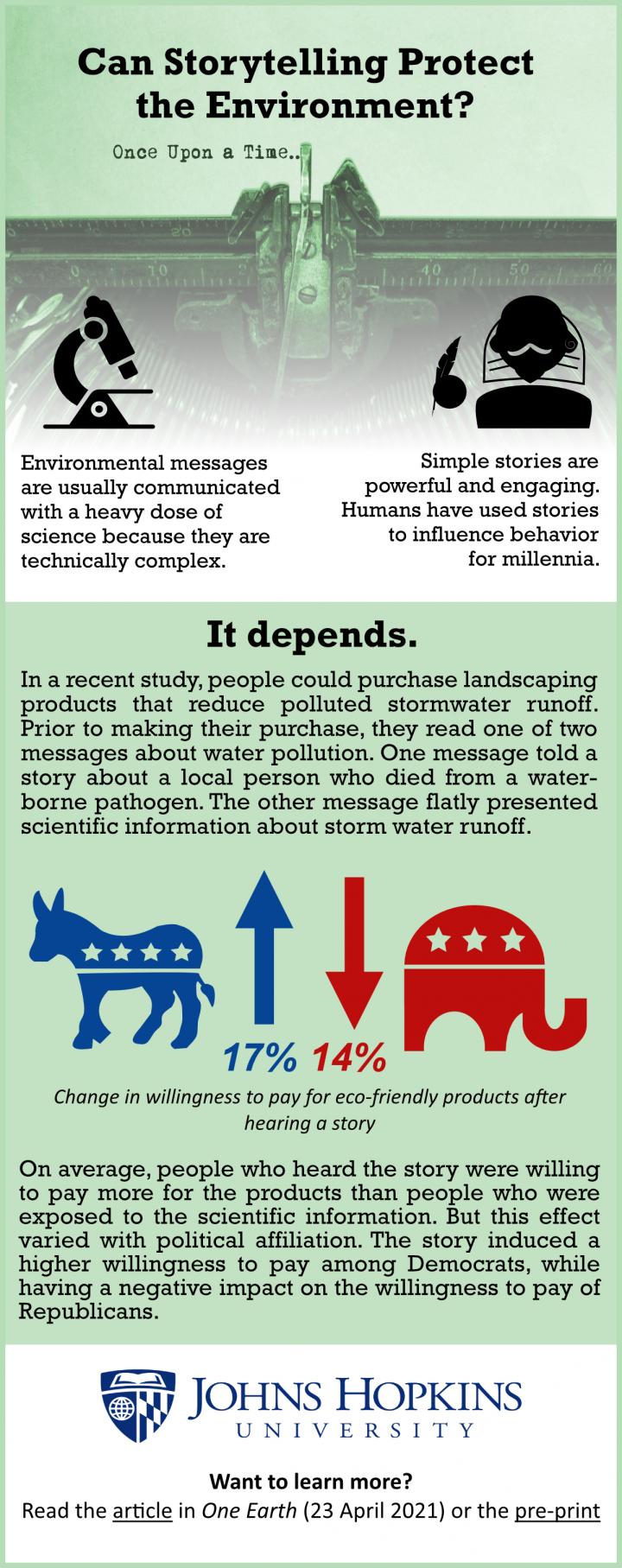
After hearing a compelling pollution-related story in which a man died, the average person paid more for green products than after having heard scientific facts about water pollution. But the average person in the study was a Democrat. Republicans paid less after hearing the story rather than the simple facts.
The findings, published this week in the journal One Earth, suggest message framing makes a real difference in people’s actions toward the environment. It also suggests there is no monolithic best way to motivate people and policymakers must work harder to tailor messages for specific audiences.
“Our findings suggest the power of storytelling may be more like preaching to the choir,” said co-author Paul J. Ferraro, an evidence-based environmental policy expert and the Bloomberg Distinguished Professor of Human Behavior and Public Policy at Johns Hopkins.
“For those who are not already leaning toward environmental action, stories might actually make things worse.”
Scientists have little scientific evidence to guide them on how best to communicate with the public about environmental threats. Increasingly, scientists have been encouraged to leave their factual comfort zones and tell more stories that connect with people personally and emotionally. But scientists are reluctant to tell such stories because, for example, no one can point to a deadly flood or a forest fire and conclusively say that the deaths were caused by climate change.
The question researchers hoped to answer with this study: Does storytelling really work to change people’s behavior? And if so, for whom does it work best?
“We said let’s do a horserace between a story and a more typical science-based message and see what actually matters for purchasing behavior,” Ferraro said.
Researchers conducted a field experiment involving just over 1,200 people at an agricultural event in Delaware. Everyone surveyed had lawns or gardens and lived in watershed known to be polluted.
Through a random-price auction, researchers attempted to measure how much participants were willing to pay for products that reduce nutrient pollution. Before people could buy the products, they watched a video with either scientific facts or story about nutrient pollution.
In the story group, participants viewed a true story about a local man’s death that had plausible but tenuous connections to nutrient pollution: he died after eating contaminated shellfish. In the scientific facts group, participants viewed an evidence-based description of the impacts of nutrient pollution on ecosystems and surrounding communities.
After watching the videos, all participants had a chance to purchase products costing less than $10 that could reduce storm water runoff: fertilizer, soil test kits, biochar and soaker hoses.
People who heard the story were on average willing to pay more than those who heard the straight science. But the results skewed greatly when broken down by political party. The story made liberals 17 percent more willing to buy the products, while making conservatives want to spend 14 percent less.
The deep behavioral divide along party lines surprised Ferraro, who typically sees little difference in behavior between Democrats and Republicans when it comes to matters such as energy conservation.
“We hope this study stimulates more work about how to communicate the urgency of climate change and other global environmental challenges,” said lead author Hilary Byerly, a postdoctoral associate at the University of Colorado. “Should the messages come from scientists? And what is it about this type of story that provokes environmental action from Democrats but turns off Republicans?”
###
Authors included: Tongzhe Li of University of Guelph in Ontario, Canada; Kent D. Messer of University of Delaware; and Collin Weigel of Johns Hopkins.
This research was supported by contributions from the Penn Foundation, the US Department of Agriculture, The Nature Conservancy, and the National Science Foundation.
Media Contact
Jill Rosen
[email protected]
Related Journal Article
http://dx.