Deep in Colombia’s sub-Andean forests, a little-known aroid has been caught running what amounts to a full-service hotel for tiny weevils: warm rooms, food, a mating venue, and a nursery where larvae can grow up eating the walls. A year-long field study of Stenospermation weberbaueri, an Araceae herb in Selva de Florencia National Natural Park in Caldas Department, reports the first documented case of brood-site pollination mutualism in the genus Stenospermation and in the entire aroid subfamily Monsteroideae. The finding, published in Botanical Studies, also adds a surprise to aroid chemistry: the dominant compound in the flower’s scent, 3-pentanol, had never before been reported as a floral scent component in the Araceae family.
The research team, led by Luna Ibáñez and Natalia Castaño-Rubiano with colleagues from Colombian and Brazilian institutions, monitored a natural population of eighteen individuals at two sites in the park, Bocatomas and La Estrella, between roughly 1600 and 1760 meters above sea level. Over twelve months in 2021 they tracked 117 inflorescences, 127 infructescences, 86 flowers, and 125 fruits, recording floral development, population phenology, spadix temperatures, floral scent chemistry, visitor behavior, pollen morphology, and the results of controlled pollination experiments. Their goal was to fill a conspicuous gap: although Araceae contains more than 3600 species, the pollination biology of Stenospermation, a Neotropical genus of about 240 species, had remained essentially undocumented beyond anecdotal reports and old suppositions.
The reproductive sequence of S. weberbaueri unfolds in six stages over 50 days, from flower bud to post-anthesis, followed by roughly 20 more days for fruit ripening to begin. Anthesis itself lasts three days. On the first two days, the female phase, the spathe detaches from the spadix and turns white inside while shifting from green-yellowish to whitish outside. It partially opens for four hours starting at 14:00, exposing stigmas coated with stigmatic fluid, then closes again for about 20 hours. The next day it repeats the schedule, opening at 14:00 and closing around 18:00 for the last time. On the third day, the male phase, the spathe opens fully, pollen is released in strands resembling a pollen kit extrusion, and by around 18:00 the spathe detaches and drops. Each inflorescence carries between 120 and 152 flowers, forming about the same number of fruits, with one to four seeds per fruit.
Temperature proved to be a central part of the performance. Using thermocouple sensors logged at 5-minute intervals in three inflorescences, plus infrared thermal images taken every 10 minutes, the researchers found that thermogenesis begins around 14:00 on the first day of the female phase, when the spathe is nearly closed, raising the inflorescence temperature 1 to 2 °C above ambient air. During the male phase on the third day, the spadix heats more dramatically, with increases ranging from 2.7 to 5.4 °C above ambient and reaching up to 24.7 °C. Thermal imaging recorded increases of up to 7.2 °C above surrounding air during both phases. These thermogenic peaks coincide with the major emission of floral scent and are synchronized with the anthesis schedule, so that warmth, odor, and open floral chambers arrive together exactly when pollinators need to be recruited and retained.
To identify the chemical signal behind that recruitment, the team used dynamic headspace sampling, enclosing inflorescences in PET bags and pulling scented air through Tenax GR cartridges at 250 mL/min for 20 minutes, then analyzing the trapped volatiles by gas chromatography coupled to mass spectrometry. The scent profile during both anthesis phases was dominated by a single ion peak with a Kovats retention index of 690, identified as the aliphatic alcohol 3-pentanol. The identity of the main constituent was confirmed against an authentic synthetic standard. According to the authors, an extensive survey suggests 3-pentanol has not been reported in any other Araceae species, making this a novel floral scent component for the family. The compound is not entirely new to science: it functions as a sex pheromone in the ambrosia beetle Megaplatypus mutatus and can trigger systemic resistance in plants, but its role in an aroid pollination system appears to be unprecedented.
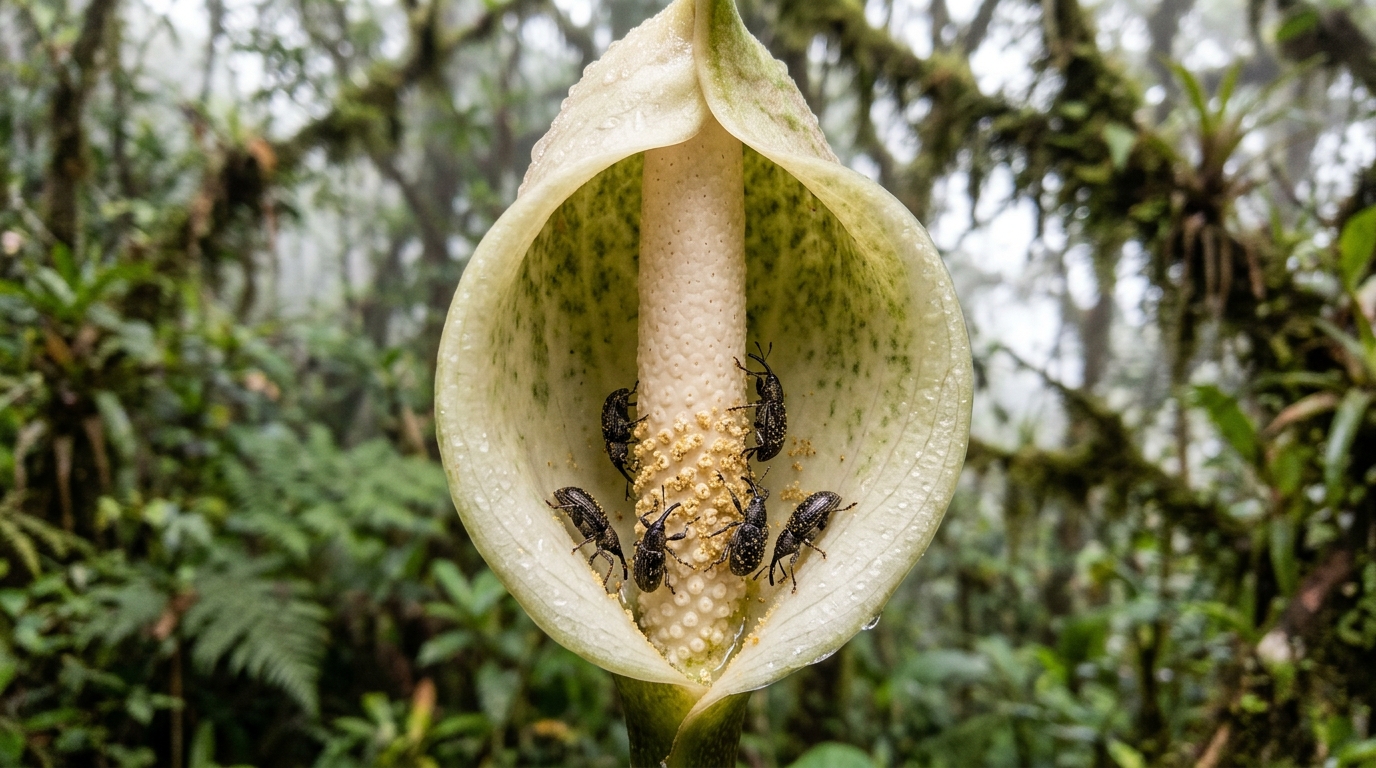
The visitor that answers the call is a single morphospecies of Cyclanthura, a genus of derelomine flower weevils in the family Curculionidae. It was the sole floral visitor recorded on S. weberbaueri throughout the study, with an average of 50 individuals per inflorescence. The weevils arrive at the onset of the female phase around 14:00, slip inside the spathe, and stay until the male phase, departing shortly after the spathe drops. During both phases they move around the spadix searching for stigmatic fluid, inserting their rostra into narrow spaces between flowers, which loads their legs and bodies with pollen grains. Copulation was also observed inside the chamber. Scanning electron microscopy confirmed that the pollen clinging to the weevils matches S. weberbaueri pollen: monads, peroblate to semi-triangular convex, meridionosulcate, with psilate to punctate exine, and 30 to 37 micrometers long in equatorial view.
Field bioassays tested whether the scent alone could do the recruiting. The researchers set out filter paper decoy spathes, six baited with synthetic 3-pentanol and six unbaited controls, plus natural abscised spathes, three baited and three unbaited, positioned near plants during the scent emission period for one hour at a time. Cyclanthura weevils flew around, and occasionally landed on, all baited filter paper decoys, and were similarly attracted to natural spathes whether baited or not. Unbaited paper decoys attracted none. The pattern indicates that 3-pentanol is a genuine long-range attractant, but the weevils’ reluctance to land on paper decoys hints that something more is needed for the final approach. The authors suggest that additional cues, such as the high reflectivity of the white spathe or the inflorescence’s thermal signature, may work alongside the olfactory signal, a synergy seen in other specialized aroid systems like the dead-horse arum Helicodiceros muscivorus.
The mutual dependence between plant and weevil was confirmed experimentally. Ten unopened inflorescences were bagged in fine veil fabric to exclude visitors, while 266 unbagged inflorescences served as controls. After three months, none of the bagged inflorescences had produced infructescences, showing that S. weberbaueri cannot self-pollinate, thanks to perfect protogyny, and cannot reproduce by apomixis. All marked and control unbagged inflorescences set fruit, indicating that cross-pollination under natural conditions is highly efficient. Without the weevils, in other words, the plant reproduces not at all, which makes the rewards it offers look less like hospitality and more like payment for an essential service.
That payment extends beyond nectar-like stigmatic fluid and a warm, sheltered chamber. The inflorescences also serve as copulation sites, and, crucially, as oviposition substrates. Larvae of Cyclanthura sp. were found in various developmental stages inside fallen, decaying spathes, though never on the spadix. The larvae appear to feed externally on decaying floral tissues as ectophagous detritivores, without damaging ovaries or developing seeds. This arrangement fits the classic definition of a brood-site pollination mutualism, in which adult insects pollinate while their offspring develop on plant tissue, and it aligns closely with systems described by Sakai in which pollinators use senescing floral tissues for brood development without impairing reproductive organs. The study is the first documentation of such a mutualism in Stenospermation and in Monsteroideae, a subfamily whose members, despite bearing bisexual flowers, often run short floral cycles and form enclosed chambers, converging on strategies otherwise typical of unisexually flowered aroids like Philodendron and Xanthosoma, which are pollinated mainly by cyclocephaline scarab beetles.
Population-level data add context to the intimacy of the interaction. Flowering and fruiting in the studied population were continuous year-round, with mean vector lengths of 0.186 and 0.320 respectively, and only a discreet peak in May and June, with lower activity in January and February. Neither flowering nor fruiting correlated with monthly rainfall, notable in a park that averages 8000 millimeters of precipitation annually. The authors caution that their observations, made on one species in one park, cannot yet say whether brood-site mutualism is a broader trend across the genus or a lineage-specific adaptation, and they call for comparative studies across Stenospermation. What the study does establish is that a white-flowered, understudied aroid in the Colombian Andes has evolved a tightly co-adapted package of scent, heat, chamber behavior, and edible spathes to secure the services of a single weevil species, expanding the known diversity of pollination mutualisms in one of the world’s largest flowering plant families.
Subject of Research: Brood-site weevil pollination mutualism in the Neotropical aroid Stenospermation weberbaueri
Article Title: Floral scents, cozy shelter, and edible spathes: brood-site weevil pollination in Stenospermation weberbaueri (Araceae)
Article References: Ibáñez, L., Álvarez-Valdez, E., Maia, A. C. D., Núñez-Avellaneda, L. A., Taborda-Ocampo, G., Zuluaga-Trochez, A., & Castaño-Rubiano, N. (2025). Floral scents, cozy shelter, and edible spathes: brood-site weevil pollination in Stenospermation weberbaueri (Araceae). Botanical Studies, 66(1), Article 34. https://doi.org/10.1186/s40529-025-00468-w
Image Credits: AI Generated
DOI: 10.1186/s40529-025-00468-w
Keywords: Araceae, Stenospermation weberbaueri, Cyclanthura, brood-site pollination mutualism, floral thermogenesis, 3-pentanol, floral scent, Colombian Andes, Monsteroideae, pollination ecology, weevil pollination, tropical botany
News Source: Drew Townsend. (November 5, 2026). Weevils Drawn by Rare Scent Get Warm Room and Nursery in Andean Aroid. Scienmag.