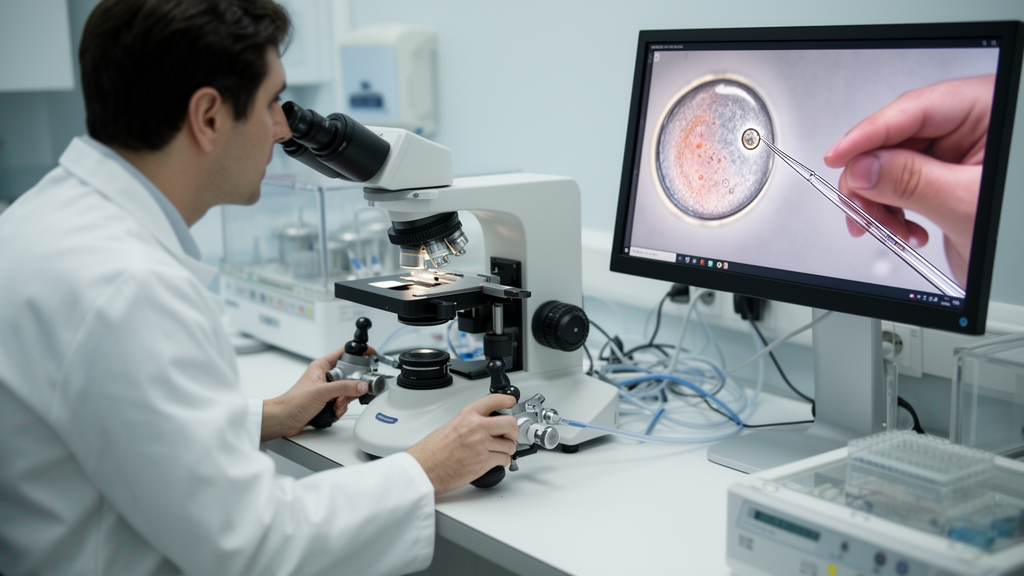
A new study published in BMC Medical Education describes a browser-based simulator that instead relies on a standard webcam, machine-learning hand tracking and predefined rule-based scoring, and reports preliminary evidence that it can distinguish experienced practitioners from medical students.
The platform uses MediaPipe Hands to detect hand landmarks through a consumer-grade camera, with predefined gestures controlling virtual holding and injection instruments. Graphical deformation and aspiration of the simulated oocyte are represented with simplified two-dimensional effects, allowing the whole system to run without dedicated haptic hardware.
To evaluate the system, the researchers recruited five experienced ICSI practitioners and 20 medical students, each of whom completed five consecutive scored trials under standardized conditions. The primary analysis compared expert and novice scores on the first trial, while novice performance across repeated trials was analyzed with repeated-measures analysis of variance and repeated aspiration-completion-threshold status with Cochran’s Q.
The results showed a striking gap between the two groups. On Trial 1, experts scored 92.8 ± 1.3 compared with 42.5 ± 2.9 for novices, a mean difference of 50.3 points (95% CI 48.46–52.14; Welch t(14.85) = 58.16, P < 0.001). The difference remained significant after the Safety component was excluded from the score, at 93.0 ± 1.3 versus 68.0 ± 1.2.
Novice scores rose steadily across the five trials, from 42.5 ± 2.9 to 79.2 ± 4.9 (Greenhouse–Geisser-corrected F(1.41, 26.85) = 2413.01, P < 0.001). The repeated-trial effect persisted when the Safety component was excluded (F(2.54, 48.17) = 89.44, P < 0.001), suggesting that the improvement was not driven by that single scoring element alone.
Performance on a predefined aspiration-completion threshold also changed markedly over the session. In the first trial, 19 of 20 novices (95%) failed to reach the threshold, but by the fifth trial none did (0%), a change that was statistically significant (Cochran Q(4) = 52.51, P < 0.001).
Usability was assessed with the System Usability Scale, completed by all 20 novices, along with an exploratory eight-item questionnaire.
The authors are careful to frame these findings as preliminary. The platform distinguished two extreme experience groups and was associated with short-term improvement on repeated simulator trials, but the study does not establish reliability, retention of skills over time, transfer of performance to biological ICSI, superiority over conventional training methods, or a causal effect of the automated feedback itself.
Because the work was a validation study of a simulation-training platform rather than a clinical intervention, it involved no patient recruitment or therapeutic outcomes, and trial registration was recorded as not applicable. The article was published as an open-access research paper on 28 October 2026, and the version shared early is subject to further edits before the final Version of Record.
Subject of Research: A browser-based ICSI simulation training platform using webcam hand tracking and automated rule-based assessment
Article Title: Integrating machine-learning-enabled hand tracking and rule-based automated assessment into ICSI simulation training: development and validation of a browser-based platform
Article References: Fu, C., Liang, Y., Zhang, L., Qiao, A., & Wang, X. (2026). Integrating machine-learning-enabled hand tracking and rule-based automated assessment into ICSI simulation training: development and validation of a browser-based platform. BMC Medical Education. https://doi.org/10.1186/s12909-026-10727-4
Image Credits: AI Generated
DOI: 10.1186/s12909-026-10727-4
Keywords: ICSI, simulation training, hand tracking, MediaPipe, medical education, automated assessment, known-groups validity, usability, assisted reproduction, webcam, novice training, validation study
News Source: Courtney Benton. (October 28, 2026). Webcam-based ICSI simulator shows novice and expert scores far apart in validation study. Scienmag.