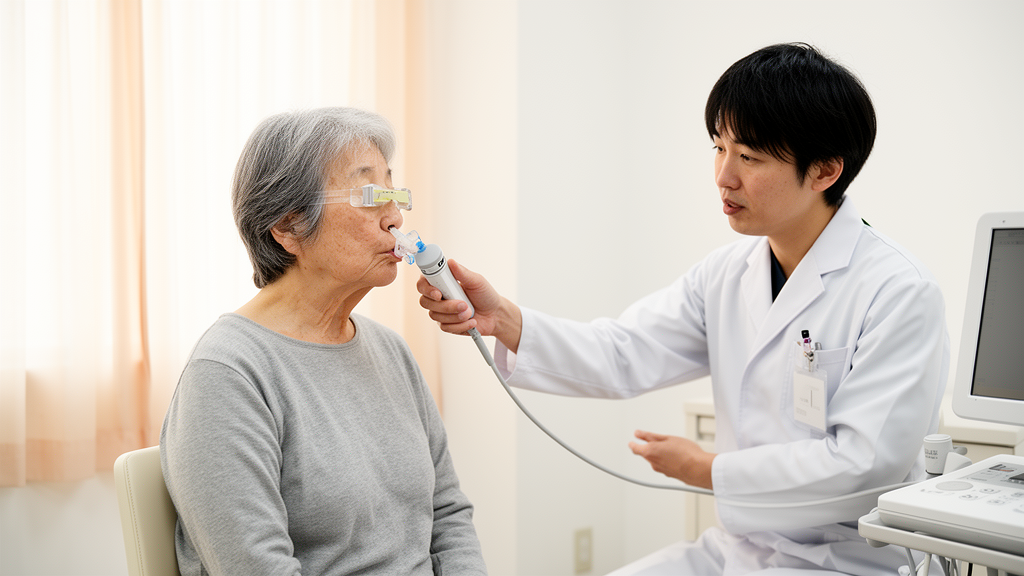
In a cross-sectional study of community-dwelling adults aged 65 and older in Fukushima Prefecture, Japan, lower respiratory muscle strength was associated with higher odds of pre-frailty and with poorer measures of overall physical function. The findings suggest that maximal inspiratory pressure and maximal expiratory pressure may be related to an intermediate state of diminished physiological reserve, although the study cannot establish whether weaker breathing muscles precede or contribute to frailty.
Researchers collected data during a community health survey conducted from August 2024 to February 2025. A total of 324 adults participated, but 11 classified as frail were excluded, leaving 313 people for analysis. The remaining participants were divided into two groups using the revised Japanese Cardiovascular Health Study criteria: 313 were classified as robust or pre-frail, with the analysis comparing pre-frailty, defined by a score of 1–2, with robustness, defined by a score of 0. Respiratory muscle strength was assessed through maximal inspiratory pressure, or MIP, and maximal expiratory pressure, or MEP.
Lower values of both measures were significantly associated with greater odds of pre-frailty in analyses that did not initially account for other participant characteristics. The associations remained significant after multivariable logistic regression adjusted for age, sex, body mass index, smoking status and history of respiratory disease. For MIP, the association with pre-frailty was reported at p < 0.001; for MEP, it was reported at p = 0.002. These results show an association rather than a causal relationship. Because the investigation was cross-sectional, it did not track changes in respiratory muscle strength, frailty status or physical function over time.
Secondary analyses also connected respiratory muscle strength with broader indicators of functional status. Participants with lower MIP tended to have higher Kihon Checklist scores, lower grip strength, weaker knee extension, slower walking speed and a lower skeletal muscle index. After adjustment, the same pattern was significant for all five outcomes. Lower MEP was associated with higher Kihon Checklist scores, lower grip strength, weaker knee extension and slower walking speed, but its relationship with skeletal muscle index was no longer significant after adjustment. Receiver operating characteristic analyses indicated that respiratory muscle strength had only modest ability to distinguish pre-frailty from robustness. The evidence therefore supports respiratory muscle strength as one of several factors associated with early vulnerability and overall functional status, not as a stand-alone diagnostic test or a proven intervention target. Establishing its clinical relevance would require longitudinal research that examines whether changes in breathing muscle strength predict the development of pre-frailty, frailty and functional decline.
Subject of Research: Association between respiratory muscle strength, pre-frailty and physical function in community-dwelling older adults in Japan
Article Title: Association of respiratory muscle strength with pre-frailty and overall functional status in community-dwelling Japanese older adults: a cross-sectional study
Article References: Sato, T., Haniuda, N., Hoshi, M., Nakanowatari, T., Ogasawara, M., Horikoshi, Y., Sone, T., Yabuki, S., & Shiba, Y. (2026). Association of respiratory muscle strength with pre-frailty and overall functional status in community-dwelling Japanese older adults: a cross-sectional study. BMC Geriatrics. https://doi.org/10.1186/s12877-026-08465-9
Image Credits: AI Generated
DOI: 10.1186/s12877-026-08465-9
Keywords: respiratory muscle strength, pre-frailty, physical frailty, older adults, functional status, maximal inspiratory pressure, maximal expiratory pressure, cross-sectional study, Japanese health survey, Association, respiratory, muscle
News Source: Beatrice Stafford. (October 22, 2026). Weaker breathing muscles linked to pre-frailty in older Japanese adults. Scienmag.