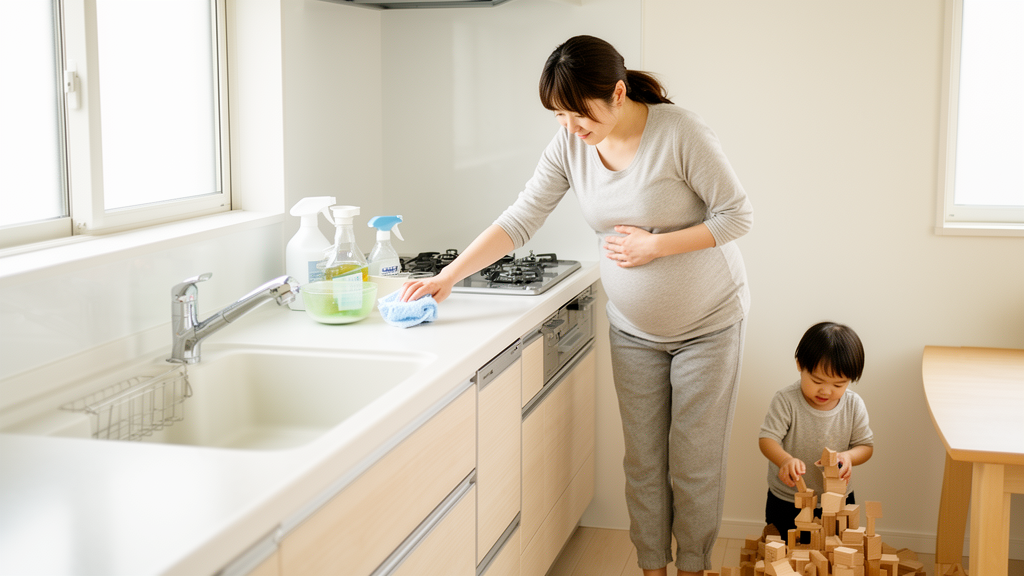
In an observational analysis of 81,125 mother–child pairs participating in the Japan Environment and Children’s Study, more frequent house dust–related cleaning during pregnancy was associated with lower odds of children screening positive for developmental concerns between 18 months and 3 years of age. The association showed a graded pattern, with lower odds observed as the reported frequency of cleaning increased. Researchers said the findings require confirmation using objective environmental exposure assessments because the cleaning questions served as proxy indicators rather than direct measurements of household exposure.
The study examined four cleaning behaviors that mothers reported undertaking during pregnancy to reduce house dust exposure. These were vacuuming the living-room floor, vacuuming the futon, airing the futon and using an anti-mite cover for a futon or bedding. For each behavior, the researchers compared groups defined by cleaning frequency, using the groups with the lowest frequencies as references. The analysis therefore compared reported household practices during pregnancy with subsequent developmental screening results, rather than testing whether children were assigned to receive a cleaning intervention.
Neurodevelopment was assessed at four points in toddlerhood: 18 months, 2 years, 2.5 years and 3 years. The researchers used the Japanese Ages and Stages Questionnaires, Third Edition, abbreviated as J-ASQ-3. At each assessment, the outcome was whether a child screened positive for developmental concerns. Generalized linear models were used to calculate adjusted odds ratios for those screening-positive outcomes relative to the lowest-frequency cleaning groups.
Two models were used to account for different sets of maternal, socioeconomic and dwelling-related characteristics. Model 1 adjusted for maternal factors and produced adjusted odds ratios ranging from 0.74 to 0.97 across the assessed cleaning behaviors and developmental assessment points. Model 2 additionally adjusted for socioeconomic and dwelling-environment factors; in that model, adjusted odds ratios ranged from 0.68 to 0.98. These figures describe associations after statistical adjustment, including odds below 1 for the higher-frequency cleaning groups relative to the reference groups. They do not establish that the cleaning practices caused the lower screening odds.
The scope of the analysis was limited to maternal cleaning behaviors reported during pregnancy and children’s developmental screening outcomes from 18 months through 3 years of age within the Japan Environment and Children’s Study. The authors noted that the cleaning measures were proxy indicators of household environmental management rather than direct measurements of exposure. They also called for confirmation with objective environmental exposure assessments. Accordingly, the results identify an association in a large cohort, not a proven developmental benefit of a particular cleaning practice. The reported evidence does not establish that changing cleaning habits will reduce a child’s likelihood of screening positive for developmental concerns.
Subject of Research: Associations between maternal house dust–related cleaning during pregnancy and toddler neurodevelopment in 81,125 Japanese mother–child pairs
Article Title: Maternal house dust–related cleaning behaviors during pregnancy and neurodevelopment from 18 months to 3 years of age in the Japan Environment and Children’s Study
Article References: Shimada, K., Matsumura, K., Kasamatsu, H., Inano, H., Sakai, J., Tsuchida, A., Tanaka, T., Inadera, H., Japan Environment and Children’s Study (JECS) Group, Kamijima, M., Yamazaki, S., Fukami, M., Kishi, R., Ota, C., Hashimoto, K., Mori, C., Ito, S., Shinohara, R., Nakayama, T., … Katoh, T. (2026). Maternal house dust–related cleaning behaviors during pregnancy and neurodevelopment from 18 months to 3 years of age in the Japan Environment and Children’s Study. BMC Pediatrics. https://doi.org/10.1186/s12887-026-07588-7
Image Credits: AI Generated
DOI: 10.1186/s12887-026-07588-7
Keywords: maternal cleaning, prenatal environment, child neurodevelopment, developmental screening, house dust, Japan Environment and Children’s Study, observational cohort, toddler development, Maternal, house, dust, related
News Source: Harold Sullivan. (October 22, 2026). Pregnancy cleaning linked to lower toddler developmental screening odds in Japanese cohort. Scienmag.