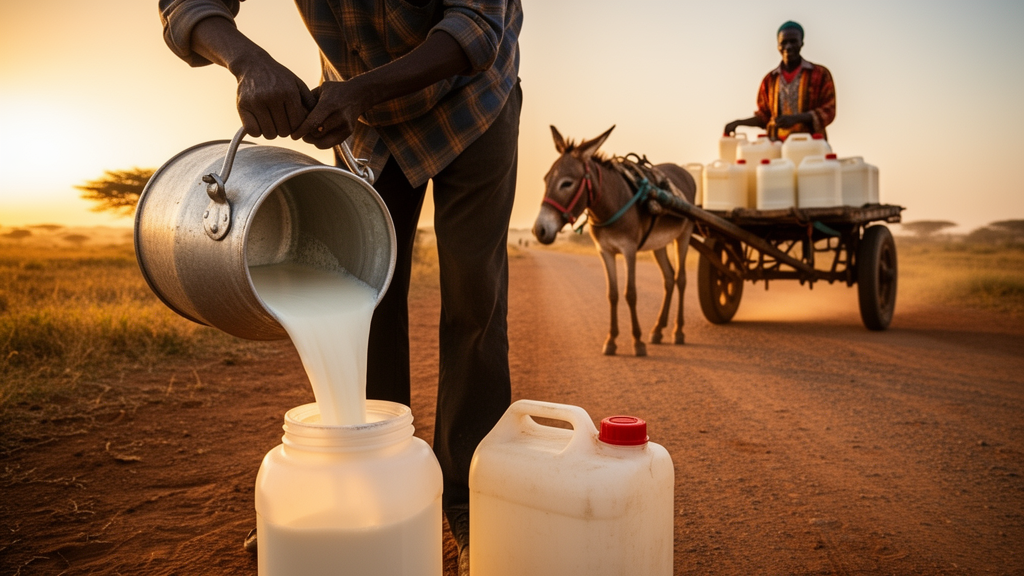
Raw milk sold in three districts of Ethiopia’s West Hararghe Zone is being diluted with water as it moves from farm to consumer, and the dilution is worst at the final stage of the chain, according to a new study published in Food Safety and Risk. Researchers collected 108 raw milk samples from producers, collectors, and service providers in the districts of Chiro, Hirna, and Mieso and analyzed them for fat, protein, lactose, solids-not-fat, and added water using a MilkoScan instrument. Water was the only adulterant detected, and its prevalence climbed steadily from producers to service providers, reaching a maximum of 13.2 percent in service provider samples from Mieso district.
The study, led by Nuredin Seid Ali, Teressa Fekata Jebessa, and Workneh Ensermu Bayisa, was designed to fill a gap in knowledge about the extent of milk adulteration in West Hararghe, a zone in Oromia Regional State located roughly 321 kilometers east of Addis Ababa. Ethiopia possesses the largest livestock population in Africa and produced approximately 3.32 billion liters of cow milk in 2018, accounting for about 91 percent of national milk output. Yet despite this production potential, milk productivity remains low and maintaining quality throughout the dairy value chain is a persistent challenge. Approximately 95 percent of marketed milk in Ethiopia moves through informal dairy value chains involving smallholder farmers, collectors, retailers, and food service providers, systems characterized by limited quality control, inadequate regulatory enforcement, and infrequent routine testing.
The sampling strategy reflected the structure of the local market. In each district, the researchers randomly took one sample from each of twelve sale points at every supply chain node, yielding 36 samples per district and 108 in total. Each sample of roughly 15 milliliters was collected into sterile screw-capped bottles, transported in an ice-packed cool box at about 4 degrees Celsius, and analyzed the same day at the Adea Dairy Factory Laboratory of the Bishoftu Meat and Dairy Industry Development Institute. Because most producer households in these districts consume milk rather than sell it, the number of producer sale points was small compared with collectors and service providers, such as cafeterias that are well known in their communities and regularly used for children’s feeding.
The chemical analysis relied on near-infrared spectroscopy coupled with partial least squares regression, a non-destructive technique requiring minimal sample preparation. Added water was estimated indirectly by converting the freezing point of each milk sample into a percentage of adulterated water using a conversion factor. Each sample was analyzed in triplicate, and the average value was used for statistical analysis. Starch and skimmed milk powder, two adulterants sometimes used to mask dilution, were tested qualitatively with iodine and nitric acid color reactions, respectively, and neither was detected in any sample.
The district-level results revealed a consistent pattern. In Chiro, water adulteration rose from 1.93 percent in producer milk to 3.20 percent in collector milk and 9.89 percent in service provider milk, with all differences statistically significant. In Mieso, the lowland district with the hottest climate, adulteration climbed from 5.74 percent at producers to 7.50 percent at collectors and 13.20 percent at service providers. In Hirna, the figures were 3.80, 9.40, and 11.30 percent respectively. The comparatively high collector-level value in Hirna suggested that substantial dilution had already occurred before the milk reached service providers in that district.
Composition data mirrored the dilution pattern. Producer milk in Chiro contained the highest fat content measured in the study, 4.28 percent, falling to 3.78 percent at collectors and 3.17 percent at service providers. In Mieso, fat declined from 3.63 percent to 2.91 percent along the chain, and in Hirna from 4.23 percent to 3.73 percent. Protein followed the same trajectory, dropping from 3.28 percent in Chiro producers to 3.04 percent in service providers, and from 3.18 percent to 2.73 percent in Mieso, the lowest protein value recorded. Solids-not-fat fell from 8.36 percent to 8.12 percent in Chiro, from 8.31 percent to 8.22 percent in Hirna, and from 8.10 percent to 7.61 percent in Mieso. Lactose declined along the chain as well, with the highest value of 4.11 percent recorded in Hirna and the lowest, 3.18 percent, in Mieso service provider samples.
The most striking quantitative finding came from Pearson correlation analysis. Water adulteration showed strong negative associations with every measured compositional parameter: a correlation coefficient of −0.95 for fat, −0.91 for solids-not-fat, −0.89 for protein, and −0.83 for lactose, all statistically significant at P ≤ 0.002. Fat proved the most sensitive indicator of dilution, which the authors attribute to the straightforward physics of added water dispersing the fat globules suspended in milk and lowering the measured fat percentage. Solids-not-fat, which comprises protein, lactose, minerals, and other dissolved solids, is likewise diluted proportionally by water addition, making it a reliable marker of milk authenticity. Lactose showed the weakest, though still strong, correlation, suggesting it is a less sensitive indicator than fat or solids-not-fat.
Compliance with regulatory standards varied by node and district. Producer and collector samples generally met the Ethiopian Standard for raw cow milk, and most also met European Union thresholds, which require at least 3.5 percent fat, 8.5 percent solids-not-fat, 4.2 percent lactose, and 2.9 percent protein for whole raw milk. In Chiro, producer and collector samples met the EU fat minimum while service provider samples fell below it. In Mieso, only producer samples met the EU fat threshold, and collector and service provider samples also fell below the Ethiopian minimum for solids-not-fat. Service provider samples in Mieso failed both EU and Ethiopian protein requirements. The authors note that factors other than adulteration, such as feeding practices and herd management, may also influence composition, and these were not evaluated in the study.
The detected adulteration levels, though lower than those reported elsewhere, remain a public health concern. Previous studies cited by the authors found water adulteration rising from 10.23 percent at farms to 24.60 percent at retail outlets in Pakistan, and from 14 percent at producers to 23 percent at cafeterias in Central and Northwestern Tigray, Ethiopia. Surveys in Kenya reported average adulteration of 19.4 percent among producers and 39.0 percent among informal retailers, and Ethiopian regional surveys documented values ranging from 0 to 24.8 percent across Amhara, Oromia, and SNNP regions. Even moderate dilution reduces the concentrations of milk constituents, and research indicates that water adulteration exceeding roughly 3.8 percent can adversely affect milk quality. When untreated water is used, it may introduce pathogenic microorganisms and chemical contaminants, shortening shelf life and raising the risk of foodborne illness, particularly among infants and other vulnerable consumers.
The authors attribute the downstream pattern to economic incentives: because milk is commonly traded by volume rather than compositional quality, intermediaries can profit by adding water to increase volume. They recommend routine milk quality monitoring, stronger regulatory enforcement, and awareness programs for dairy value chain actors to minimize adulteration and protect consumers. The study is a laboratory-based assessment of a single sampling round in three purposively selected districts, so the findings describe these specific locations and time points rather than the entire zone or country. Nevertheless, the progressive deterioration in chemical composition with increasing water adulteration provides quantitative evidence for targeting interventions at the marketing and distribution stages of the informal dairy chain, where the milk that reaches consumers is most diluted.
Subject of Research: Water adulteration and chemical composition of raw milk along the dairy value chain in West Hararghe Zone, Eastern Ethiopia
Article Title: Assessment of raw milk quality and water adulteration across milk value chain in West Hararghe Zone, Eastern Ethiopia
Article References: Ali, N. S., Jebessa, T. F., & Bayisa, W. E. (2026). Assessment of raw milk quality and water adulteration across milk value chain in West Hararghe Zone, Eastern Ethiopia. Food Safety and Risk, 13(1), Article 34. https://doi.org/10.1186/s40550-026-00161-1
Image Credits: AI Generated
DOI: 10.1186/s40550-026-00161-1
Keywords: raw milk, water adulteration, milk quality, Ethiopia, dairy value chain, food safety, MilkoScan, chemical composition, solids-not-fat, food fraud, West Hararghe, consumer protection
News Source: Alan Morgan. (October 29, 2026). Water Dilution of Raw Milk Rises Along Ethiopian Supply Chain, Study Finds. Scienmag.