


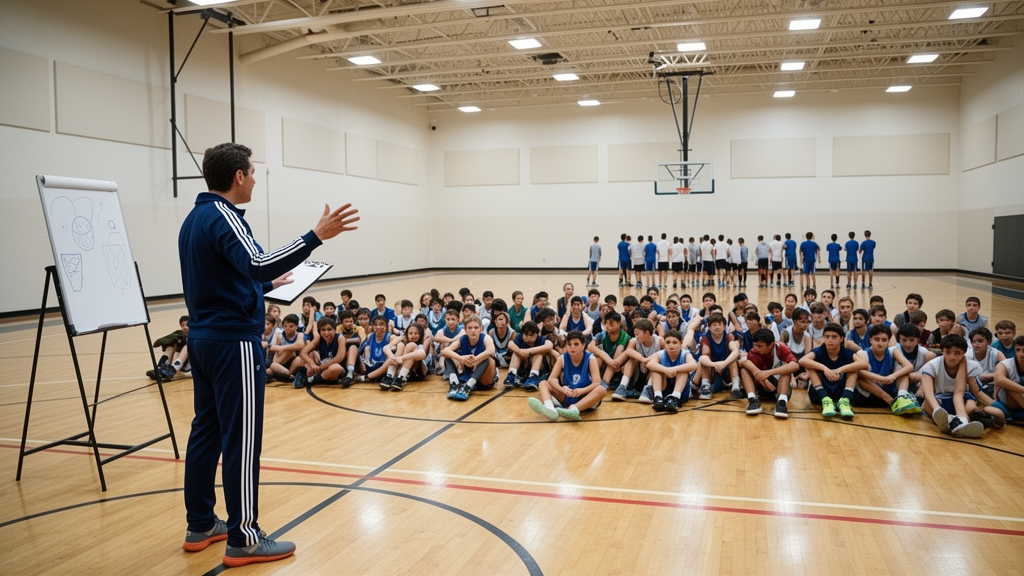
Physical education teachers in Malaysian secondary schools want to combine theoretical knowledge with practical sport instruction, but most of them rarely manage to do so within a single, well-planned lesson. That is the central finding of a qualitative study published in Frontiers in Sports and Active Living, in which researchers at Universiti Malaya interviewed ten secondary school physical education teachers about how they integrate theory and practice in their day-to-day teaching. The study, conducted using a Basic Qualitative Inquiry design, found that integration typically happened in two constrained ways: lessons delivered sequentially, with theory one week and practice the next, or theory inserted informally while students were already playing. Neither approach reflected structured lesson planning, and both were shaped less by pedagogical philosophy than by a shortage of instructional time, large class sizes, the absence of structured teaching modules, and variation in teacher competence.
The research team, led by Siti Nursyahiirah Hasan and Annisaa Basar of the Department of Educational Foundations and Humanities, recruited participants through purposive sampling, selecting teachers with direct experience in teaching sport skills and active involvement in planning physical education lessons. All worked in Malaysian secondary schools. Data were collected through semi-structured interviews that were audio-recorded and fully transcribed, and the researchers supplemented the interviews with limited non-participant observations of the same teachers, although these observations served only as contextual support and were not analysed as an independent data source.
The analytical approach was deliberately interpretive. Interview transcripts were coded manually and subjected to thematic analysis, involving repeated readings, the identification of initial codes, the grouping of codes into categories, and the development of broader themes. Coding was carried out by the primary researcher, with co-authors reviewing the coded transcripts and resolving interpretive discrepancies through discussion. Reflexive memos documented analytical decisions throughout. Data collection and analysis proceeded iteratively: the researchers compared accounts across successive interviews and concluded data collection after ten participants when new interviews primarily reinforced patterns already identified, which they treated as an indication of thematic saturation. To strengthen credibility, the team conducted member checking through face-to-face sessions with all ten participants, sharing preliminary findings and themes to verify that the interpretations matched the teachers’ experiences, and maintained an audit trail tracing the development of codes and themes from the original transcripts.
The thematic analysis produced three main themes. The first, sequential and informal implementation of theory-practice integration, captured how teachers separated conceptual content from physical activity in time. One participant described the pattern plainly: “The first week is theory… the second week is practical.” Another explained that the separation was driven by scheduling pressure: “In the first week I explain the topic in the classroom…the second week I conduct the practical session because time is limited.” A second subtheme described theory being slipped into practical sessions on the fly. “While they were playing, I threw in a little theory,” one teacher reported. In both cases, integration depended on improvisation rather than on lesson plans that deliberately wove movement principles, game strategies, or safety concepts into practical work.
The second theme identified the constraints behind these patterns, which the researchers divided into structural and professional categories. On the structural side, teachers repeatedly pointed to limited instructional time and large class sizes. “Many students, short time,” one participant summarised, elaborating that if teachers tried to cover both theory and practice in the same session, “the students might end up waiting too long.” On the professional side, teachers reported the absence of structured teaching modules and uneven competence or confidence across different sports. “There is no special module,” one teacher said, and another noted there was “no specific module to systematically combine theory and practical instruction.” Without such resources, teachers relied on personal experience and professional judgement, which the authors suggest may produce considerable variation in practice across schools and, consequently, inconsistency in students’ learning experiences.
The third theme concerned student learning experiences as reported by the teachers. Practical instruction clearly boosted engagement: “Students become enthusiastic,” one participant observed, explaining that when teaching drew on knowledge and experience, students wanted to participate rather than watch. Teachers also recognised the value of genuine integration for understanding: “When theory and practice go hand in hand, students understand,” another said. But the study’s participants indicated that practical instruction alone, without sufficient theoretical grounding, limited students’ conceptual understanding of the principles underlying the skills they performed. The authors conclude that practical instruction enhanced motivation and participation, while insufficient theoretical integration left a gap in conceptual learning.
From these themes the researchers built an inductively derived framework, the Structured Integration Model of Theory-Practice in Secondary School Physical Education. Consistent with the inductive logic of Basic Qualitative Inquiry, the model was developed after data analysis rather than imposed beforehand. It identifies two categories of influence directly evidenced in the teachers’ accounts: structural constraints, specifically instructional time and large class sizes, and professional constraints, specifically the lack of structured teaching modules and variation in teacher competence or confidence across sports. These factors shaped whether integration occurred through structured planning, informal insertion, or sequential separation, which in turn influenced student engagement, motivation, and conceptual understanding as reported by participants. Constructs such as facilities, curriculum structure, institutional positioning, professional training pathways, and teaching experience were noted as proposed directions for future investigation because they were not directly evidenced in the dataset.
The discussion adds an important nuance: sequential and informal integration should not automatically be judged pedagogically deficient. The authors acknowledge that delivering concepts before practice can help when content is unfamiliar or technically demanding, and that inserting explanations during activity may constitute adaptive teaching, a form of real-time adjustment of tasks, explanations, and feedback documented in other physical education research. However, they distinguish the Malaysian teachers’ situation from such deliberate adaptation: in this study, the adaptations were primarily driven by contextual constraints rather than intentional pedagogical design, functioning as compensatory responses to limited time, large classes, and missing instructional guidance. The predominance of practical instruction, the authors argue, should not be read as teachers undervaluing theory; within tight lessons and crowded classes, teachers prioritised physical participation while theoretical content was deferred or briefly incorporated.
The study’s limitations are stated explicitly. The sample of ten teachers is small and may restrict transferability to broader contexts, and the research emphasises depth of understanding rather than statistical generalisation. The findings rest primarily on teachers’ self-reported perspectives without extensive triangulation using student data or curriculum documents. Although co-authors reviewed the coded transcripts, coding was not performed through fully independent parallel coding with formal inter-coder agreement statistics. The supplementary observations were not independently coded or analysed. The authors call for future research incorporating structured observation protocols and formal reliability procedures.
The practical implications point toward policy and training rather than individual blame. The authors recommend clearer pedagogical frameworks and structured teaching modules or instructional guidelines to help teachers connect conceptual explanations with practical skill development systematically. Professional development programmes should emphasise strategies for theory-practice integration and build teachers’ confidence and competence in sport instruction. School administrators and policymakers, they argue, should consider instructional time allocation, class size, and access to teaching resources when designing physical education programmes, since addressing these structural conditions may create more supportive environments for integrated teaching. The findings also suggest that collaborative strategies such as peer-assisted learning could offer additional opportunities for engagement and skill development. Within the Malaysian secondary school context, where the integration of theory and practice in physical education remains relatively underexplored, the study provides empirical grounding for curriculum implementation, teacher training, and the monitoring of physical education practice.
Subject of Research: Teachers' perspectives on integrating theoretical and practical instruction in secondary school physical education in Malaysia
Article Title: Exploring teachers’ perspectives on integrating theory and practice in secondary school physical education
Article References: Hasan, S. N., Basar, A., Ali, S. K. S., & Hasan, S. N. (2026). Exploring teachers’ perspectives on integrating theory and practice in secondary school physical education. Frontiers in Sports and Active Living, 8, Article 1932526. https://doi.org/10.3389/fspor.2026.1932526
Image Credits: AI Generated
DOI: 10.3389/fspor.2026.1932526
Keywords: physical education, theory-practice integration, qualitative research, teacher perspectives, secondary school, Malaysia, pedagogy, semi-structured interviews, thematic analysis, teacher professional development, student engagement, instructional constraints
News Source: Ophelia Keating. (October 29, 2026). PE Teachers Say Limited Time and Large Classes Force Theory and Practice Apart. Scienmag.



