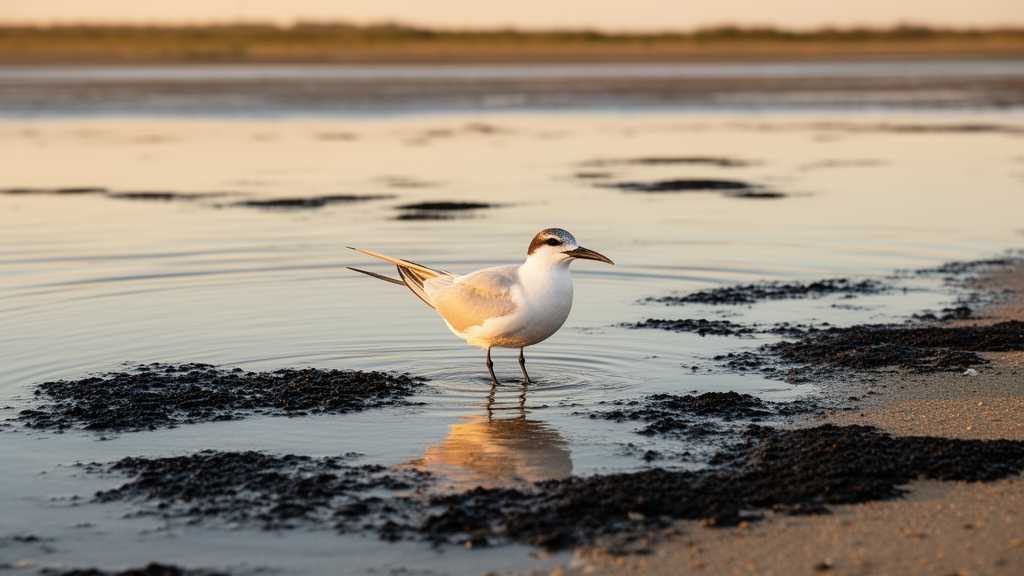
The Binzhou Chenier Island and Wetland National Nature Reserve, one of the world’s best-preserved and largest chenier systems, has become the setting for a detailed investigation of how microbes are distributed across the habitat of one of its characteristic birds, the gull-billed tern (Gelochelidon nilotica). A new study published in BMC Zoology examined microbial communities in four different environmental media within the reserve: nest sediments, surrounding soils, water, and aquatic plants.
The research team, led by Bo Zhou, JingYi Yu and colleagues including Shuai Shang, used high-throughput sequencing combined with multivariate statistical analysis to characterize both the structure and the functional traits of microbial communities in these four media. Their goal was to understand how gull-billed tern activities and the microhabitats around their nests influence microbial life, and to clarify how connected — or disconnected — microbial communities are across the different parts of the wetland environment.
The central finding is that habitat filtering is the primary driver of microbial community differentiation in the study area, with the activities of the gull-billed terns acting as an additional but secondary regulatory influence.
Perhaps the most striking result concerns water. The study found that water acts as a key barrier restricting microbial dispersal between media, producing a clear delineation of communities into terrestrial and aquatic clusters. Microbes in soils and sediments on land form one group, while those in the water column and on aquatic plants form another, with the water itself serving as the boundary between them.
Within the terrestrial side of that divide, the microbial community structures of nest sediments and adjacent surrounding soils were highly similar.
Connections between the different media were generally weak. The authors interpret this limited cross-medium connectivity as evidence that bird activities exert only a limited influence on microbial communities overall, rather than acting as a strong mixing force that homogenizes microbes across the wetland landscape.
Functionally, the picture was one of conservatism. Functional pathways across different habitats were generally conserved, meaning that the broad metabolic capabilities present in the microbial communities did not differ dramatically from one medium to another. Where functional differentiation between groups did occur, it matched the niche requirements of each microhabitat — the microbes in each environment carried functional profiles suited to the conditions of that environment.
The authors are careful to frame their conclusions conservatively. They note that the findings are based only on taxonomically assignable taxa, which means that unclassified or poorly characterized organisms were excluded from the analysis. They also point out that the study did not include bird-related samples themselves, such as material from the birds or their nests’ direct inputs, and that future research incorporating such samples will be needed to deepen understanding of the underlying mechanisms.
Despite these limitations, the study offers a clear conceptual contribution: it clarifies a limited but directed regulatory role for waterbirds in microbial connectivity between terrestrial and aquatic ecosystems. Rather than serving as major vectors that shuffle microbes freely between land and water, gull-billed terns appear to modulate microbial communities in ways that respect the dominant barrier imposed by the water itself.
The researchers argue that these findings have practical value for conservation. Understanding the assembly mechanisms and functional adaptation patterns of microbial communities across multiple media, they write, provides microbiological insights relevant to material cycling, the maintenance of ecosystem health, and the scientific conservation and management of waterbird habitats in the Binzhou Chenier Island Wetland. The gull-billed tern, as a typical dominant species in the region, can serve as an indicator species reflecting changes in the wetland ecological environment, making the microbial ecology of its habitat a useful lens on the reserve’s condition more broadly.
Subject of Research: Microbial community structure and function across nest sediments, soils, water and aquatic plants in the habitat of the gull-billed tern in the Binzhou Chenier Island Wetland National Nature Reserve
Article Title: Analysis of microbial communities in the habitat of the gull-billed tern (Gelochelidon nilotica) within the Chenier Island Wetland National Nature Reserve
Article References: Zhou, B., Yu, J., Liu, Y., Liu, S., Yu, X., Cao, Y., Wang, J., & Shang, S. (2026). Analysis of microbial communities in the habitat of the gull-billed tern (Gelochelidon nilotica) within the Chenier Island Wetland National Nature Reserve. BMC Zoology. https://doi.org/10.1186/s40850-026-00291-1
Image Credits: AI Generated
DOI: 10.1186/s40850-026-00291-1
Keywords: microbial communities, gull-billed tern, Gelochelidon nilotica, wetland, Chenier Island, habitat filtering, high-throughput sequencing, microbial dispersal, nest sediments, waterbird conservation, BMC Zoology, Analysis
News Source: Morgan Morrow. (October 28, 2026). Water acts as a barrier shaping microbial communities in gull-billed tern habitats. Scienmag.