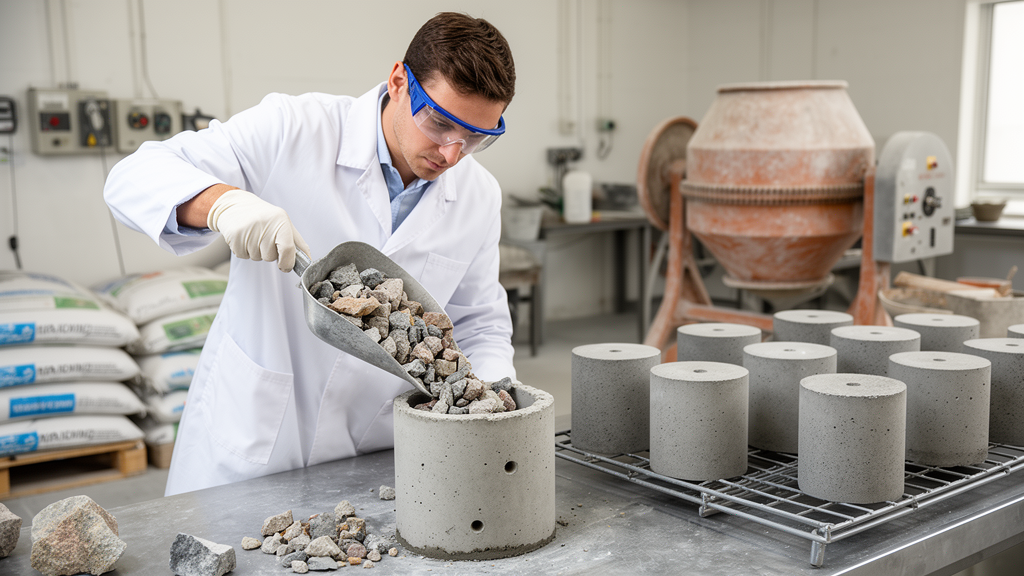
Concrete consumes more aggregate than almost anything else humans make, and a new systematic review has now compared, in a single framework, fourteen different waste materials that could stand in for the natural coarse aggregate at the heart of it. The review, published as an open-access article in October 2026, screened 538 records and synthesised 154 studies that met strict eligibility criteria, including the requirement that the waste replace the coarse fraction, material retained on the 4.75 millimetre sieve, and that every study report a natural-aggregate control mix so results could be normalised. The materials examined ranged from recycled concrete and crushed brick to ceramic, waste glass, plastic, tyre rubber, sintered fly-ash lightweight aggregate, coconut shell, oil-palm shell, steel slag, waste marble, granite waste, coal bottom ash and electronic waste.
The review’s central contribution is a three-family classification built on density, porosity and surface chemistry. The first family gathers dense, low-porosity streams such as steel slag, marble, granite, glass and vitrified ceramic, with specific gravity at or above roughly 2.4 and water absorption typically below 3 percent. The second family comprises porous, water-absorbing wastes including recycled concrete aggregate, recycled brick, sintered fly-ash pellets, coal bottom ash and the bio-based shells. The third family contains polymeric, hydrophobic wastes: plastic, tyre rubber and e-waste, whose polymer fractions sit at or below roughly 1.4 in specific gravity. The authors are explicit that this grouping is a mechanistic hypothesis rather than a validated design tool, and that confirming it would require a harmonised experimental programme testing all fourteen streams at common replacement levels in a fixed reference mix with replicate batches.
The performance patterns follow the families closely. Dense, low-porosity wastes maintained or increased strength and reduced the transport of water and ions through the hardened material. Porous streams reduced hardened density by approximately 25 to 30 percent and increased absorption, which is why most investigations limited them to 20 to 30 percent replacement for structural applications. Polymeric streams reduced strength substantially while increasing ductility and, in the case of rubber, frost resistance. The most striking single result came from steel slag: one investigation measured 28-day compressive strength rising from 34.3 to 53.5 megapascals at full replacement, roughly 56 percent above the control, attributed to the interlock of angular, iron-rich particles and a refined interfacial transition zone. The review stresses that this value derives from a single study and sits at the upper limit of the wider slag literature.
At the opposite end of the spectrum, recycled concrete aggregate fell from 30.9 to 17.6 megapascals at full replacement, and rubber-modified mixes lost more than half their 28-day compressive strength within just 20 percent replacement, a consequence of low-stiffness particles bonding poorly to the surrounding paste. Yet the polymeric family delivered a distinctive trade-off: at full replacement, compressive strength dropped by roughly 85 percent while tensile strength fell only about 50 percent, so the tensile-to-compressive ratio increased and the concrete became less brittle and more deformable. That behaviour underlies the use of rubberised concrete where energy absorption matters more than load capacity, such as pavements, kerbs and crash barriers.
The review is unusually candid about the fragility of its own evidence base. Six of the fourteen streams rest on a single coarse-aggregate study for their transport, chemical-attack and frost behaviour, and two investigations account for a disproportionate share of the conclusions: one source supplies the steel-slag results for fresh properties, density, permeable voids, all three strength measures, elastic modulus, sorptivity, chloride penetration and sulfate resistance, while another is the corresponding source for rubber. Recycled concrete aggregate is the only stream with a converging evidence base across all property groups. No quantitative meta-analysis was possible, because the primary studies rarely report the dispersion measures pooling requires and differ in water-to-binder ratio, cement type, aggregate grading, curing regime and test standards, so every numerical value quoted is either a single identified study’s result or the range spanned by a handful of studies.
Durability findings come with their own caveats. In the rapid chloride penetration test, coarse glass produced the lowest charge passed, consistent with an impermeable particle offering no transport pathway, while recycled concrete and brick produced the highest charges because adhered mortar and microcracked interfacial zones form continuous conduction paths. The review also flags a subtle artefact: steel slag contains metallic iron and iron-oxide phases far more conductive than siliceous rock, which inflates the measured current independently of pore structure and makes the coulomb value a pessimistic and unreliable indicator for that material. No study applying migration or diffusion testing to steel-slag coarse aggregate concrete was located, a gap the authors describe as specific and addressable. On carbonation, dense aggregates performed no faster than control, while porous mineral and bio-based aggregates carbonated faster in proportion to their absorption, a double-edged outcome since faster carbonation increases carbon dioxide uptake over the service life but also advances reinforcement depassivation.
Waste glass carries the review’s sharpest warning. Soda-lime glass is an amorphous silicate with high intrinsic alkali content and is among the more reactive materials that can be introduced into concrete. Particle size governs the outcome non-monotonically: glass ground below roughly 75 to 100 micrometres acts as a pozzolan and suppresses the alkali-silica reaction, coarse particles above about 5 millimetres react slowly but concentrate swelling gel at discrete sites, and a pessimum size in the 1 to 2 millimetre range produces the greatest expansion. Mixed-colour cullet, which is what most recycling streams deliver, is variable in reactivity. Crucially, the reviewed coarse glass studies ran for days to months, far shorter than the period the reaction needs to develop, so their favourable short-term results provide no information on this mechanism, and the absence of long-term expansion data for coarse glass aggregate concrete is among the clearest gaps the review identifies.
The sustainability analysis punctures a common assumption. Aggregate accounts for only 5 to 10 percent of the cradle-to-gate carbon dioxide of concrete, against 80 to 90 percent for cement, so substituting coarse aggregate alone alters cradle-to-gate emissions by approximately minus 6 to plus 6 percent. For recycled coarse aggregate specifically, a small increase of 0.3 to 3.4 percent has been reported, because crushing, screening and hauling recycled material consume more energy than quarrying local stone. The widely cited 17 percent reduction derives from replacing a quarter of the cement with fly ash, a binder-substitution effect that cannot be attributed to aggregate replacement. Cost benefits follow a similar geography: agricultural shells showed the largest reported unit-cost reductions at roughly 28 to 30 percent on the assumption of zero-cost residues, recycled brick about 19 percent and recycled concrete about 15 percent, but both cost and carbon benefits diminish beyond roughly 50 to 100 kilometres of haulage.
The review closes with graded guidance rather than design values. Steel slag, despite the strongest reported mechanical performance, carries extensive conditions: slag type must be identified, free lime and free periclase measured, volumetric stability demonstrated through standard expansion tests, ageing of three to six months or accelerated treatment applied, and leaching compliance verified, with particular attention to chromium, vanadium and barium in electric-arc-furnace slags. Recycled concrete aggregate is established for structural use at 20 to 30 percent replacement combined with supplementary cementitious materials. Lightweight and bio-based streams suit non-structural applications, with structural use limited to roughly 25 to 30 percent, while rubber, plastic and e-waste should stay below about 15 to 20 percent in any structural role, with e-waste confined to encapsulated, low-exposure applications because lead and cadmium release from the hardened material has been reported. The authors note that most of the evidence derives from short-term laboratory tests on single-waste systems, that instrumented full-scale data are almost absent, and that independent replication of the steel-slag and rubber results is the field’s highest research priority.
Subject of Research: Comparative performance of fourteen waste materials as partial or full substitutes for natural coarse aggregate in concrete
Article Title: A comparative review of concrete properties using waste materials as natural coarse aggregate substitutes
Article References: Shahriar, M. F., & Kamal, T. (2026). A comparative review of concrete properties using waste materials as natural coarse aggregate substitutes. Discover Concrete and Cement, 2(1), Article 89. https://doi.org/10.1007/s44416-026-00128-7
Image Credits: AI Generated
DOI: 10.1007/s44416-026-00128-7
Keywords: concrete, coarse aggregate, recycled concrete aggregate, steel slag, waste glass, tyre rubber, alkali-silica reaction, durability, life-cycle assessment, construction and demolition waste, sustainability, systematic review
News Source: Denise Maddox. (October 28, 2026). Waste Materials Can Replace Concrete’s Coarse Aggregate, Review Finds, With Limits. Scienmag.