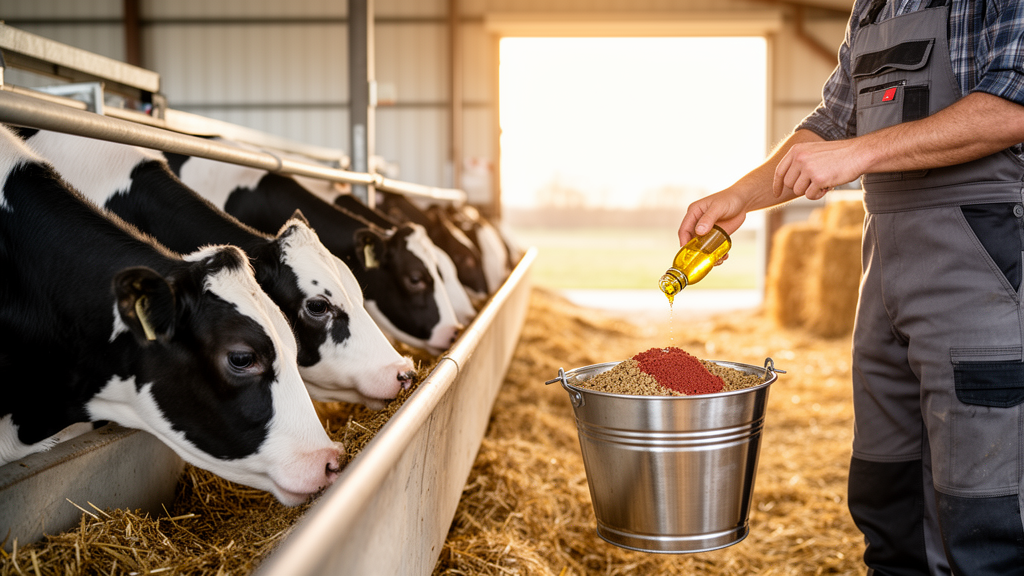
Weaned Holstein steer calves fed a blend of oregano essential oil and cobalt showed dose-dependent improvements in growth performance, nutrient digestibility, antioxidant status, and ruminal fermentation, according to a randomized controlled feeding trial published in BMC Veterinary Research. The study, led by Huan Chen and colleagues with senior author David P. Casper, tested four inclusion rates of the blended additive in recently weaned calves and found that higher doses produced consistently better outcomes across most measured endpoints.
The study enrolled sixty-four healthy Holstein steer calves aged 70 ± 5 days and weighing 91.6 ± 0.93 kg, blocked by body weight. In the randomized complete block design, calves were randomly assigned to one of four treatments, with sixteen calves per treatment. The oregano essential oil and cobalt blend, supplied as a powder, was manually mixed into the calves' total mixed ration at 0, 4, 6, or 8 grams per day. The total mixed ration consisted of pelleted feed and oat hay at a ratio of 9:1, and the powder was added once daily at 07:30 h. The 70-day trial included 14 days of adaptation and 56 days of data collection.
The study was designed to assess growth performance, body frame measurements, blood biochemical, immune, antioxidant, and heat-stress indicators, rumen fermentation, nutrient digestibility, and post-incubation recoverable bacterial colony counts. With increasing inclusion rates of the blend, body weight, body weight gain, average daily gain, and dry matter intake all increased linearly (P < 0.01), as did gains in withers height and apparent total-tract digestibility of dry matter, crude protein, and neutral detergent fiber. Feed efficiency, heart girth gain, abdominal girth gain, and acid detergent fiber digestibility also increased linearly, though at the P < 0.05 threshold.
Blood markers revealed a favorable shift in antioxidant and immune status. Serum superoxide dismutase showed significant linear, quadratic, and cubic dose responses to increasing inclusion rates (P < 0.05). Total antioxidant capacity and immunoglobulin A displayed both linear and quadratic responses, while immunoglobulin G increased linearly and malondialdehyde, a marker of oxidative damage, decreased linearly (P < 0.05). Together, these patterns suggest that the blend reduced oxidative stress and supported immune function as the dose rose, although the study measured blood indicators rather than direct health outcomes such as disease incidence.
Ruminal fermentation also shifted with supplementation. Increasing amounts of the blend produced linear decreases in total volatile fatty acid concentration and in the acetate-to-propionate ratio, while propionate concentration increased linearly (P < 0.05).
The blend also altered recoverable bacterial counts after incubation. Post-incubation recoverable Escherichia coli and Salmonella/Shigella colony counts decreased linearly with increasing inclusion rates (P < 0.01). The authors frame this as an effect on gut health, though the measurement reflects colony counts recovered after incubation rather than direct clinical outcomes in the animals.
The study addresses a practical question in calf rearing. Post-weaning calves are vulnerable to nutritional and environmental stress caused by abrupt dietary transitions, which may impair growth, immunity, gut health, and later performance. With the restriction of antibiotic growth promoters, plant essential oils have attracted attention as natural feed additives, and oregano essential oil combined with cobalt has previously shown potential to improve calf growth and ruminal function. The authors note that the optimal inclusion rate for post-weaned Holstein steer calves had remained unclear, motivating the dose-response design of this trial.
The authors conclude that feeding the blend at inclusion rates up to 8 grams per day can improve growth performance, antioxidant status, gut health, and total tract apparent nutrient digestibility, while shifting ruminal fermentation and altering post-incubation recoverable bacterial colony counts in weaned calves. Importantly, they emphasize that future studies evaluating higher supplementation levels are needed to determine the optimal or maximum effective dose, meaning the 8 g/day level should not be interpreted as the ceiling of the response. The findings apply to weaned Holstein steer calves under the conditions of this 70-day trial, and the article was published as an open-access paper on 25 October 2026.
Subject of Research: Dose-response effects of an oregano essential oil and cobalt feed additive on growth and health of weaned Holstein steer calves
Article Title: Weaned Holstein steer calves fed an oregano essential oil and cobalt blend to enhance growth performance
Article References: Chen, H., Liu, T., Cairang, D., Cheng, Y., Zhu, H., Zhang, T., & Casper, D. P. (2026). Weaned Holstein steer calves fed an oregano essential oil and cobalt blend to enhance growth performance. BMC Veterinary Research. https://doi.org/10.1186/s12917-026-06001-w
Image Credits: AI Generated
DOI: 10.1186/s12917-026-06001-w
Keywords: Holstein steer calves, oregano essential oil, cobalt, weaning stress, growth performance, nutrient digestibility, rumen fermentation, antioxidant status, feed additives, veterinary research, Weaned, Holstein
News Source: William Thompson. (October 28, 2026). Oregano Oil and Cobalt Blend Boosts Growth in Weaned Holstein Steer Calves. Scienmag.