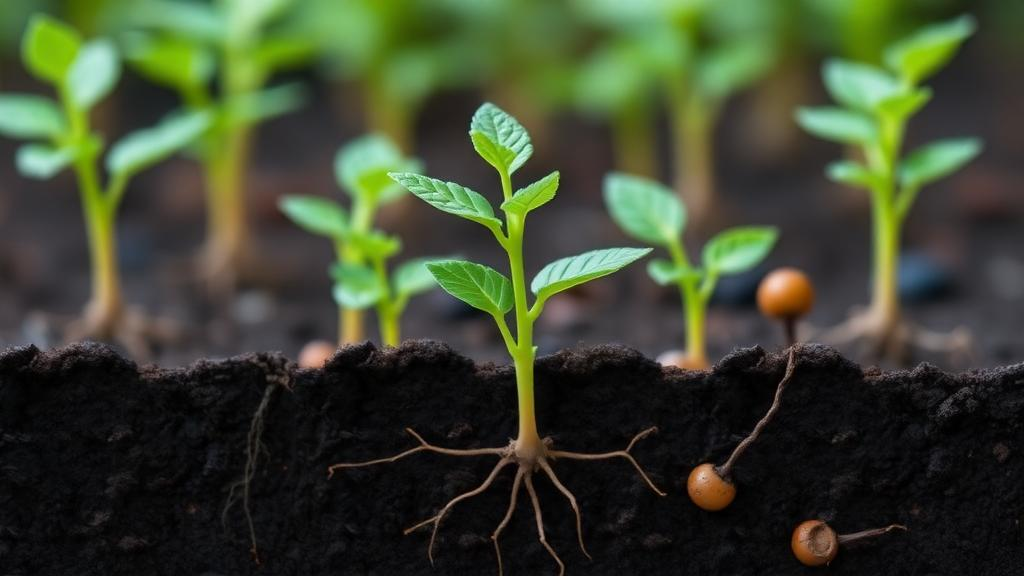
A review published in Bioscience Nanotechnology on 24 August 2026 argues that the next generation of nano-enabled biostimulants should be designed not around the nanomaterials themselves, but around their effects on the rhizosphere — the narrow zone of soil shaped by roots and their microbial communities. The paper, authored by Anurag Yadav and Kusum Yadav, proposes that explicitly engineered surface chemistry, carrier architecture and release kinetics could systematically reprogram root exudation profiles, in turn selecting and stabilizing beneficial rhizosphere microbial guilds in ways conventional formulations cannot.
The authors’ central critique is practical: most nano-enabled biostimulants developed so far are described in terms of materials and doses, whereas their actual leverage, they argue, lies in how they influence root exudation patterns and the assembly of trait-based rhizosphere guilds. The review lays out a proposed mechanistic sequence running from nanocarrier surfaces and release kinetics, through plant physiological and exudate responses, to guild-level microbiome restructuring under realistic soil, climate and management filters — including the possibility of off-target or ecotoxic outcomes rather than uniformly beneficial rewiring.
Because the work is a review, it presents a framework and testable claims rather than new experimental results. Its key proposal is that claims about nano–exudate–guild linkages can be tested with coordinated exudate metabolomics, trait-based microbiome profiling and field-scale performance trials. The authors argue that such claims should be predictable in advance rather than described after the fact, and they integrate multi-omics approaches, trait-based ecology and nanoparticle fate modeling to define experimental and computational frameworks aimed at predicting these linkages.
The review concludes by merging these insights into explicit design principles, safe operating spaces and testable hypotheses, which the authors present as a route for moving the next generation of nano-enabled biostimulants away from exploratory approaches and toward predictive, microbiome-compatible products. As with any review, the framework’s value will depend on whether future experiments and field trials confirm the proposed nano–exudate–guild relationships under real agricultural conditions.
Subject of Research: A review of how nano-enabled biostimulants may rewire root exudation and rhizosphere microbial communities
Article Title: Nanoenabled biostimulants as rhizosphere engineers: how surfaces and carriers rewire root exudation and microbial guilds
Article References: Yadav, A., & Yadav, K. (2026). Nanoenabled biostimulants as rhizosphere engineers: how surfaces and carriers rewire root exudation and microbial guilds. Bioscience Nanotechnology, 2(1), Article 25. https://doi.org/10.1186/s44331-026-00035-5
Image Credits: AI Generated
DOI: 10.1186/s44331-026-00035-5
Keywords: nano-enabled biostimulants, rhizosphere, root exudation, microbiome, nanocarriers, release kinetics, trait-based ecology, multi-omics, soil microbes, sustainable agriculture, Nanoenabled, biostimulants
News Source: Alan Morgan. (October 28, 2026). Nano-enabled biostimulants could rewire root exudates and soil microbes. Scienmag.