• HOME
  • NEWS
  • EXPLORE
    • CAREER
      • Companies
      • Jobs
    • EVENTS
    • iGEM
      • News
      • Team
    • PHOTOS
    • VIDEO
    • WIKI
  • BLOG
  • COMMUNITY
    • FACEBOOK
    • INSTAGRAM
    • TWITTER
Tuesday, August 11, 2026
BIOENGINEER.ORG
No Result
View All Result
  • Login
  • HOME
  • NEWS
  • EXPLORE
    • CAREER
      • Companies
      • Jobs
        • Lecturer
        • PhD Studentship
        • Postdoc
        • Research Assistant
    • EVENTS
    • iGEM
      • News
      • Team
    • PHOTOS
    • VIDEO
    • WIKI
  • BLOG
  • COMMUNITY
    • FACEBOOK
    • INSTAGRAM
    • TWITTER
  • HOME
  • NEWS
  • EXPLORE
    • CAREER
      • Companies
      • Jobs
        • Lecturer
        • PhD Studentship
        • Postdoc
        • Research Assistant
    • EVENTS
    • iGEM
      • News
      • Team
    • PHOTOS
    • VIDEO
    • WIKI
  • BLOG
  • COMMUNITY
    • FACEBOOK
    • INSTAGRAM
    • TWITTER
No Result
View All Result
Bioengineer.org
No Result
View All Result
Home NEWS Science News Biology

Warming threat to tropical forests risks release of carbon from soil

Bioengineer by Bioengineer
August 12, 2020
in Biology
Reading Time: 2 mins read
0
IMAGE
Share on FacebookShare on TwitterShare on LinkedinShare on RedditShare on Telegram

IMAGE

Credit: Geetha Iyer

Billions of tonnes of carbon dioxide risk being lost into the atmosphere due to tropical forest soils being significantly more sensitive to climate change than previously thought.

Carbon emissions from soils in tropical forests – which store one quarter of the world’s soil carbon – could increase dramatically if temperatures continue to rise in line with current predictions, researchers say.

A new experiment conducted in Panama suggests these harmful emissions of soil carbon could rise by 55 per cent if the climate warms by four degrees Celsius.

Carbon dioxide is released naturally by soils through decomposition and plant root activity. However, the release of so much extra carbon dioxide – which the study found was coming from increased decomposition of soil organic matter – could trigger further global warming.

Previous research has shown that rising temperatures threaten to release carbon locked away in cooler or frozen soils – such as in the Arctic tundra. Until now, tropical soils were thought to be less sensitive to the effects of climate warming.

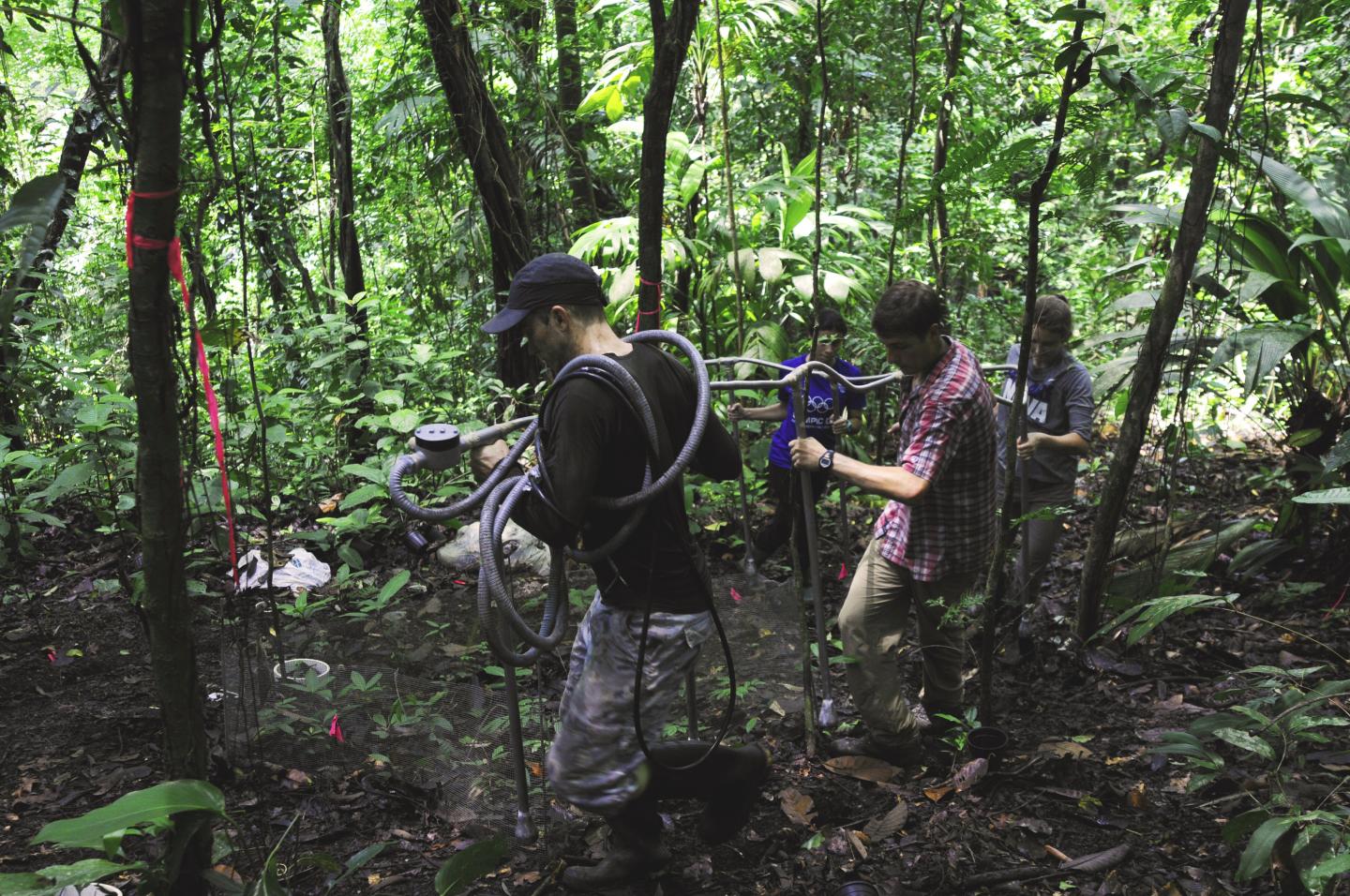
A team led by researchers from the University of Edinburgh conducted a large-scale experiment in a tropical forest on Barro Colorado Island in the Panama Canal.

They built heating devices and buried them one metre into the forest soil. Over a two-year period the equipment – fitted with heating cables and a thermostat – kept the experimental areas four degrees warmer than the surrounding soil.

The findings show that as much as an extra eight tonnes of soil carbon could be released as carbon dioxide from every hectare of tropical forest each year at the higher temperatures.

Researchers expect the rate of emissions will eventually decline in the experimentally warmed soils, but they do not yet know how long this will take, or the long-term impact of soil warming on climate change.

They will continue the experiment – known as the Soil Warming Experiment in Lowland Tropical Rainforest, or SWELTR – to better understand how tropical forests respond to a warming world.

###

The study, published in the journal Nature, also involved researchers from the Smithsonian Tropical Research Institute (STRI) in Panama and the Australian National University (ANU). It was funded by the European Union and the Natural Environment Research Council, the Smithsonian Institution and STRI, and ANU-Biology.

Dr Andrew Nottingham, of the University of Edinburgh’s School of GeoSciences, who led the study, said: “The results demonstrate the high sensitivity of these ecosystems to warming. It should be a wake-up call for us to take action to mitigate climate change and preserve tropical forests, which are one of the most important components in Earth’s carbon cycle.”

Study co-author Professor Patrick Meir, also of the School of GeoSciences at Edinburgh and the Australian National University, said: “The high carbon emissions from warmed tropical forest soil differ from expectations, and indicate a need to re-examine current predictions”.

Media Contact
Corin Campbell
[email protected]

Related Journal Article

http://dx.doi.org/10.1038/s41586-020-2566-4

Tags: Atmospheric ChemistryClimate ChangeClimate ScienceEarth ScienceGeographyGeology/SoilTemperature-Dependent Phenomena
Share12Tweet8Share2ShareShareShare2

Related Posts

High-resolution X-ray imaging reveals leaf interiors, guiding efforts to reduce water loss

High-resolution X-ray imaging reveals leaf interiors, guiding efforts to reduce water loss

August 11, 2026
Breakthrough Advances Heart Valve Disease Treatment

Breakthrough Advances Heart Valve Disease Treatment

August 11, 2026

Cholesterol sensor helps immune cells maintain balance

August 11, 2026

Population history, not age, drives ancient trees’ evolutionary importance in endangered conifer

August 11, 2026
Please login to join discussion

POPULAR NEWS

  • Neutrophil Traps Drive Liver Metastasis by Disrupting NK Cell Surveillance Through CCDC25

    29 shares
    Share 12 Tweet 7
  • Android Smartphone Alerts’ Performance and User Responses During 2025 Marmara EreÄŸlisi Earthquake

    29 shares
    Share 12 Tweet 7
  • Adipolin May Reveal Early Vascular Damage in Children With Obesity

    29 shares
    Share 12 Tweet 7
  • Washington Study Identifies Barriers and Supports for Neurodevelopmental Follow-Up in At-Risk Newborns

    29 shares
    Share 12 Tweet 7

About

We bring you the latest biotechnology news from best research centers and universities around the world. Check our website.

Follow us

Recent News

Neutrophil Traps Drive Liver Metastasis by Disrupting NK Cell Surveillance Through CCDC25

Android Smartphone Alerts’ Performance and User Responses During 2025 Marmara Ereğlisi Earthquake

Adipolin May Reveal Early Vascular Damage in Children With Obesity

Subscribe to Blog via Email

Enter your email address to subscribe to this blog and receive notifications of new posts by email.

Join 86 other subscribers
  • Contact Us

Bioengineer.org © Copyright 2023 All Rights Reserved.

Welcome Back!

Login to your account below

Forgotten Password?

Retrieve your password

Please enter your username or email address to reset your password.

Log In
No Result
View All Result
  • Homepages
    • Home Page 1
    • Home Page 2
  • News
  • National
  • Business
  • Health
  • Lifestyle
  • Science

Bioengineer.org © Copyright 2023 All Rights Reserved.