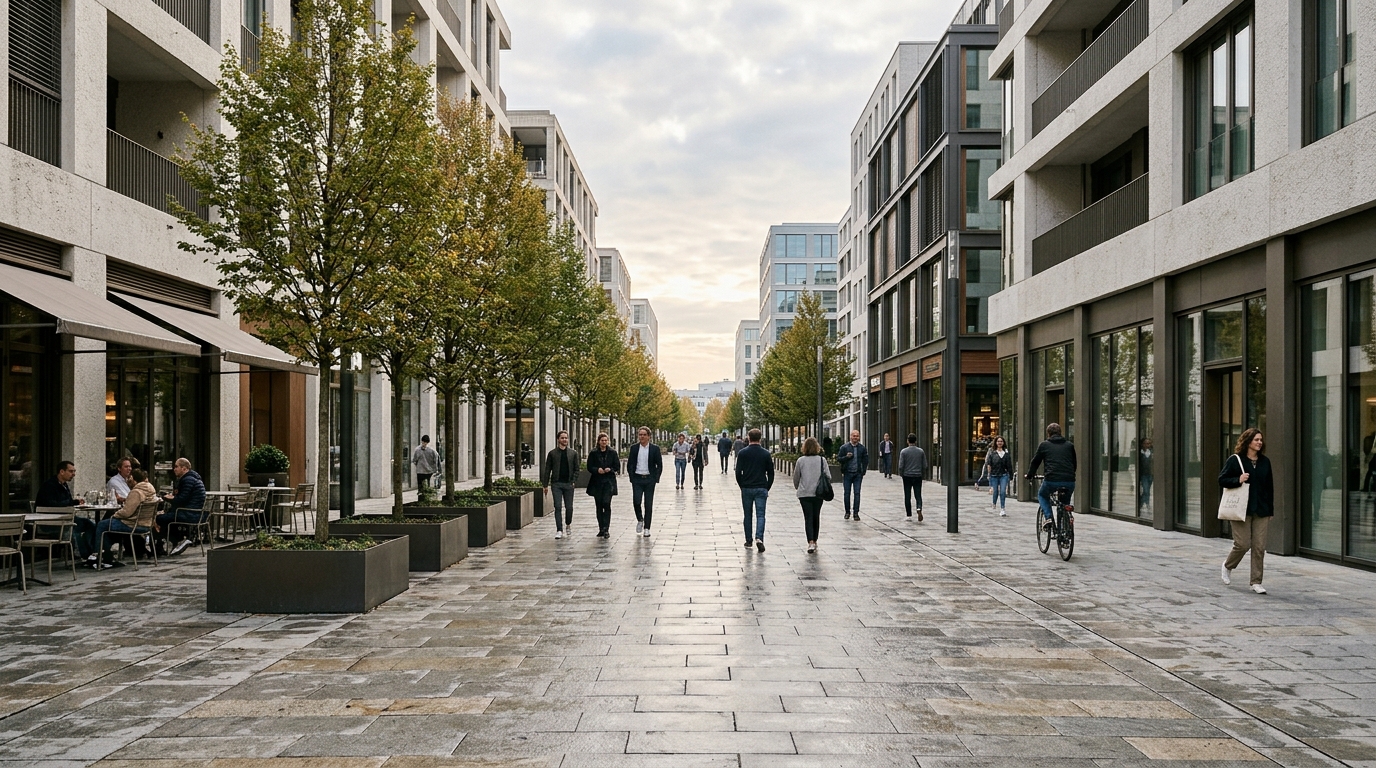
Walkability has become one of the most celebrated ideas in urban planning, promoted as a shortcut to greener, healthier, and more connected cities. Yet a new perspective article argues that the sustainability of walkable urban design is too often assumed rather than measured, and that its true environmental, social, and economic impacts remain largely unquantified. Writing in Frontiers in Sustainable Cities, researchers from King Abdullah University of Science and Technology (KAUST) in Saudi Arabia contend that walkability should be treated as a sustainability intervention whose performance must be demonstrated through rigorous quantitative assessment, not taken for granted from its intended benefits.
The article, authored by Nisreen Abuwaer, Safi Ullah, Furqan Tahir, and Sami G. Al-Ghamdi, frames the problem against the backdrop of transportation’s outsized role in global environmental change. In 2019, the transportation sector accounted for approximately 15 percent of global greenhouse gas emissions, equivalent to 8.7 gigatonnes of carbon dioxide equivalent, and contributed 23 percent of energy-related carbon dioxide emissions worldwide, according to figures from the Intergovernmental Panel on Climate Change cited in the paper. Road vehicles dominate these emissions, responsible for 70 percent of total transport-related carbon dioxide, followed by aviation, shipping, and rail.
Car-centric transportation systems also carry social and economic costs that fall unevenly across populations. The authors note that cities built around private vehicles often prioritize wealthier residents who can afford cars, while low-income populations face limited access to reliable public transport or are pushed into car ownership despite financial strain. This inequity can reduce job opportunities, increase commuting costs, and widen social disparities. Traffic congestion and inefficient transport systems simultaneously raise fuel expenses and strain municipal budgets for road maintenance and infrastructure expansion, making the case for accessible and affordable mobility alternatives all the more pressing.
Against this backdrop, walkability appears to offer an obvious solution. Replacing vehicle trips with walking can reduce per capita carbon dioxide emissions by lowering dependency on cars, buses, and trains for everyday commutes, thereby cutting vehicle kilometers traveled. The potential scale of such savings is illustrated by emission baselines the authors cite: in Europe, light-duty passenger vehicles have an official emission baseline of approximately 120 grams of carbon dioxide per kilometer, but real-world driving conditions often push emissions as high as 168 grams per kilometer, with peaks reaching up to 193 grams per kilometer under heavy congestion. In Bangkok, light-duty diesel and gasoline vehicles average 182.5 and 171.01 grams of carbon dioxide per kilometer respectively, rising to 232.25 grams per kilometer at lower driving speeds due to increased fuel consumption.
Reduced reliance on motorized transport also lowers fuel consumption and frees urban land currently devoted to parking, which can be repurposed for green spaces. But the authors caution that the transition toward walkability is not without trade-offs. Achieving high-density, mixed-use, walkable neighborhoods often requires a fundamental redesign of existing car-centric urban areas, involving large-scale changes to road space, sidewalks, crossings, drainage, and lighting. These transformations demand significant additional material inputs, energy use, ongoing maintenance, and associated embodied environmental impacts, particularly when existing infrastructure must be substantially reconstructed or retrofitted. Accordingly, the researchers argue that the environmental benefits of walkability should be evaluated alongside the embodied impacts of infrastructure construction, replacement, and maintenance using life-cycle approaches.
The social dimension of walkability is similarly nuanced. Well-designed pedestrian infrastructure, including sidewalks, safe crossings, shaded paths, and plazas, requires modest public investment yet can deliver inclusive, low-cost mobility. Walkable environments may improve mental and physical health by easing congestion, reducing stress, and encouraging daily activity, while fostering social interaction and strengthening local identity. Universal design features such as curb ramps, tactile paving, accessible signals, and barrier-free pathways enable people of all ages and abilities to participate in public life, though some groups still require complementary transit for inclusive mobility. In hot climates, the authors emphasize, climate-sensitive design is critical to balance comfort, safety, and environmental impact.
However, walkability interventions also involve opportunity costs because urban road space, parking, municipal budgets, and public right-of-way are finite resources. Reallocating road or parking space to pedestrian infrastructure can reduce space available for other transport uses and may involve trade-offs among competing mobility priorities. These decisions can affect different population groups unevenly, depending on their mobility needs and reliance on private vehicles. Without equity safeguards, the authors warn, walkability can reinforce existing inequalities: in low-income areas it often reflects necessity rather than choice, exposing residents to pollution, heat, and flooding. There is also growing evidence that both residential and retail gentrification are positively correlated with improvements in walkability, and rising property values and commercial rents can cause displacement and disrupt established social networks.
On the economic front, walkability is often credited with lowering long-term infrastructure costs, boosting local economies through increased foot traffic and tourism, and enhancing resilience to climate and energy shocks. Reduced car dependence lowers household transport costs, while health benefits may cut healthcare spending. Yet the authors note that initial capital requirements can be substantial when walkability improvements involve major reconstruction or retrofitting of existing car-oriented streets. Published assessments show that some road-diet interventions can be implemented at relatively modest additional cost when coordinated with resurfacing, whereas larger pedestrian and complete-street projects can require substantially greater investment. Transitions away from car-dependent mobility may also generate labor-market adjustments in vehicle manufacturing, maintenance, and fuel supply chains, with evidence from broader low-carbon transitions indicating that employment losses can occur in affected sectors even as new opportunities emerge elsewhere.
To move beyond assumption, the researchers propose a sequential and iterative assessment architecture that combines established environmental, social, and economic assessment methods to quantify the benefits and trade-offs of a walkability intervention relative to a defined baseline, spatial boundary, functional unit, and time horizon. Life cycle assessment, standardized under the International Organization for Standardization, tracks environmental impacts such as carbon emissions, ozone depletion, acidification, human toxicity, energy use, resource depletion, and eutrophication through four iterative stages: defining the goal and system boundaries, compiling a life cycle inventory of material and energy flows, conducting life cycle impact assessment, and interpreting results. Complementary approaches such as social life cycle assessment and life cycle costing extend this perspective to capture social outcomes and economic performance across the full life cycle. Additional tools include the sustainable process index, an ecological footprint method that calculates the total land area required to sustainably embed all material and energy flows, as well as carbon footprinting, the social vulnerability index, health impact assessment, and cost-benefit analysis.
The authors acknowledge that integrating these tools presents a key methodological challenge: they operate at different spatial and temporal scales and use different outcome measures. Life cycle assessment may evaluate environmental impacts over the full life cycle of infrastructure, whereas social vulnerability indices and health impact assessments may focus on present-day or shorter-term population-level outcomes. Aggregate economic benefits identified through cost-benefit analysis may mask unequal distributions of costs and benefits across social groups. The researchers therefore recommend a multi-criteria assessment that retains individual results while explicitly identifying where environmental benefits, economic efficiency, and social equity reinforce or conflict with one another, rather than relying on a single composite score. They also stress that standardized frameworks must account for substantial variation in data availability, spatial resolution, and quality across cities and countries, particularly in lower-income and data-constrained contexts, and that transparent reporting of data limitations, uncertainty, and assumptions is essential to ensure comparisons across locations are meaningful. With such rigorous, holistic, and data-driven evaluation in place, the authors conclude, walkability can be strategically cultivated to enhance livability, resilience, and long-term sustainability for diverse communities.
Subject of Research: Quantifying the environmental, social, and economic sustainability of walkable urban design
Article Title: Quantification of walkability in terms of sustainability
Article References: Abuwaer, N., Ullah, S., Tahir, F., & Al-Ghamdi, S. G. (2026). Quantification of walkability in terms of sustainability. Frontiers in Sustainable Cities, 8, Article 1976335. https://doi.org/10.3389/frsc.2026.1976335
Image Credits: AI Generated
DOI: 10.3389/frsc.2026.1976335
Keywords: walkability, sustainability, urban planning, life cycle assessment, transportation emissions, social equity, gentrification, economic assessment, pedestrian infrastructure, sustainable cities, Quantification, terms
News Source: Denise Maddox. (November 5, 2026). Walkability Is Not Automatically Sustainable, Researchers Warn. Scienmag.