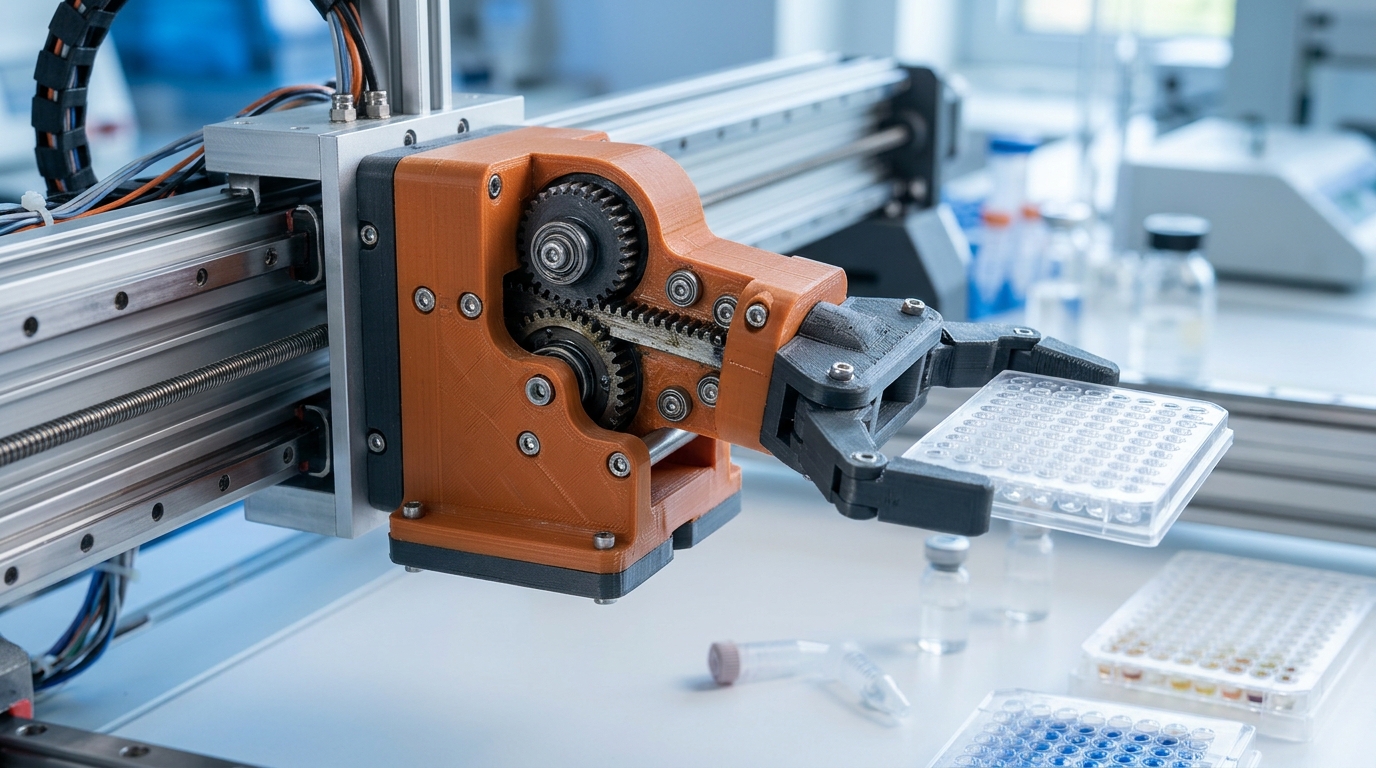
A $7.34 CAD set of 3D-printed plastic parts can now give a basic laboratory gantry robot a skill that normally demands a robotic arm costing tens of thousands of dollars: picking up a delicate sample, flipping it 180 degrees and setting it back down, all without a single motor. Engineers at the University of Waterloo report in HardwareX that their passive substrate handling and rotation module converts the ordinary linear movement of a three-axis gantry into precise rotation through a rack-and-pinion mechanism, using nothing more than the robot’s own pipette as the carrier. The team demonstrated the design on an Opentrons OT-2 liquid handler, automating the manipulation of soft contact lens hydrogels during wettability measurements that previously required a human with tweezers at every step.
The core problem the module addresses is a familiar one in laboratory automation. Commercial fully automated platforms such as the Tecan Fluent or Hamilton Microlab STAR can cost between $80,000 and $1,000,000 once grippers, stackers and heaters are added, which limits their adoption in typical research environments. Many laboratories therefore retrofit cheaper workstations, including CNC machines and basic liquid handlers costing roughly $700 to $20,000, with 3D-printed tools tailored to specific tasks. Yet these extensions usually stop short of the dexterous movements that come naturally to human hands. Solid sample manipulation tasks such as collecting, transferring, positioning and reorienting samples during thin film fabrication or hydrogel characterization demand motor functions that often exceed what a gantry-based system can do.
Existing workarounds each carry trade-offs. Robotic arms and grippers can achieve these movements but introduce $3,000 to $60,000 in additional cost and considerable complexity. Some three-axis gantry robots already have a rotational degree of freedom at the toolhead, but only about the vertical axis; unlocking rotation about a horizontal axis requires a fixed rotary module. Simple motor-based systems have been used to tilt instrumentation within a 20-degree range, but external motors bring integration challenges, and existing approaches still do not address flexible substrate manipulation. Without automation, these dexterous tasks fall to manual intervention, which bottlenecks the pipeline and prevents end-to-end automated sample preparation or characterization.
The new module sidesteps motors entirely by exploiting the gantry’s existing linear motion. Its four primary components are a pipette-pinion assembly, a rack clip, a substrate holder and a stage. The pipette adapter is designed to fit onto a cut 1000 microlitre Opentrons pipette tip, using the native friction-fit mechanism that normally holds standard tips, so the robot picks up the rotation hardware the same way it picks up a tip. Standard tip pickup and pipette movement commands from the liquid handler’s own API position and transport the assembly, making the rotation module easy to fold into existing automated workflows. When substrate handling is not needed, the assembly simply rests in its holder and the robot performs other tasks.
Rotation happens through gear geometry rather than electronics. The pinion is a module 2, 10-tooth spur gear with a 20-degree pressure angle and 10 mm face width. As the pipette retrieves the assembly and moves it across a clip-on rack mounted in a 10.4 mL square 24-deep well plate, the pinion teeth engage the rack’s six teeth, converting horizontal travel into a 180-degree rotation of the pinion and the substrate holder it carries. The substrate holder attaches to the pinion through a rectangular sliding fit and four small neodymium magnets, which provide added security during transport. Alignment magnets on the assembly hold the pinion at the 0-degree or 180-degree orientations, preventing unintended rotation during transfer. A small filleted lip on the substrate stage gradually overcomes the magnetic attraction as the assembly translates laterally, enabling smooth and reliable release.
The average angular error across all ten turns was +0.77 degrees with a standard deviation of 0.36 degrees, indicating a slight over-rotation on every turn, with individual errors ranging from +0.19 to +1.46 degrees. The authors report that this error was inconsequential to the module’s functionality, because the pinion and substrate holder both feature filleted edges with ample tolerance to allow successful connection within that angular range.
The validation application targets a genuine bottleneck in biomaterials characterization. Surface wettability, describing how well a liquid wets a surface, is commonly measured on contact lens materials through sessile drop contact angle goniometry, in which the angle formed between a water droplet and the solid surface indicates wetting behaviour. Although the method relies on image processing, it remains highly dependent on the operator: how the droplet is applied, how the baseline is defined and the entire manual protocol all affect the observed contact angle, and the process is time-intensive. Contact lens manipulation is particularly delicate, typically requiring an operator with tweezers to gently pick up, invert and place a lens onto a mount, and to remove it carefully afterwards. Single contact angle measurements can be completed within a few minutes over several cycles spanning 6 to 24 hours, so automating the handling enables extended unattended operation of the assay.
In the automated workflow, the robot picks up the lens mount from the stage, rotates it 180 degrees using the rack, submerges it in a well to retrieve a contact lens by capillary force, then flips it back and places it on the stage for measurement. Five contact angle measurements over air exposure are made by repeatedly depositing 5 microlitre droplets of MilliQ water onto the lens surface. To remove the lens, the mount is picked up and inverted again, and the lens is released by submerging the mount in the well and lightly brushing it against the well wall. The lens soaks in MilliQ water for 4 minutes before wettability is measured again, and this cycle was repeated four times in triplicate. The flip itself takes 6 seconds, with the gantry moving over the rack at 10 mm/s, and the total setup time using the module’s functions was 42 seconds.
The demonstration produced 144 minutes of continuous operation with 48 successful instances of lens substrate transfer and manipulation across two lens types, a senofilcon A silicone hydrogel lens and an omafilcon A conventional hydrogel lens. The measurements also revealed material-specific behaviour: the senofilcon A lens started at a contact angle of 54 degrees, rising to 64 degrees after four minutes of air exposure, and rehydration in MilliQ water did not restore its initial wetting state. The omafilcon A lens began at 33.4 degrees and increased to 66.9 degrees after five repeated measurements, but unlike the silicone hydrogel, its wettability returned to a fresh-lens-like state after rehydration, highlighting the range of surface behaviour between contact lens materials.
The module’s limitations are acknowledged by its creators. It provides rotational motion about a single axis at a time, and adding further degrees of freedom would require additional hardware development. The workflow is constrained by substrate weight and size, since heavier or bulkier items create excess torque at the pipette and pipette-adapter interface, potentially affecting the friction fit and causing instability. Rotational precision is limited by the discrete incremental steps of the rack-and-pinion mechanism, though more teeth and added alignment guides can improve it, and users must guard against collisions within the gantry workspace. Even so, at $7.34 CAD in materials, almost entirely PLA filament plus five magnets and a dab of super glue, the design offers laboratories an accessible route to dexterous sample handling, and its general functions can be translated to G-code for other gantry systems such as CNC machines and retrofitted 3D printers.
Subject of Research: A passive 3D-printed rack-and-pinion module that adds 180-degree substrate rotation to three-axis gantry laboratory robots
Article Title: Passive rotational substrate handling in three-axis gantry robots
Article References: Choksi, T., Ng, E., Nazeri, M., & Gu, F. (2026). Passive rotational substrate handling in three-axis gantry robots. HardwareX, 28, Article e00857. https://doi.org/10.1016/j.ohx.2026.e00857
Image Credits: AI Generated
DOI: 10.1016/j.ohx.2026.e00857
Keywords: laboratory automation, gantry robots, rack and pinion, 3D printing, Opentrons OT-2, contact angle, contact lenses, wettability, sample handling, liquid handler, open-source hardware, robotics
News Source: Denise Maddox. (November 6, 2026). $7 3D-printed rack-and-pinion module gives lab gantry robots a flip hand. Scienmag.