U.S. wind plants achieve a predicted annual production gain of 0.8% by using wake steering
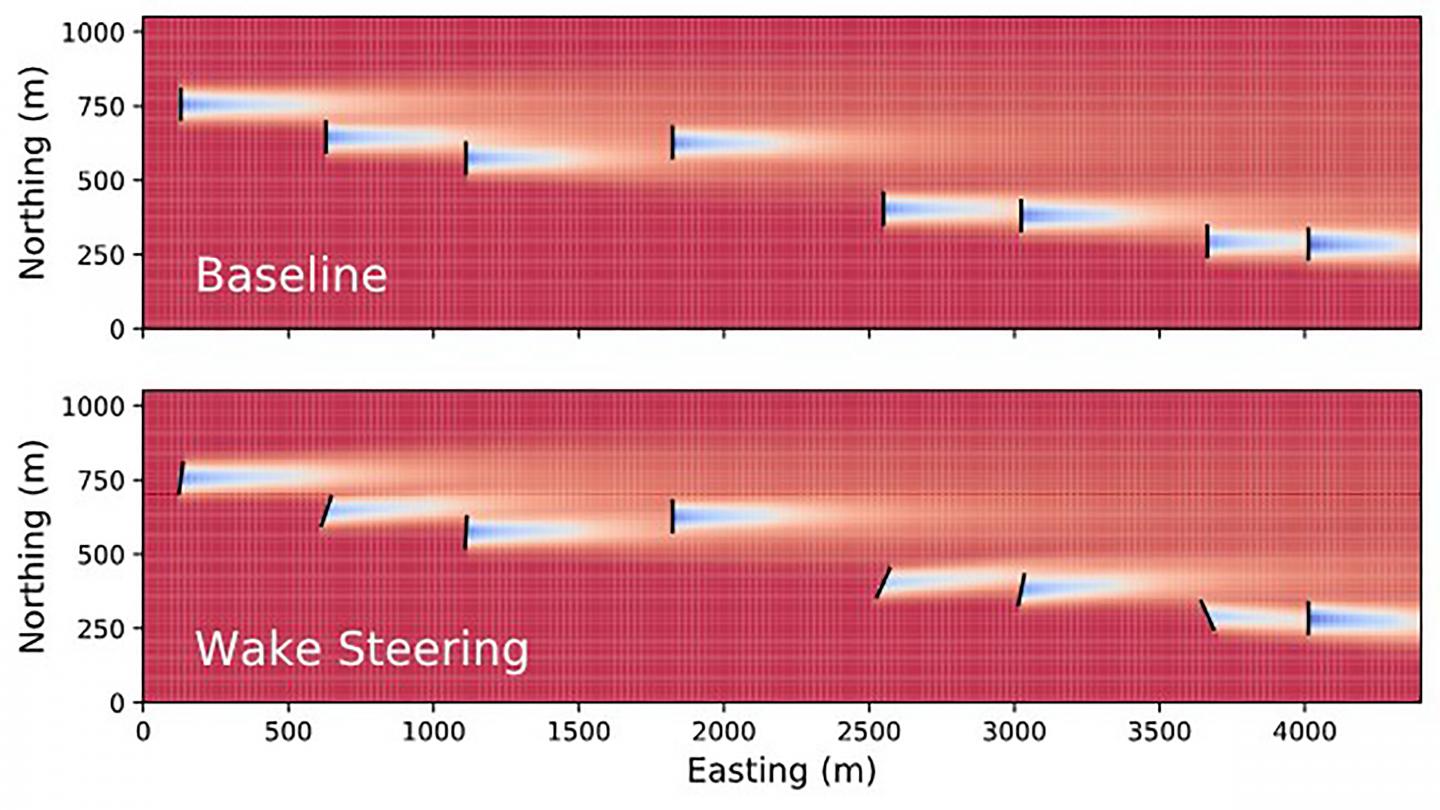
Credit: Eric Simley, NREL
WASHINGTON, May 18, 2021 — Wake steering is a strategy employed at wind power plants involving misaligning upstream turbines with the wind direction to deflect wakes away from downstream turbines, which consequently increases the net production of wind power at a plant.
In Journal of Renewable and Sustainable Energy, by AIP Publishing, researchers at the U.S. Department of Energy’s National Renewable Energy Laboratory (NREL) illustrate how wake steering can increase energy production for a large sampling of commercial land-based U.S. wind power plants.
While some plants showed less potential for wake steering due to unfavorable meteorological conditions or turbine layout, several wind power plants were ideal candidates that could benefit greatly from wake steering control.
Overall, a predicted average annual production gain of 0.8% was found for the set of wind plants investigated. In addition, the researchers found that on wind plants using wake steering, wind turbines could be placed more closely together, increasing the amount of power produced in a given area by nearly 70% while maintaining the same cost of energy generation.
“We were surprised to see that that there was still a large amount of variability in the potential energy improvement from wake steering, even after accounting for the wake losses of different wind plants,” said author David Bensason.
Just as umbrellas may cast a shadow, wind turbines create a region of slower, more turbulent air flow downstream of their rotor, which is known as a wake. When these wakes flow into another turbine, they reduce its power production capacity.
The wake steering strategy “steers” these wakes away from turbines by offsetting the angle between the rotor face and the incoming wind direction. This technique sacrifices the power efficiencies of a few turbines in order to increase the performance of the wind power plant as a whole. Wake steering can only increase energy production if there are wake losses to start. Consequently, the benefits of wake steering tend to increase for wind plants with higher wake losses.
The study is one of the first to use the Gauss-Curl-Hybrid wake model, which NREL developed. This model predicts wake behavior in a wind plant more accurately than prior models and captures effects that are more prominent in large-scale plants. The researchers also combined several publicly available databases and tools that together make the investigation of wake steering potential for a large sample of U.S. wind plants possible.
“We hope that this study, which highlighted the potential for wake steering for a large sample of existing commercial wind plants in the U.S., motivates wind plant owners to implement wake steering in their wind plants to increase energy production and contribute to making wind energy a widely deployed affordable clean energy source,” said co-author Eric Simley.
###
The article “Evaluation of the potential for wake steering for U.S. land-based wind power plants” is authored by D. Bensason, E. Simley, O. Roberts, P. Fleming, M. Debnath, J. King, C. Bay, and R. Mudafort. The article will appear in Journal of Renewable and Sustainable Energy on May 18, 2021 (DOI: 10.1063/5.0039325). After that date, it can be accessed at https:/
ABOUT THE JOURNAL
Journal of Renewable and Sustainable Energy is an interdisciplinary journal that publishes across all areas of renewable and sustainable energy relevant to the physical science and engineering communities. Topics covered include solar, wind, biofuels and more, as well as renewable energy integration, energy meteorology and climatology, and renewable resourcing and forecasting. See https:/
Media Contact
Larry Frum
[email protected]
Related Journal Article
http://dx.