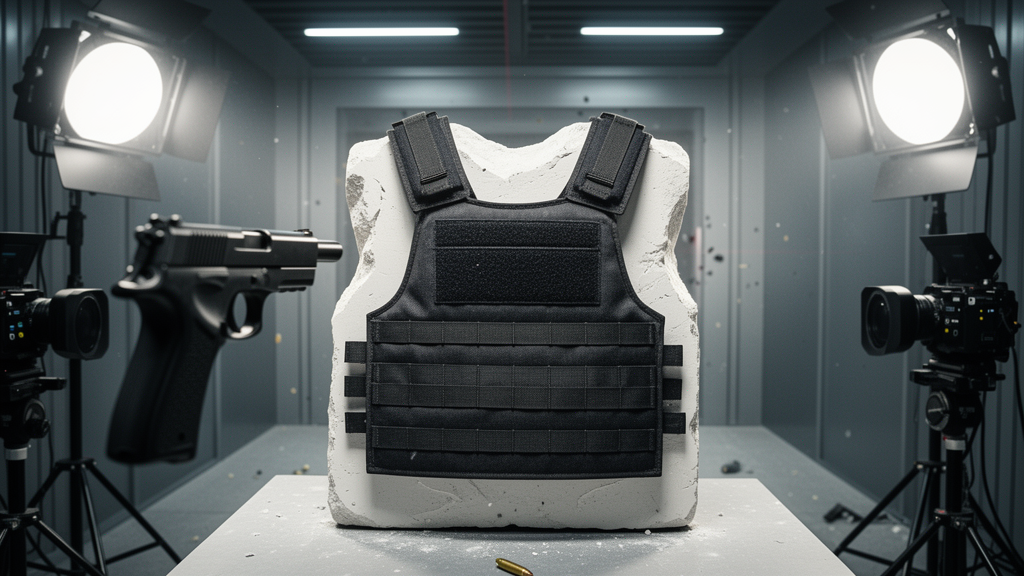
Engineers have built a prototype body armor system that pairs Kevlar composite plates with a W-shaped geometry inspired by medieval lamellar armor, and early ballistic tests suggest the design can combine flexibility with protection that flat plates could not match. The work, published in Discover Materials on 28 October 2026 by Lucas Choi and Anshuman Das, is described as an exploratory proof-of-concept rather than a field-ready system.
Contemporary body armor, the authors note, tends to fall into one of two camps: flexible, lightweight systems with limited structural reinforcement, or rigid monolithic plates that offer higher ballistic resistance at the cost of mobility.
The testing protocol was based on a modified National Institute of Justice (NIJ) 0101.06 Level IIA procedure. Six 9 mm, 124 grain full metal jacket projectiles were fired at approximately 365 m/s at five reduced-scale specimens. The W-plated specimens showed negligible backface deformation of less than 1 mm, well within the NIJ 0101.06 specification of less than 44 mm, and recorded zero projectile penetrations.
By contrast, a flat lamellar comparison specimen exhibited 57 mm of backface deformation, exceeding the NIJ specification limit.
Controlled quasi-static compression testing reinforced the ballistic results. The W-plated specimens sustained a mean maximum load of 13.61 ± 1.35 kN, compared with 1.12 ± 0.10 kN for the flat controls, a 12.2-fold difference. The authors attribute this performance gap to the geometry of the plates, which appears to distribute and resist loads more effectively than a flat configuration.
Microstructural analysis after testing indicated that fiber integrity and interlayer bonding were preserved in the specimens, suggesting that the composite material itself was not degraded by the ballistic and compression tests. The authors report that this preservation of structure supports the idea that the geometry, rather than material damage, drives the observed performance differences.
The study is explicitly preliminary. The specimens were reduced in scale, the protocol was modified from the full NIJ standard, and the results come from a small number of specimens and shots. The authors describe the findings as preliminary evidence supporting geometry-driven composite armor architectures that balance flexibility, lightweight construction, and ballistic protection, not as a demonstration of a finished armor product.
Even so, the results illustrate how a centuries-old design principle, overlapping segmented plates arranged in a load-bearing geometry, can be reinterpreted with modern composite materials. If subsequent full-scale testing confirms the prototype results, geometry-driven segmentation could offer a route to armor that bends with the wearer while still meeting established ballistic protection thresholds.
Subject of Research: A W-shaped segmented Kevlar composite armor prototype inspired by medieval lamellar designs that showed improved ballistic resistance and load capacity in preliminary testing.
Article Title: Geometry-driven W-plated Kevlar composite armor for balancing flexibility and ballistic resistance
Article References: Choi, L., & Das, A. (2026). Geometry-driven W-plated Kevlar composite armor for balancing flexibility and ballistic resistance. Discover Materials. https://doi.org/10.1007/s43939-026-01043-1
Image Credits: AI Generated
DOI: 10.1007/s43939-026-01043-1
Keywords: Kevlar, body armor, ballistic resistance, composite materials, NIJ 0101.06, backface deformation, lamellar armor, segmented plates, quasi-static compression, proof-of-concept, Geometry-driven, W-plated
News Source: Denise Maddox. (October 29, 2026). W-shaped Kevlar plates stop 9 mm rounds with under 1 mm of backface deformation. Scienmag.