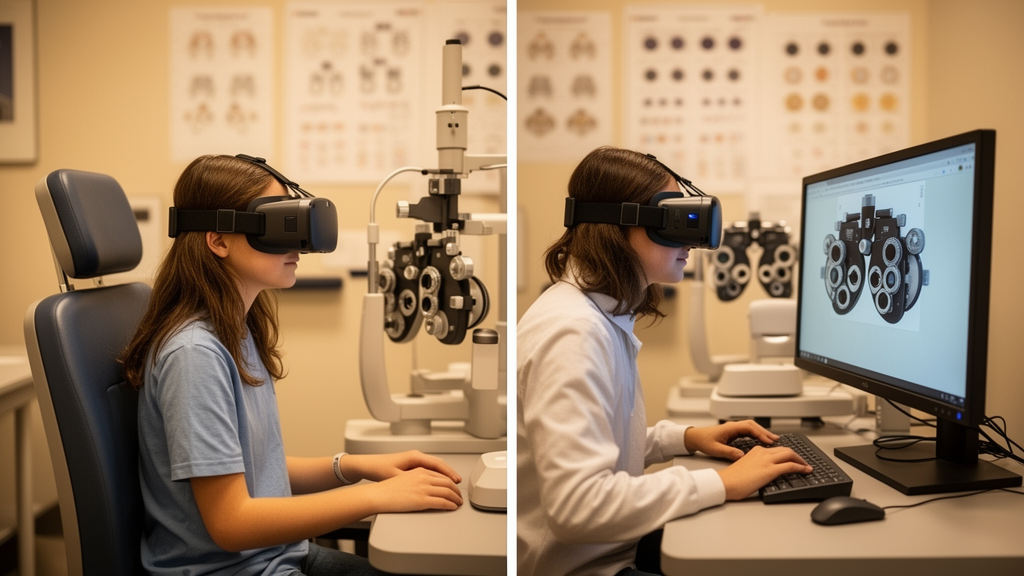
Students training to diagnose eye misalignments enjoyed virtual reality more than a desktop simulator, but they rated the older computer-based tool as more practical for actually getting the job done. That is the central tension emerging from a new study at the University of Liverpool, where orthoptics students tried both learning environments and then reported on their experiences in detail. The findings, published in Bioelectronic Medicine, suggest that consumer-grade VR hardware can be adapted for specialist healthcare training, even though it did not outperform the desktop simulation on every measure the researchers tested.
Orthoptics is an allied health profession focused on diagnosing and treating defects in eye movements, including strabismus, or eye misalignment, as well as ocular deviations and limitations in ocular motility. Because these diagnostic tasks demand precision, errors or inappropriate treatment could compromise a patient’s visual health and quality of life. Students therefore undergo extensive university training that combines lectures with clinical placements, where they apply theoretical knowledge to real patients under the supervision of a qualified orthoptist.
Those placements, however, are under strain. The researchers note that placement capacity is challenged by rising student numbers, dependence on patient availability, concerns for patient safety, and the need to expose students to a range of different eye conditions. Placement sites cannot consistently guarantee that students will see the types of strabismus appropriate to their stage in the curriculum. With only about 5% of the population affected by binocular vision disorders, and roughly 74% of those disorders being strabismus, students may struggle to encounter a broad range of symptom severity for specific or rare conditions during their training.
Virtual learning environments offer one possible answer. The Strabismus Simulator, a 2D interactive computer simulation developed by Faruk and Orge, lets orthoptists practice core evaluations such as the cover-uncover test, the alternate cover test, the alternate cover test with prism, and the simultaneous prism cover test. It can be accessed on any desktop computer at any time, without a supervisor or human patient present, and its pre-programmed virtual patients expose students to disorders they might otherwise never see. But 2D learning has limits: a monoscopic screen makes depth perception harder than in real stereoscopic vision, and motor skills such as handling diagnostic equipment depend on that depth perception.
To test whether virtual reality could address these shortcomings, the research team built a collaborative VR learning environment on an HTC Vive Focus 3 headset, running on laptops equipped with an i7-11800H processor, 32GB of RAM and a 16GB NVIDIA GeForce RTX 3080 graphics card. In the VR condition, students diagnosed a 3D virtual patient with a +1 deviation of the left eye in all positions on the x-axis, a limitation restricting rightward movement of the left eye to 25% of normal, and a manifest, visibly misaligned condition. In the desktop condition, the same groups used the Strabismus Simulator to diagnose three separate 2D virtual patients whose conditions were randomised, with correct diagnoses revealed afterwards.
Sixty-seven undergraduate orthoptics students initially took part, though fifteen were removed from the analysis after some worked on questionnaires as a group despite being told to answer individually, leaving 52 participants with usable data: 31 first-year and 21 second-year students. The study used a counterbalanced within-subjects design, with groups alternating the order of the two learning environments across testing sessions. Each condition lasted ten minutes, and afterwards students completed questionnaires measuring user experience, sense of presence, comfort with proximity to a patient, and their views on VR in higher education. The whole session took about thirty minutes.
The results split cleanly along the two dimensions of the User Experience Questionnaire. Hedonic scores, which capture pleasure and enjoyment, were significantly higher for VR, with a mean of 1.39 compared with 0.97 for the desktop simulation. Pragmatic scores, which measure how well a system supports users in reaching their goals, went the other way: the computer condition scored 0.83 against just 0.14 for VR. Neither year group differed significantly from the other on either measure, and there were no significant interactions between learning environment and year group.
On the remaining measures, the two environments were statistically indistinguishable. Sense of presence, measured with an abridged version of the Witmer and Singer presence questionnaire, averaged 4.52 in VR and 4.46 on the desktop, a non-significant difference. Comfort with proximity to patients also did not change significantly from the start of the study, averaging 5.03 at baseline, 5.09 after the VR condition and 5.05 after the computer condition. Year group did matter here: second-year students, who had already completed clinical placements, were significantly more comfortable with patient proximity than first-year students at all three time points, a pattern the authors interpret as evidence that placement experience likely influences this aspect of training.
Attitudes measured by the Students in Higher Education Questionnaire leaned clearly toward VR. Some 76.9% of participants preferred using a head-mounted display over a 2D display, 15.4% had no preference and 7.7% preferred the 2D display. In relation to whether VR systems increase interest in teaching content, 87.5% agreed and 12.5% disagreed. On whether introducing VR into the curriculum would improve learning outcomes, 82.6% agreed, 13% had no preference and 4.4% disagreed.
The authors offer several explanations for the pragmatic gap and flag important limitations. Students are unlikely to have prior VR experience, with only 8% reported to have access to a headset compared with 93% having desktop access, and the VR condition required learning to operate a head-mounted display, handheld controllers and a 3D environment within a short time. The Strabismus Simulator, by contrast, has been available for roughly ten years and accumulated over 110,000 views. Time constraints also meant students diagnosed only one patient in VR versus three on the desktop, an asymmetry the authors say may have influenced pragmatic scores. Only one student per group wore the headset while others observed on the laptop, roles were not recorded, and group identifiers and condition order were lost from the final dataset, so the authors caution that standard errors and significance tests should be interpreted with some care. The researchers conclude that VR may have potential as a supplementary educational resource for orthoptics training, but further research is needed to determine whether these positive perceptions translate into real-world improvements in learning, diagnostic performance and clinical practice.
Subject of Research: A comparison of student experiences of virtual reality and desktop computer simulations for training orthoptics students in diagnosing eye movement disorders
Article Title: Teaching through technology: comparing student experiences of VR and computer simulations in orthoptics education
Article References: Batterley, M., Meyer, G., Mehta, J., Campion, S., & Ward, R. (2026). Teaching through technology: comparing student experiences of VR and computer simulations in orthoptics education. Bioelectronic Medicine, 12(1), Article 19. https://doi.org/10.1186/s42234-026-00214-y
Image Credits: AI Generated
DOI: 10.1186/s42234-026-00214-y
Keywords: virtual reality, orthoptics, healthcare education, strabismus, simulation, user experience, sense of presence, clinical training, University of Liverpool, medical education, student experience, Teaching
News Source: Ophelia Keating. (October 28, 2026). VR proves more fun but less practical than desktop simulation in orthoptics training. Scienmag.