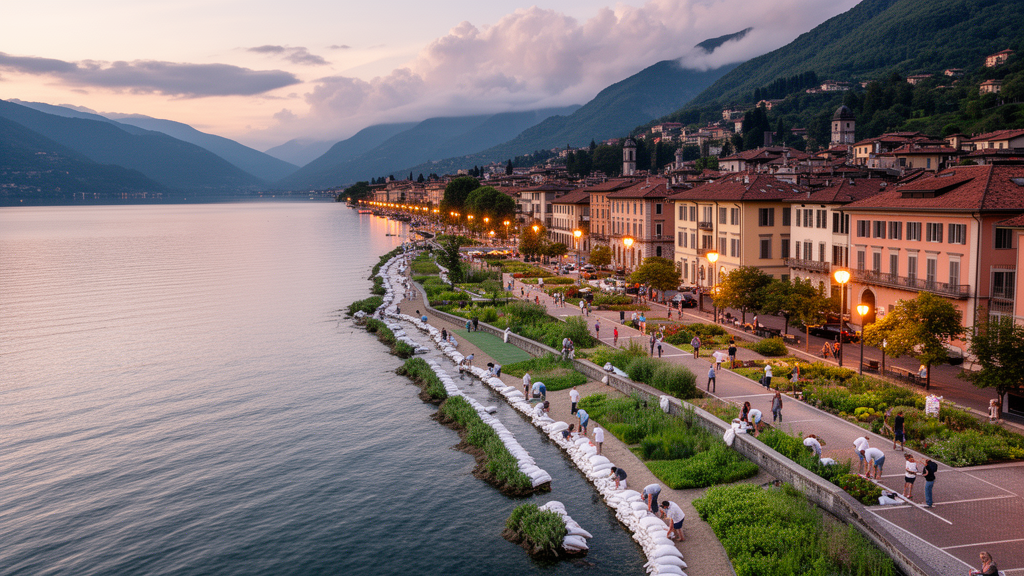
The approach, called Swarm Flood Proofing, was developed within the GESTI.S.CO. project, co-funded under the Italy-Switzerland Interreg EU Cooperation Programme, and is described in a study published in the journal City, Territory and Architecture.
The study, led by Daniele Fabrizio Bignami, with Emanuele Carenzo, Martina Conti and Laura Raspanti, conceptualizes an innovative method that combines temporary and permanent small-scale flood proofing techniques for the defence of built environments as a whole. According to the authors, such techniques are usually applied only in small or isolated portions of built-up areas, or in an impromptu manner. The swarm concept is intended to overcome that fragmentation by coordinating microscale temporary measures and micro-works across an entire city.
Como was chosen as the case study because it faces a particularly complicated flood threat. Waters can arrive simultaneously from its lake and from the surrounding hills. The city has been attempting to build a large infrastructure to defend itself from floods for more than thirty-eight years, a delay that illustrates how difficult major defence projects can be to realize in dense urban settings.
According to the abstract, the Swarm Flood Proofing approach conceived and developed for Como proved to be potentially able to counteract both upstream waters and downstream lake waters, in this way protecting the citizens and goods of the city through the widespread cooperative use of microscale measures. The authors emphasize that this is a design simulation: the result is a strategic option to be compared with flood control alternatives, not a completed or tested defence system.
The alternatives the authors list include non-structural measures, major structural measures and green infrastructures. They position the swarm approach as an additional strategic tool designed to reduce the impact of flood disasters in urban areas, one that would enhance sustainable urban planning practices and civil protection plans, and cooperate with the implementation of stronger and smarter climate change adaptation actions.
Why introduce a new option at all? The authors point to contexts where implementing defence choices based on large-scale infrastructure, whether green or grey, or on non-structural measures alone, becomes complicated. The obstacles they identify are not only financial. Dense urban spaces where people settle and interrelate also raise landscape safeguard needs, cultural heritage values, high densities of buildings, infrastructures and people, and land use and environmental components that must be protected.
Based on the analysis of the Como case, the authors conclude that, under verified conditions and assuming detailed hazard and risk analyses, the Swarm Flood Proofing approach could also be helpful in defending other fragile urban contexts and local communities. They describe it as especially effective where large-scale or non-structural choices alone become difficult to implement. The stated conditions matter: the approach is presented as conditional on verified circumstances and on thorough hazard and risk analysis, not as a universally applicable solution.
The study also frames the concept in terms of governance and planning. Swarm Flood Proofing, the authors write, combines and exemplifies knowledge coming from multiple domains, and allows a proper interpretation of an original way for planners and decision makers to favour the growth of disaster resilience-oriented local communities. In other words, the distributed character of the measures is paired with a distributed, cooperative model of community involvement in flood defence.
The article is published as open access and is currently shared as an accepted manuscript, a version that is citable and carries a permanent DOI but remains subject to further edits before the final Version of Record appears. Readers evaluating the findings should therefore treat the reported simulation results as preliminary in presentation, while the underlying conceptual contribution, a framework for coordinating many small flood-proofing measures at the scale of a whole city, is the study’s central claim.
For cities facing rising flood exposure under climate change, the Como simulation offers a concrete illustration of an alternative path: defending a city not with one monumental barrier but with a distributed network of small, cooperative interventions. Whether that potential can be realized elsewhere, the authors note, depends on verified conditions and detailed hazard and risk analyses being carried out for each specific urban context.
Subject of Research: A conceptual flood-defence strategy using distributed small-scale measures, simulated for the city of Como, Italy.
Article Title: Disaster-resilient communities against floods: the “swarm” concept as a frame for effective small-size cooperative and distributed measures working at the urban scale: a design simulation for Como
Article References: Bignami, D. F., Carenzo, E., Conti, M., & Raspanti, L. (2026). Disaster-resilient communities against floods: the “swarm” concept as a frame for effective small-size cooperative and distributed measures working at the urban scale: a design simulation for Como. City, Territory and Architecture. https://doi.org/10.1186/s40410-026-00326-7
Image Credits: AI Generated
DOI: 10.1186/s40410-026-00326-7
Keywords: flood risk, urban resilience, Swarm Flood Proofing, Como, climate change adaptation, flood proofing, civil protection, urban planning, Interreg, disaster resilience, Disaster-resilient, communities
News Source: Denise Maddox. (October 28, 2026). Research report: Disaster-resilient communities against floods: the “swarm” concept as a frame for effective small-size cooperative and distributed measures working at the urban scale: a design simulation for Como. Scienmag.