• HOME
  • NEWS
  • EXPLORE
    • CAREER
      • Companies
      • Jobs
    • EVENTS
    • iGEM
      • News
      • Team
    • PHOTOS
    • VIDEO
    • WIKI
  • BLOG
  • COMMUNITY
    • FACEBOOK
    • INSTAGRAM
    • TWITTER
Sunday, May 10, 2026
BIOENGINEER.ORG
No Result
View All Result
  • Login
  • HOME
  • NEWS
  • EXPLORE
    • CAREER
      • Companies
      • Jobs
        • Lecturer
        • PhD Studentship
        • Postdoc
        • Research Assistant
    • EVENTS
    • iGEM
      • News
      • Team
    • PHOTOS
    • VIDEO
    • WIKI
  • BLOG
  • COMMUNITY
    • FACEBOOK
    • INSTAGRAM
    • TWITTER
  • HOME
  • NEWS
  • EXPLORE
    • CAREER
      • Companies
      • Jobs
        • Lecturer
        • PhD Studentship
        • Postdoc
        • Research Assistant
    • EVENTS
    • iGEM
      • News
      • Team
    • PHOTOS
    • VIDEO
    • WIKI
  • BLOG
  • COMMUNITY
    • FACEBOOK
    • INSTAGRAM
    • TWITTER
No Result
View All Result
Bioengineer.org
No Result
View All Result
Home NEWS Science News Chemistry

Vitamin B6 deficiency enhances the noradrenergic system, leading to behavioral deficits

Bioengineer by Bioengineer
May 25, 2021
in Chemistry
Reading Time: 2 mins read
0
IMAGE
Share on FacebookShare on TwitterShare on LinkedinShare on RedditShare on Telegram

IMAGE

Credit: TMIMS

Schizophrenia is a heterogeneous psychiatric disorder characterized by positive symptoms such as hallucinations and delusions, negative symptoms such as apathy and lack of emotion, and cognitive impairment. We have reported that VB6 (pyridoxal) levels in peripheral blood of a subpopulation of patients with schizophrenia is significantly lower than that of healthy controls. More than 35% of patients with schizophrenia have low levels of VB6 (clinically defined as male:

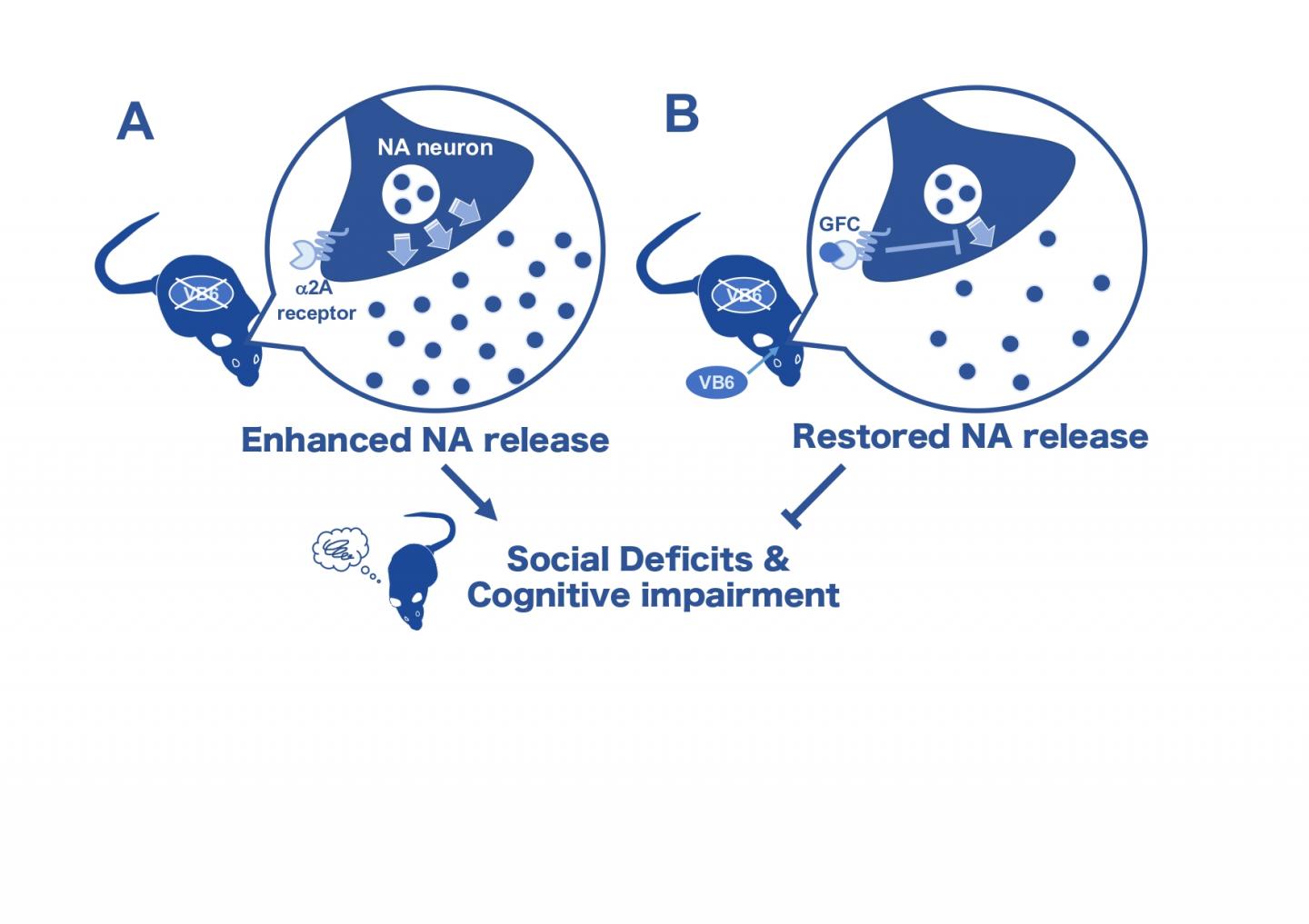
VB6 is not synthesized de novo in humans, but is primarily obtained from foods. In the present study, to clarify the relationship between VB6 deficiency and schizophrenia, we generated VB6-deficient (VB6(-)) mice through feeding with a VB6-lacking diet as a mouse model for the subpopulation of schizophrenia patients with VB6 deficiency. After feeding for 4 weeks, plasma VB6 level in VB6(-) mice decreased to 3% of that in control mice. The VB6(-) mice showed social deficits and cognitive impairment. Furthermore, the VB6(-) mice showed a marked increase in 3-methoxy-4-hydroxyphenylglycol (MHPG) in the brain, suggesting enhanced NA metabolism in VB6(-) mice. We confirmed the increased NA release in the prefrontal cortex and the striatum of VB6(-) mice through in vivo microdialysis. These findings suggest that the activities of NAergic neuronal systems are enhanced in VB6(-) mice.

Furthermore, VB6 supplementation directly into the brain using an osmotic pump ameliorated the hyperactivation of the NAergic system and behavioral abnormalities. indicating that the enhanced NA turnover and the behavioral deficits shown in the VB6(-) mice are attributed to VB6 deficiency in the central nervous system. In addition, the ?2A adrenergic receptor agonist guanfacine also improved the hyperactivated NAergic system in the frontal cortex and behavioral disorders. These results show that the behavioral deficits in VB6(-) mice may be caused by an enhancement of NAergic signaling.

Schizophrenic patients with VB6 deficiency, who account for more than 35% of all patients, present with relatively severe clinical symptoms and treatment resistance. Our findings suggest that a new therapeutic strategy targeting the NAergic system might be effective for these patients. They will also provide evidence based on pathophysiology for a new therapeutic strategy called “VB6 treatment for schizophrenia,” which we are currently conducting clinical research on.

###

Media Contact
Kazuya Toriumi
[email protected]

Original Source

https://www.nature.com/articles/s41398-021-01381-z#Abs1

Related Journal Article

http://dx.doi.org/10.1038/s41398-021-01381-z

Tags: BiochemistryHematologyMedicine/HealthMental HealthneurobiologyNeurochemistryPhysiology
Share12Tweet8Share2ShareShareShare2

Related Posts

Miniature Sensor Uses Light to Detect Touch — Chemistry

Miniature Sensor Uses Light to Detect Touch

May 8, 2026
Iron Minerals Determine Whether Dissolved Organic Matter Fuels Microbes or Becomes Long-Term Carbon Storage — Chemistry

Iron Minerals Determine Whether Dissolved Organic Matter Fuels Microbes or Becomes Long-Term Carbon Storage

May 8, 2026

Kate Evans Appointed Associate Lab Director for Biological and Environmental Systems Science at ORNL

May 8, 2026

Advancing Multiscale Modeling and Overcoming Operational Challenges in Autothermal COâ‚‚-to-Methanol Reactors

May 8, 2026
Please login to join discussion

POPULAR NEWS

  • Research Indicates Potential Connection Between Prenatal Medication Exposure and Elevated Autism Risk

    840 shares
    Share 336 Tweet 210
  • New Study Reveals Plants Can Detect the Sound of Rain

    727 shares
    Share 290 Tweet 181
  • Scientists Investigate Possible Connection Between COVID-19 and Increased Lung Cancer Risk

    68 shares
    Share 27 Tweet 17
  • Salmonella Haem Blocks Macrophages, Boosts Infection

    61 shares
    Share 24 Tweet 15

About

We bring you the latest biotechnology news from best research centers and universities around the world. Check our website.

Follow us

Recent News

Evaluating Digoxin Use in Patients with Symptomatic Rheumatic Heart Disease

Evaluating the Effectiveness and Safety of Digitalis Glycosides in Treating Heart Failure

Urdu Fall Risk Questionnaire Adapted for Elderly

Subscribe to Blog via Email

Success! An email was just sent to confirm your subscription. Please find the email now and click 'Confirm' to start subscribing.

Join 82 other subscribers
  • Contact Us

Bioengineer.org © Copyright 2023 All Rights Reserved.

Welcome Back!

Login to your account below

Forgotten Password?

Retrieve your password

Please enter your username or email address to reset your password.

Log In
No Result
View All Result
  • Homepages
    • Home Page 1
    • Home Page 2
  • News
  • National
  • Business
  • Health
  • Lifestyle
  • Science

Bioengineer.org © Copyright 2023 All Rights Reserved.