• HOME
  • NEWS
  • EXPLORE
    • CAREER
      • Companies
      • Jobs
    • EVENTS
    • iGEM
      • News
      • Team
    • PHOTOS
    • VIDEO
    • WIKI
  • BLOG
  • COMMUNITY
    • FACEBOOK
    • INSTAGRAM
    • TWITTER
Friday, June 26, 2026
BIOENGINEER.ORG
No Result
View All Result
  • Login
  • HOME
  • NEWS
  • EXPLORE
    • CAREER
      • Companies
      • Jobs
        • Lecturer
        • PhD Studentship
        • Postdoc
        • Research Assistant
    • EVENTS
    • iGEM
      • News
      • Team
    • PHOTOS
    • VIDEO
    • WIKI
  • BLOG
  • COMMUNITY
    • FACEBOOK
    • INSTAGRAM
    • TWITTER
  • HOME
  • NEWS
  • EXPLORE
    • CAREER
      • Companies
      • Jobs
        • Lecturer
        • PhD Studentship
        • Postdoc
        • Research Assistant
    • EVENTS
    • iGEM
      • News
      • Team
    • PHOTOS
    • VIDEO
    • WIKI
  • BLOG
  • COMMUNITY
    • FACEBOOK
    • INSTAGRAM
    • TWITTER
No Result
View All Result
Bioengineer.org
No Result
View All Result
Home NEWS Science News Chemistry

Visionary bone damage study

Bioengineer by Bioengineer
April 7, 2021
in Chemistry
Reading Time: 2 mins read
0
IMAGE
Share on FacebookShare on TwitterShare on LinkedinShare on RedditShare on Telegram

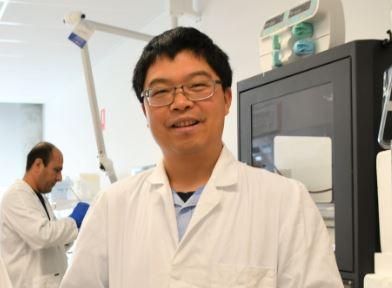
X-rays confirm promise of new luminescent markers
IMAGE

Credit: Flinders University

A novel way to pinpoint and illuminate bone damage promises to make X-rays more efficient at diagnosing bone and other injuries, Flinders University researchers say.

The new technique, looking at potential biomedical applications of an ancient inorganic salt-based aggregation induced emission (AIE) radio-luminescence material, could open new frontiers in medicine including X-ray dosimetry, bioimaging and advanced applications such as optogenetics, says Professor Youhong Tang, from Flinders University’s College of Science and Engineering.

The review article, published by Professor Tang, postdoctoral student Dr Javad Tavokoli, colleagues in Hong Kong and Australian technology company Micro-X and, examined the potential of the AIEgen luminogens (AIEgens) in deep tissue imaging. The study used X-ray testing provided by Adelaide-based Micro-X.

“We were able to use Micro-X advanced X-ray machines at the Tonsley Innovation District to show the benefits of this AIEgen system which can be excited by X-ray (as the radioluminescence emitter) and UV light (as the photoluminescence emitter) compared to current AIEgens which mostly only act as the photoluminescence emitter,” he says.

“The study highlighted the disadvantages of autofluorescence, poor signal-to-noise radio, and poor tissue penetration depth of traditional photoluminescence emitters which could be elegantly solved by these radioluminescence luminogens,” says Professor of Mechanical and Materials Engineering, Dr Tang.

“Not only do they pinpoint bone and soft tissue damage for better diagnosis and treatment but we suggest further studies could see these AIE-based materials with multifunctionalities used for improved drug delivery, biosensors, bioimaging, and tissue engineering.”

Lead author on the journal article in Aggregate, Dr Tavokoli, how based at the Centre for Health Technologies at University of Technology Sydney, says the next generation of fluorescent gels could also capitalise on additional light-emitting properties making them attractive for different applications.

The latest work not only explores a series of inorganic AIE systems but also “fundamentally helps to understand both the unconventional organic and inorganic clusteroluminescence phenomena, Professor Tang concludes.

###

The paper, Revisiting an ancient inorganic aggregation?induced emission system: An enlightenment to clusteroluminescence (2021) by Zheng Zhao, Zaiyu Wang, Javad Tavakoli, Guogang Shan, Jianyu Zhang, Chen Peng, Yu Xiong, Xuepeng Zhang, Tsz Shing Cheung, Youhong Tang, Bolong Huang and Zhaoxun Yu published in Aggregate DOI: 10.1002/agt2.36

Media Contact
Professor Youhong Tang
[email protected]

Related Journal Article

http://dx.doi.org/10.1002/agt2.36

Tags: Atomic/Molecular/Particle PhysicsChemistry/Physics/Materials SciencesMaterialsMedicine/HealthMolecular PhysicsNanotechnology/MicromachinesTechnology/Engineering/Computer Science
Share13Tweet8Share2ShareShareShare2

Related Posts

AI and Physics Collaborate to Design Advanced Hydrogen Storage Materials

June 25, 2026

International Team Including Dresden Scientists Develops Novel Designer Proteins for Advanced Study of Living Tissue

June 25, 2026

New Study Uncovers Key Factors Driving Water Chemistry in Nanoscale Environments

June 25, 2026

Plasma Technology Extends Catalyst Lifespan in Hydrogen Production

June 24, 2026
Please login to join discussion

POPULAR NEWS

  • Saying Goodbye to PGY-6: Pediatric Fellowship Realities

    103 shares
    Share 41 Tweet 26
  • Multi-Hospital Study Reveals Long Covid Burden Is Twice as High as Current Estimates

    92 shares
    Share 36 Tweet 23
  • Detection of EDCs in Breast Milk and Infant Urine Up to Six Months Highlights Early Exposure Risks

    77 shares
    Share 31 Tweet 19
  • New Drug Candidate Developed at McMaster Shows Potential for Treating Brain Cancer

    58 shares
    Share 23 Tweet 15

About

We bring you the latest biotechnology news from best research centers and universities around the world. Check our website.

Follow us

Recent News

Tracking Lanthanide-Labeled Microplastics in Plants

POSTECH Researchers Slash Cost of Reconstituted Cell-Free Systems by 95%

AI and Physics Collaborate to Design Advanced Hydrogen Storage Materials

Subscribe to Blog via Email

Success! An email was just sent to confirm your subscription. Please find the email now and click 'Confirm' to start subscribing.

Join 82 other subscribers
  • Contact Us

Bioengineer.org © Copyright 2023 All Rights Reserved.

Welcome Back!

Login to your account below

Forgotten Password?

Retrieve your password

Please enter your username or email address to reset your password.

Log In
No Result
View All Result
  • Homepages
    • Home Page 1
    • Home Page 2
  • News
  • National
  • Business
  • Health
  • Lifestyle
  • Science

Bioengineer.org © Copyright 2023 All Rights Reserved.