• HOME
  • NEWS
  • EXPLORE
    • CAREER
      • Companies
      • Jobs
    • EVENTS
    • iGEM
      • News
      • Team
    • PHOTOS
    • VIDEO
    • WIKI
  • BLOG
  • COMMUNITY
    • FACEBOOK
    • INSTAGRAM
    • TWITTER
Tuesday, October 20, 2026
BIOENGINEER.ORG
No Result
View All Result
  • Login
  • HOME
  • NEWS
  • EXPLORE
    • CAREER
      • Companies
      • Jobs
        • Lecturer
        • PhD Studentship
        • Postdoc
        • Research Assistant
    • EVENTS
    • iGEM
      • News
      • Team
    • PHOTOS
    • VIDEO
    • WIKI
  • BLOG
  • COMMUNITY
    • FACEBOOK
    • INSTAGRAM
    • TWITTER
No Result
View All Result
Bioengineer.org
No Result
View All Result
Home NEWS Science News Technology

Vision model estimates guidewire contact forces in vessel-phantom images

by
October 20, 2026
in Technology
Reading Time: 2 mins read
0
Vision model estimates guidewire contact forces in vessel-phantom images

Vision model estimates guidewire contact forces in vessel-phantom images

Share on FacebookShare on TwitterShare on LinkedinShare on RedditShare on Telegram

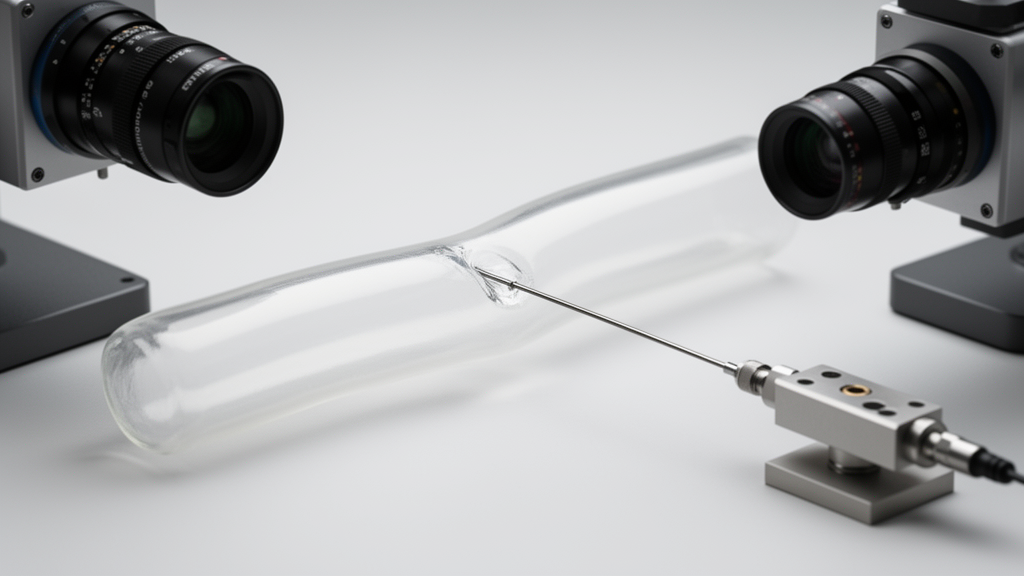
A vision-based computational method estimated guidewire contact forces from conventional planar images without adding sensing hardware. Tested on 343 samples acquired on a three-dimensional printed vessel phantom, the model achieved a mean absolute error (MAE) of 0.861 g and a root mean square error (RMSE) of 1.036 g. An ablation experiment found that adding the region-mask component reduced MAE by 79% relative to the identical architecture without it.

The study addresses contact force between a guidewire and a vessel wall during percutaneous coronary intervention, where force is a key mechanical factor in vessel injury but cannot be measured directly with conventional imaging. Sensor-based methods can measure contact force directly, but they also increase instrumentation complexity and cost. The proposed alternative instead learns an end-to-end mapping from planar images to force values associated with four predefined contact regions, using visual information alone.

Technically, the approach combines multi-scale feature extraction with region-mask mean pooling. The former is incorporated into the model alongside the region-mask operation, while mean pooling summarizes features according to the four designated regions. The system then maps the resulting visual representation to the contact force in each region.

The authors report that the method requires neither additional sensing hardware nor complex physical modeling, distinguishing it from a sensor-based measurement approach. Evaluation was confined to 343 samples acquired on a three-dimensional printed vessel phantom, so the reported performance does not establish accuracy in patients or during live percutaneous coronary intervention. In the ablation comparison, researchers tested the identical architecture without the region mask.

Inclusion of the mask was associated with a 79% reduction in MAE, indicating a substantial contribution from that component within the experimental dataset. The findings support the technical feasibility of vision-based, sensorless contact-force estimation under the tested conditions and suggest a possible route toward force feedback in interventional procedures, but that broader application was not demonstrated.

Subject of Research: Vision-based estimation of regional guidewire contact forces from planar images

Article Title: Visual estimation of guidewire contact forces by integrating multi-scale features and region mask

Article References: Guo, J., Yang, D., Xiao, N., Li, J., Zheng, Q., & Wei, W. (2026). Visual estimation of guidewire contact forces by integrating multi-scale features and region mask. Medical & Biological Engineering & Computing. https://doi.org/10.1007/s11517-026-03690-1

Image Credits: AI Generated

DOI: 10.1007/s11517-026-03690-1

Keywords: guidewire contact force, computer vision, medical imaging, percutaneous coronary intervention, region masking, sensorless estimation, image analysis, vessel phantom, multi-scale features, force feedback, Visual, estimation

News Source: Blake Davidson. (October 20, 2026). Vision model estimates guidewire contact forces in vessel-phantom images. Scienmag.
Tags: Computer Visionestimationforce feedbackguidewire contact forceimage analysisMedical Imagingmulti-scale featuresPercutaneous Coronary Interventionregion maskingsensorless estimationvessel phantomvisual
Share12Tweet7Share2ShareShareShare1

Related Posts

Dual dynamic bonds yield strong, self-healing bio-based epoxy vitrimers

Dual dynamic bonds yield strong, self-healing bio-based epoxy vitrimers

October 20, 2026
Onchidium reevesii confirmed in Korean tidal flats

Onchidium reevesii confirmed in Korean tidal flats

October 20, 2026

Nitrogen-Containing High-Entropy Alloy Reveals Temperature-Shaped Microstructural Recovery

October 20, 2026

Robot Assistance May Aid Upper-Limb Recovery, but Evidence Remains Fragile

October 20, 2026

POPULAR NEWS

  • Dual dynamic bonds yield strong, self-healing bio-based epoxy vitrimers

    Dual dynamic bonds yield strong, self-healing bio-based epoxy vitrimers

    29 shares
    Share 12 Tweet 7
  • Infant brain connectivity differs with familial ADHD risk

    29 shares
    Share 12 Tweet 7
  • Meta-analysis finds 75% five-year survival after selected living-donor liver transplants

    29 shares
    Share 12 Tweet 7
  • Vision model estimates guidewire contact forces in vessel-phantom images

    29 shares
    Share 12 Tweet 7

About

We bring you the latest biotechnology news from best research centers and universities around the world. Check our website.

Follow us

Recent News

Dual dynamic bonds yield strong, self-healing bio-based epoxy vitrimers

Infant brain connectivity differs with familial ADHD risk

Meta-analysis finds 75% five-year survival after selected living-donor liver transplants

Subscribe to Blog via Email

Enter your email address to subscribe to this blog and receive notifications of new posts by email.

Join 85 other subscribers
  • Contact Us

Bioengineer.org © Copyright 2023 All Rights Reserved.

Welcome Back!

Login to your account below

Forgotten Password?

Retrieve your password

Please enter your username or email address to reset your password.

Log In
No Result
View All Result
  • Homepages
    • Home Page 1
    • Home Page 2
  • News
  • National
  • Business
  • Health
  • Lifestyle
  • Science

Bioengineer.org © Copyright 2023 All Rights Reserved.