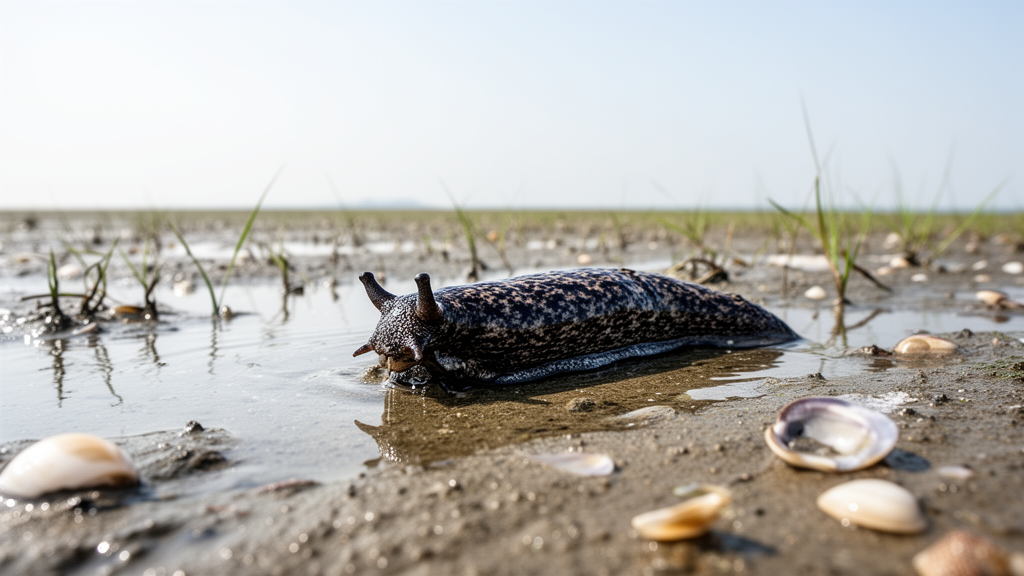
The first confirmed record of the air-breathing sea slug Onchidium reevesii in Korea has been documented in tidal flats at Jindo, Muan and Suncheon on the country’s southern and western coasts. Researchers examined nine specimens collected from saltmarsh vegetation, combining external morphology and scanning electron microscopy with mitochondrial COI and 16S rRNA gene analyses. The species had previously been recorded only from coastal China, including the vicinity of its type locality. The new findings therefore extend its documented geographic distribution across the Yellow Sea to the Korean Peninsula.
The specimens were collected during periods of maximum low tide in the upper intertidal and supralittoral zones. Two individuals were collected from Jindo on 11 July 2024, four from Suncheon on 23 August 2024 and three from Muan on 13 August 2025. They occurred within dense patches of saltmarsh vegetation on moist, muddy substrates that remained saturated when exposed by the retreating tide. No individuals were found in the middle or lower intertidal zones during the collections. The observations indicate that the species can occur in vegetation-covered upper-intertidal habitats, but they do not establish its abundance or distribution throughout the tidal flat.
Members of Onchidiidae are shell-less, air-breathing gastropods that inhabit intertidal environments. The family has particularly high species richness in coastal ecosystems of Southeast Asia, while records from Korea have been extremely limited. Species boundaries and nomenclatural assignments within the family have historically been difficult to resolve using morphology alone. Recent studies have consequently used integrative approaches that combine morphological observations with molecular data, allowing species delimitation to be assessed through more than one type of evidence.
Nine specimens were examined in the present study. One was a juvenile measuring 17 millimetres in body length; the other eight measured 43–74 millimetres in body length and 27–40 millimetres in width. The dorsal notum was grey to yellowish-grey and carried numerous fine papillae distributed across the surface. A distinctly enlarged central papilla, or peduncle, was present in the middle of the notum. The ventral foot was light yellow to beige, and the mantle was light grey with scattered black spots in some individuals, while some specimens lacked those spots. These features corresponded with descriptions of O. reevesii previously reported from China.
Radular morphology provided an additional morphological check on the identification. Researchers dissected the buccal mass from specimen MA2, collected at Muan, and isolated the radula after the surrounding tissues had been dissolved in sodium hydroxide. The structure was cleaned, mounted and coated with gold for scanning electron microscopy. The rachidian, innermost lateral and lateral teeth were consistent with published descriptions of O. reevesii from China. The study therefore based its identification on the combined external and radular characters of the Korean specimens rather than on coloration or body size alone.
Partial mitochondrial COI and 16S rRNA sequences were successfully obtained from specimens collected at Jindo, Suncheon and Muan. BLAST searches found that the Korean COI sequences were 99.64–99.83% similar to published O. reevesii reference sequences, using the five closest matches retrieved with specimen SC1. The Korean 16S sequences were 99.33–99.55% similar to the five closest matches. The sequences did not match other onchidiid genera such as Paromoionchis. All newly generated sequences were deposited in GenBank, providing public sequence records for the Korean material.
Maximum-likelihood phylogenetic analyses provided an additional test of the species assignment. The COI dataset included eight newly generated Korean sequences, five GenBank sequences identified as O. reevesii, six sequences representing the congeners O. stuxbergi and O. typhae, and Paromoionchis tumidus as the outgroup. The 14-sequence 16S dataset included nine newly generated sequences and five additional O. reevesii sequences from GenBank, with the same congeners and outgroup. In both trees, the Korean specimens clustered with Chinese O. reevesii sequences. No or only minimal sequence divergence was detected among the three Korean localities or between the Korean and Chinese samples in the COI dataset, and the 16S tree showed a nearly identical topology.
The new record also brings renewed attention to an earlier Korean report of an onchidiid slug. That record, from Muan, was identified as Onchidium hongkongensis on the basis of photographic evidence alone. The name is not recognized as valid in the World Register of Marine Species, and subsequent taxonomic revisions treated Onchidium hongkongense as a junior synonym of Paromoionchis tumidus. The earlier specimen’s identity therefore remains uncertain. Because it came from Muan, where the present study confirmed O. reevesii, the researchers said the possibility that the earlier record represented O. reevesii could not be ruled out. They also stated that the possible presence of P. tumidus in Korea merits further collection and examination.
The confirmed Korean occurrence adds a documented species to the biodiversity of the country’s tidal flats and provides a new biogeographic record for a genus whose Korean distribution has been poorly documented. The specimens were observed only in July and August, and the study did not include year-round sampling, so the seasonal pattern cannot be established from these observations alone. The limited sample also consists of nine animals from three localities, with the phylogenetic analyses based on partial mitochondrial sequences. Broader sampling across Korean and neighboring East Asian saltmarsh habitats, additional genetic markers and detailed anatomical work will be needed to clarify the species’ distribution, population variation and connectivity between Korean and Chinese populations, as well as the diversity of onchidiid slugs in the region.
Subject of Research: Integrative taxonomic confirmation of Onchidium reevesii in Korean tidal flats
Article Title: First record of Onchidium reevesii from Korean tidal flats ( Mollusca , Gastropoda , Onchidiidae )
Article References: Kim, B., Yang, I., Lee, S.-K., Kim, H., Khim, J. S., Ryu, J., & Park, J. (2026). First record of Onchidium reevesii from Korean tidal flats (Mollusca, Gastropoda, Onchidiidae). Biodiversity Data Journal, 14, Article e189286. https://doi.org/10.3897/bdj.14.e189286
Image Credits: AI Generated
Keywords: Onchidium reevesii, Onchidiidae, air-breathing sea slugs, Korean tidal flats, saltmarsh biodiversity, integrative taxonomy, mitochondrial COI, 16S rRNA, maximum-likelihood phylogeny, Yellow Sea, First, record
News Source: Gavin Prescott. (October 20, 2026). Onchidium reevesii confirmed in Korean tidal flats. Scienmag.