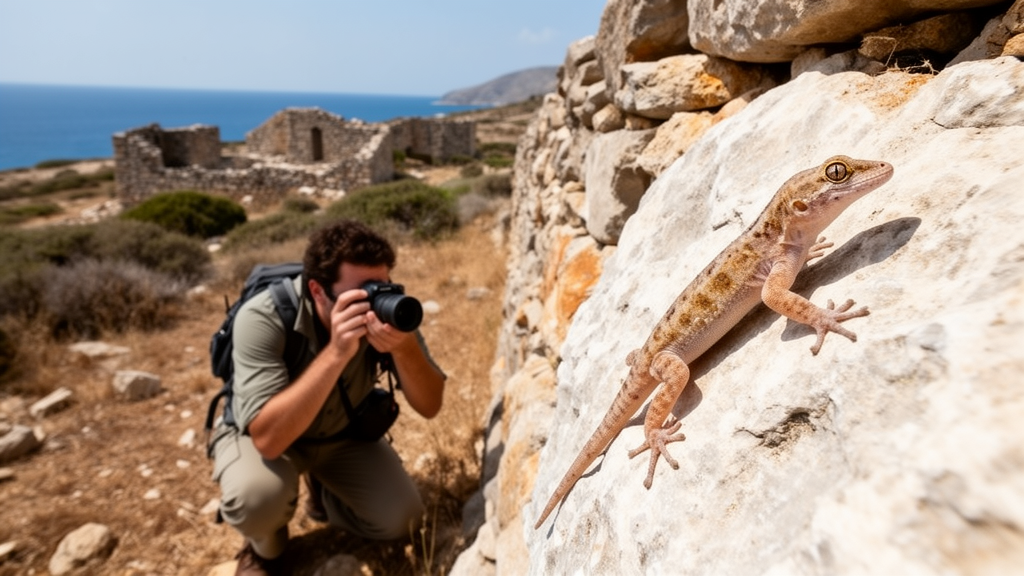
A three-day herpetological survey documented the first recorded occurrence of the Mediterranean or Turkish house gecko, Hemidactylus turcicus , on Piperi Island in Greece’s Northern Sporades. During fieldwork on 9 July 2023, researchers found one adult gecko at about 22:15 beside the island’s abandoned church, followed by two more among limestone rubble within 50 metres of the first specimen. Additional animals appeared within 20 minutes, leading the study authors to describe the immediate area as supporting a dense population.
Piperi is a small, isolated and uninhabited island northeast of Alonissos, with a surface area of 4.3 square kilometres. It forms part of Zone A of the National Marine Park of Alonissos and the Northern Sporades, the park’s core zone for protecting the Mediterranean monk seal, Monachus monachus . Public access is generally prohibited unless a special research permit is obtained.
The first gecko was found at an elevation of 290 metres above sea level, on limestone rubble associated with a collapsed stone wall next to an abandoned but regularly maintained church. Two additional individuals were detected between stones within a 50-metre radius, and more were found during the following 20 minutes. Hemidactylus turcicus is a nocturnal, insectivorous gecko in the family Gekkonidae.
It commonly occupies habitats containing rocks and boulders and can also occur on house walls. Genetic uniformity among most Mediterranean populations, compared with greater diversity in the Levant, has been interpreted as indicating recent, rapid and probably human-mediated dispersal across the Mediterranean basin. The species has also been transported beyond its native range, with records in Florida dating from 1915 and subsequent spread through North, Central and South America.
The new record fills a documented gap in a distribution that already includes the Greek mainland and most Aegean and Ionian islands. The species has been reported as scarce or absent at higher elevations in Greece, possibly because of an intolerance of low temperatures, although the new observation at 290 metres does not establish how elevation affects the Piperi population. Earlier records for Piperi included the endemic saurian subspecies Podarcis gaigeae weigandii but did not report other lizard species.
A 1968 checklist omitted H. turcicus despite a visit to the island, while dedicated surveys, literature reviews and later compilations likewise failed to list the gecko. The authors hypothesize that its nocturnal habits may have contributed to this absence from earlier observations, particularly where fieldwork occurred during the day; the current study did not directly compare detection rates across survey times. To document the animals, the researchers took voucher photographs of each observed gecko and collected a tissue sample from the first individual.
That specimen was deposited at the Zoological Museum of Aristotle University of Thessaloniki as ZMAU30.10.74.1. No other gecko species were detected during the expedition. The finding expands the known distribution of H. turcicus within the Northern Sporades and revises the recorded reptile fauna of Piperi.
Further research is needed to establish the population’s demographic characteristics and phylogenetic affiliations.
Subject of Research: First documented occurrence of Hemidactylus turcicus on Piperi Island in Greece’s Northern Sporades.
Article Title: First record of Hemidactylus turcicus (Linnaeus, 1758) from Piperi Island, Northern Sporades, Greece
Article References: Daftsios, T., Iakovidis, D., Gogolos, N., & Sagonas, K. (2024). First record of Hemidactylus turcicus (Linnaeus, 1758) from Piperi Island, Northern Sporades, Greece. Herpetozoa, 37, 227-229. https://doi.org/10.3897/herpetozoa.37.e122349
Image Credits: AI Generated
DOI: 10.3897/herpetozoa.37.e122349
Keywords: Hemidactylus turcicus, Mediterranean house gecko, Piperi Island, Northern Sporades, Greece, herpetological survey, gecko distribution, island biodiversity, zoological records, nocturnal reptiles, First, record
News Source: Margaret Porter. (October 20, 2026). Field survey records first Mediterranean house gecko on Piperi Island. Scienmag.