Credit: Jess Brassard/Michigan Tech
Viruses are not easy to characterize. But we need to because being able to quickly predict the surface charge of viruses opens up new possibilities for vaccine purification and making gene therapy treatments for eye diseases and muscular dystrophy.
Caryn Heldt, director of the Health Research Institute at Michigan Technological University, studies virus surface chemistry with funding through the National Science Foundation’s faculty early career development (CAREER) program. Her latest paper, published in Langmuir, focuses on using surface charge to determine a virus’ isoelectric point, a common way to characterize viruses.
The innovation is that instead of bulk characterization, she’s doing it using a single-particle method.
“So we have these bulk methods where we put a virus in solution and we characterize the solution,” said Heldt, who is also the James and Lorna Mack Chair in Bioengineering and an associate professor of chemical engineering. “But if your virus isn’t completely purified — which is also difficult to do — then your characterization of your bulk solution means you’re characterizing everything in that solution.”
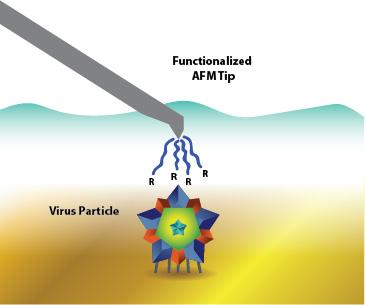
To improve the accuracy of this characterization, Heldt suggests a single-particle method that uses atomic force microscopy (AFM). The adhesion between the AFM probe and the sticky virus surfaces can be measured — it’s called chemical force microscopy (CFM).
“Viruses are these complicated molecules that have a lot of different chemistries on them,” Heldt said, adding that as a big, complex molecule a virus reaches its isoelectric point when all its negative and positive charges balance out. “At a particular pH, the virus has a neutral charge. So if we want the virus to have a positive charge, we put the pH below the isoelectric point and vice versa.”
That means Heldt’s team could make the AFM probe positive or negative, then scan a solution across different pHs to determine a virus’ isoelectric point. To verify that the method worked, the team used two viruses: non-enveloped porcine parovirus (PPV), which has a well-documented isoelectric point, and enveloped bovine viral diarrhea virus (BVDV), which does not have a known isoelectric point. The methods matched up.
“So now we can try and predict chromatography conditions with just a small amount of virus,” Heldt said, explaining that chromatography uses surface charge to determine whether a virus is present in a medical test or for vaccine purification. “Also, we have preliminary data that shows this could be helpful for manufacturing viruses that could be modified and used to target specific genes to help with diseases like muscular dystrophy and some retinal diseases.”
In both cases for chromatography and gene therapy, less is more. In a body or vaccine, it doesn’t take much virus to wreak havoc; single-particle methods could provide more answers with a smaller sample. For gene therapy, using a bunch of inactive virus capsids that a body’s immune system would fight is not ideal treatment; CFM could more easily discern inactive from active capsids, which could then be purified for a more effective treatment.
As a biomedical engineer, Heldt is keen to bridge the fundamental understanding of virus chemistry and its applications. By refining virus characterization, single-particle methods could streamline several medical processes including vaccine production and gene therapy manufacturing.
###
Media Contact
Allison Mills
[email protected]
Original Source
https:/
Related Journal Article
http://dx.