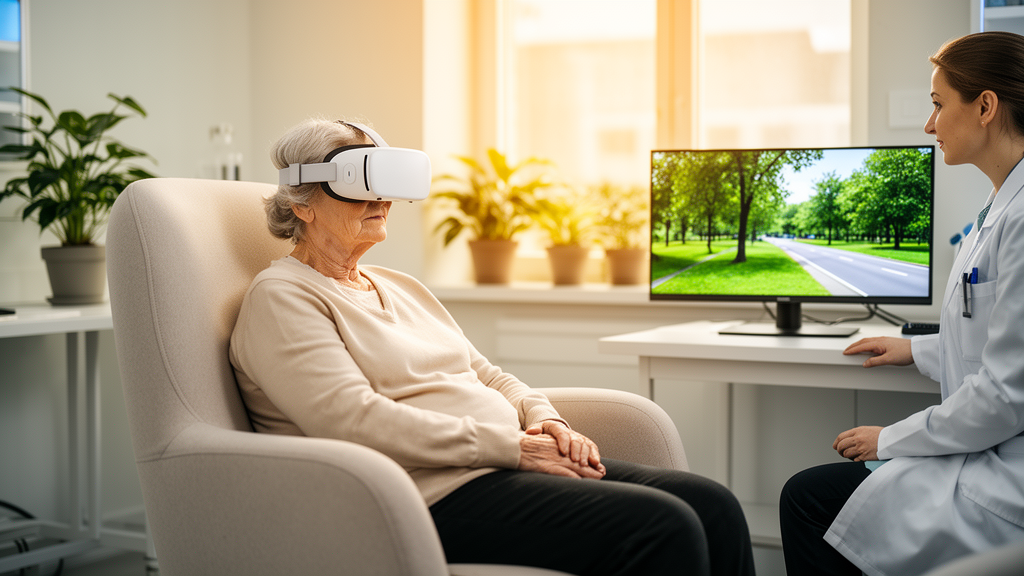
Step into a headset, walk down a virtual street, and your body quietly tells the truth about the city around you. That is the premise of a new experimental study published in BMC Public Health, in which researchers from Ghent University, Deakin University, and collaborating institutions used immersive virtual reality to isolate two of the most consequential features of any urban street: the amount of greenery and the density of traffic. Their findings, drawn from ninety older adults in Ghent, Belgium, offer some of the most controlled evidence to date that greener, quieter streets are measurably more relaxing to walk through, and they arrive at a moment when cities worldwide are wrestling with how to design environments that protect the mental health of ageing populations.
The stakes of the question are far from abstract. According to the study’s authors, mental health problems affect approximately fourteen percent of older adults worldwide, and stress is recognized as a key contributor to those problems. Urban environments are known to influence stress, yet the field has long suffered from a conspicuous gap: well-controlled experimental studies examining how specific street-level features affect stress in older adults have been lacking. Most existing evidence comes from observational research, where people who live near parks differ from those who do not in countless ways that confound the analysis. What has been needed is an experiment, and virtual reality has emerged as a surprisingly elegant way to run one.
The design of the study is a textbook example of factorial experimentation applied to environmental psychology. Each of the ninety participants, all aged sixty-five or older, walked six times through a virtual urban street in a two-by-three factorial, within-subject design, meaning every participant experienced all six combinations of greenery and traffic conditions. The order of the conditions was randomized, a critical safeguard against learning effects, fatigue, or simple habituation skewing the results. Because each person served as their own control, the researchers could attribute differences in self-reported relaxation to the manipulated features of the street rather than to stable differences between individuals. The analysis relied on a linear mixed model with a random intercept, appropriately accounting for the fact that the repeated measures were clustered within participants.
The results were strikingly clean. More greenery and less traffic were each independently related to an increase in self-reported feelings of relaxation. In other words, the two factors did not merely matter in combination; each exerted its own effect. A leafy street with heavy traffic was more relaxing than a barren street with the same traffic, and a quiet street with sparse vegetation beat a noisy, busy one with identical planting. This independence matters for urban planning, because it suggests that adding vegetation and reducing traffic are complementary levers, not substitutes for one another. A city cannot simply plant trees along a motorway and call the problem solved, nor can it quiet a street and leave it bare.
One of the study’s specific hypotheses, however, did not survive the quantitative analysis intact. The researchers investigated whether greenery might buffer the adverse effects of traffic density, a form of interaction that environmental psychologists have long hypothesized: the idea that vegetation might soften, or mask, the psychological toll of passing cars. In the statistical model, no such buffering effect was observed. Yet the story grew more nuanced when the team triangulated their quantitative data with qualitative interviews. During those interviews, some participants did describe greenery as buffering the effects of traffic, suggesting that the phenomenon may exist in lived experience even when it does not emerge as a statistically detectable interaction in self-reported relaxation scores. This divergence between numbers and narratives is itself instructive, highlighting why the study’s mixed-methods approach was valuable rather than merely decorative.
The choice of participants deserves attention. Older adults are often underrepresented in technology-based research, on the assumption that headsets and simulated environments will confuse or exclude them. This study explicitly explored whether virtual reality is a feasible and engaging method for use with older adults, and the experience of running ninety people aged sixty-five and above through repeated immersive walks suggests that it can be. That methodological finding may prove as consequential as the substantive one. If VR can reliably simulate street environments for older participants, researchers can test proposed urban designs before a single brick is laid, asking residents how a planned street actually feels rather than inferring it from surveys conducted in living rooms.
The technical advantages of the virtual approach are worth spelling out. In a real city, greenery and traffic are entangled: streets with more trees often carry less traffic, quieter neighborhoods tend to be wealthier, and weather, time of day, and countless other variables shift from one walk to the next. Virtual reality dissolves that entanglement. The researchers could hold every feature of the street constant except the two they wished to manipulate, presenting the same architecture, the same lighting, and the same walking route across all six conditions. Randomized presentation order then neutralized sequence effects. The result is a level of internal validity that field studies of real streets simply cannot achieve, and it comes without exposing vulnerable participants to actual traffic.
What does this mean for the people who design cities? The authors are direct: insights from the study could be used by urban planners and designers to enhance urban streets. For a rapidly ageing world, the implications compound. Older adults walk less in hostile environments, and reduced walking feeds back into physical and mental health decline. If a modest increase in street greenery produces a measurable rise in relaxation, and if reducing traffic does so independently, then the two interventions together offer a plausible, evidence-based recipe for streets that invite rather than deter older pedestrians. The finding that greenery helps even amid heavy traffic gives planners working on constrained corridors a reason to plant anyway, while the independent traffic effect argues that vegetation should complement, not replace, efforts to calm or divert motor traffic.
The study also sits within a broader scientific movement. It connects to environmental psychology, spatial demography, transport research, and quality-of-life research, and it exemplifies a shift from asking whether nature is good for us to specifying exactly which environmental features produce which psychological effects, in whom, and under what conditions. That specificity is what turns correlational findings into design guidance. A planner told that nature is beneficial has little to act on; a planner told that manipulated greenery on a controlled street independently increased relaxation among adults over sixty-five has something concrete. The mixed-methods design, combining a linear mixed model on repeated measures with qualitative interviews, models the kind of triangulation that future studies of built environments will likely need to adopt.
Caveats remain, as they always do. Self-reported relaxation is a subjective measure, and the qualitative-quantitative divergence on the buffering hypothesis is a reminder that statistical models and human experience do not always align. The virtual street, however realistic, is not a real street, with real sounds, real risks, and real social encounters. Yet the study’s strengths, its randomized within-subject factorial design, its appropriately modeled clustered data, its recruitment of an often-overlooked population, and its transparent triangulation of methods, make it a model of what experimental environmental research can look like. As headsets become cheaper and simulations more convincing, the laboratory street may become as standard a tool in public health as the treadmill is in cardiology. For the older adults of future cities, the message from this research is quietly encouraging: the greenest, calmest route is also the most relaxing one, and science can now prove it one virtual walk at a time.
Subject of Research: Effects of urban greenery and traffic density on relaxation in older adults, studied through virtual reality
Article Title: A virtual reality study to investigate the influence of greenery and traffic density on self-reported feelings of relaxation among older adults
Article References: Jacobs, N., Deforche, B., Van Dyck, D., Veitch, J., Teychenne, M., Perchoux, C., Hooyberg, A., & Van Cauwenberg, J. (2026). A virtual reality study to investigate the influence of greenery and traffic density on self-reported feelings of relaxation among older adults. BMC Public Health. https://doi.org/10.1186/s12889-026-29743-6
Image Credits: AI Generated
DOI: 10.1186/s12889-026-29743-6
Keywords: virtual reality, urban greenery, traffic density, older adults, relaxation, mental health, stress, environmental psychology, urban planning, BMC Public Health, mixed methods, public health
News Source: Glenn Wilkins. (October 10, 2026). Virtual Reality Reveals How Greenery and Traffic Shape Relaxation in Older Adults. Scienmag.