• HOME
  • NEWS
  • EXPLORE
    • CAREER
      • Companies
      • Jobs
    • EVENTS
    • iGEM
      • News
      • Team
    • PHOTOS
    • VIDEO
    • WIKI
  • BLOG
  • COMMUNITY
    • FACEBOOK
    • INSTAGRAM
    • TWITTER
Saturday, May 16, 2026
BIOENGINEER.ORG
No Result
View All Result
  • Login
  • HOME
  • NEWS
  • EXPLORE
    • CAREER
      • Companies
      • Jobs
        • Lecturer
        • PhD Studentship
        • Postdoc
        • Research Assistant
    • EVENTS
    • iGEM
      • News
      • Team
    • PHOTOS
    • VIDEO
    • WIKI
  • BLOG
  • COMMUNITY
    • FACEBOOK
    • INSTAGRAM
    • TWITTER
  • HOME
  • NEWS
  • EXPLORE
    • CAREER
      • Companies
      • Jobs
        • Lecturer
        • PhD Studentship
        • Postdoc
        • Research Assistant
    • EVENTS
    • iGEM
      • News
      • Team
    • PHOTOS
    • VIDEO
    • WIKI
  • BLOG
  • COMMUNITY
    • FACEBOOK
    • INSTAGRAM
    • TWITTER
No Result
View All Result
Bioengineer.org
No Result
View All Result
Home NEWS Science News Cancer

Vine compound starves cancer cells

Bioengineer by Bioengineer
November 19, 2018
in Cancer
Reading Time: 2 mins read
0
Share on FacebookShare on TwitterShare on LinkedinShare on RedditShare on Telegram
IMAGE

Credit: Pictures: Severin Muyisa / Suresh Awale

Professor Gerhard Bringmann, an expert in natural product chemistry, and his team from the Institute of Organic Chemistry at the Julius-Maximilians-Universität Würzburg (JMU) in Germany, together with Professor Suresh Awale and colleagues from the Institute of Natural Medicine of the University of Toyama in Japan have discovered a new, highly effective compound, which is a promising starting point to develop new drugs to treat pancreatic cancer.

A paper recently published in the Journal of Natural Products describes these exciting studies. The prestigious web portal "ACS News Service Weekly PressPac" of the American Chemical Society (ACS) now also presents the new findings to a broader public in a press release of 14 November 2018.

Cancer cells survive by activating the Akt/mTOR signalling pathway

Pancreatic cancer is one of the deadliest forms of cancer, with a five-year survival rate of less than five percent. Because these cancer cells proliferate so aggressively, they deplete nutrients and oxygen in the region of the tumor. Whereas most cells would die under such extreme conditions, pancreatic cancer cells survive by activating a cell signalling pathway called Akt/mTOR.

Some researchers are therefore looking for compounds with antiausterity properties that disrupt this pathway. Substances that are preferably toxic to cancer cells under nutrient deprived conditions are called antiausterity compounds deriving from the Greek word "austerotes".

Alkaloids from rainforest vines

Suresh Awale, Gerhard Bringmann, and their teams previously identified some unusual alkaloids (naturally occurring organic compounds that contain nitrogen) with antiausterity potential from vines found in the Congolese rainforest.

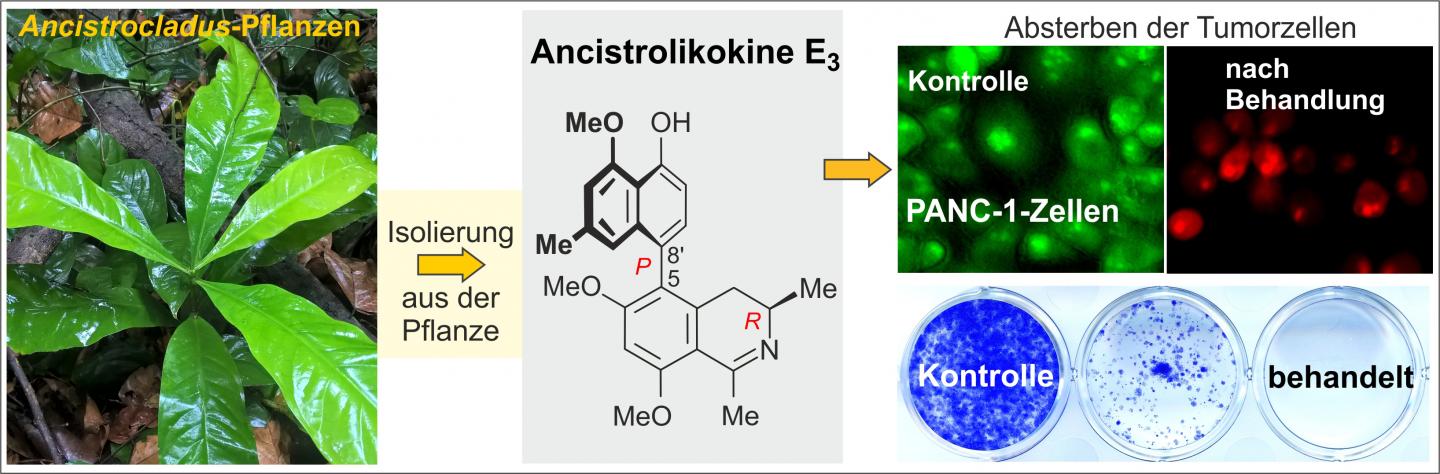
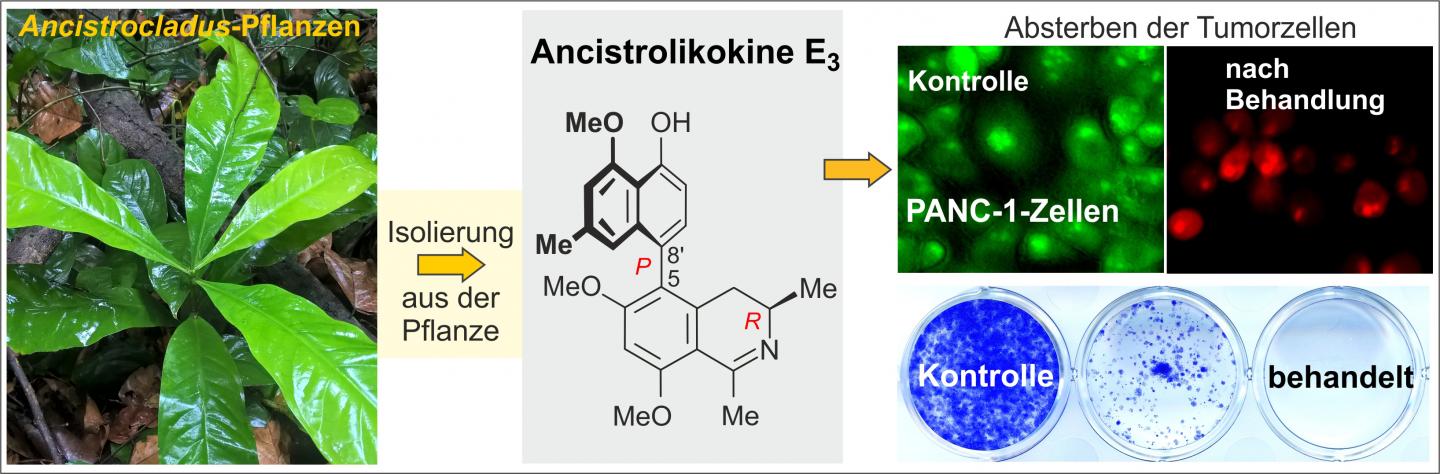
Now the researchers from Würzburg and Japan have isolated and characterized the structure of ancistrolikokine E3 from twigs of the vine Ancistrocladus likoko, thereby identifying another promising new agent, which effectively targets PANC-1 pancreatic cancer cells in the lab.

Dramatic changes to the cancer cells

Ancistrolikokine E3 causes dramatic changes to the morphology of the cancer cells (see upper right illustration), which ultimately kill them. Furthermore, the compound inhibited cancer cell migration and colonization (see lower left illustration) in lab tests, which suggests that the compound could help prevent metastasis formation in patients.

The researchers showed that the compound kills the cancer cells by inhibiting the Akt/mTOR pathway and the autophagy pathway. The studies thus support that ancistrolikokine E3 and other structurally related alkaloids could be promising compounds for anticancer drug development based on the antiausterity strategy.

###

Media Contact

Gerhard Bringmann
[email protected]
49-931-318-5323
@Uni_WUE

https://www.uni-wuerzburg.de/

Original Source

https://go.uniwue.de/likokine http://dx.doi.org/10.1021/acs.jnatprod.8b00733
Share12Tweet8Share2ShareShareShare2

Related Posts

Revolutionizing Gastro-Oesophageal Adenocarcinoma Treatment: Progress and Prospects

May 15, 2026

Cancer-Linked Protein Plays Key Role in Tumor DNA Repair

May 15, 2026

Deadly Urothelial Cancer Linked to MYC Overexpression

May 15, 2026

New Targeted Radiopharmaceutical Therapy Achieves Remission in Pancreatic Cancer Model

May 15, 2026
Please login to join discussion

POPULAR NEWS

  • Research Indicates Potential Connection Between Prenatal Medication Exposure and Elevated Autism Risk

    843 shares
    Share 337 Tweet 211
  • New Study Reveals Plants Can Detect the Sound of Rain

    730 shares
    Share 291 Tweet 182
  • Salmonella Haem Blocks Macrophages, Boosts Infection

    62 shares
    Share 25 Tweet 16
  • Breastmilk Balances E. coli and Beneficial Bacteria in Infant Gut Microbiomes

    58 shares
    Share 23 Tweet 15

About

We bring you the latest biotechnology news from best research centers and universities around the world. Check our website.

Follow us

Recent News

Mobile App Enhances Exercise for Older Adults’ Cognition

Botulinum Toxin Reduces Urinary Retention Post-Hemorrhoidopexy

Blood Metal Exposure Linked to Puberty Timing

Subscribe to Blog via Email

Enter your email address to subscribe to this blog and receive notifications of new posts by email.

Join 82 other subscribers
  • Contact Us

Bioengineer.org © Copyright 2023 All Rights Reserved.

Welcome Back!

Login to your account below

Forgotten Password?

Retrieve your password

Please enter your username or email address to reset your password.

Log In
No Result
View All Result
  • Homepages
    • Home Page 1
    • Home Page 2
  • News
  • National
  • Business
  • Health
  • Lifestyle
  • Science

Bioengineer.org © Copyright 2023 All Rights Reserved.