• HOME
  • NEWS
  • EXPLORE
    • CAREER
      • Companies
      • Jobs
    • EVENTS
    • iGEM
      • News
      • Team
    • PHOTOS
    • VIDEO
    • WIKI
  • BLOG
  • COMMUNITY
    • FACEBOOK
    • INSTAGRAM
    • TWITTER
Monday, October 5, 2026
BIOENGINEER.ORG
No Result
View All Result
  • Login
  • HOME
  • NEWS
  • EXPLORE
    • CAREER
      • Companies
      • Jobs
        • Lecturer
        • PhD Studentship
        • Postdoc
        • Research Assistant
    • EVENTS
    • iGEM
      • News
      • Team
    • PHOTOS
    • VIDEO
    • WIKI
  • BLOG
  • COMMUNITY
    • FACEBOOK
    • INSTAGRAM
    • TWITTER
  • HOME
  • NEWS
  • EXPLORE
    • CAREER
      • Companies
      • Jobs
        • Lecturer
        • PhD Studentship
        • Postdoc
        • Research Assistant
    • EVENTS
    • iGEM
      • News
      • Team
    • PHOTOS
    • VIDEO
    • WIKI
  • BLOG
  • COMMUNITY
    • FACEBOOK
    • INSTAGRAM
    • TWITTER
No Result
View All Result
Bioengineer.org
No Result
View All Result
Home NEWS Science News Health

Venous origin of brain blood-vessel malformations

Bioengineer by Bioengineer
November 3, 2020
in Health
Reading Time: 2 mins read
0
IMAGE
Share on FacebookShare on TwitterShare on LinkedinShare on RedditShare on Telegram

IMAGE

Credit: Fabrizio Orsenigo

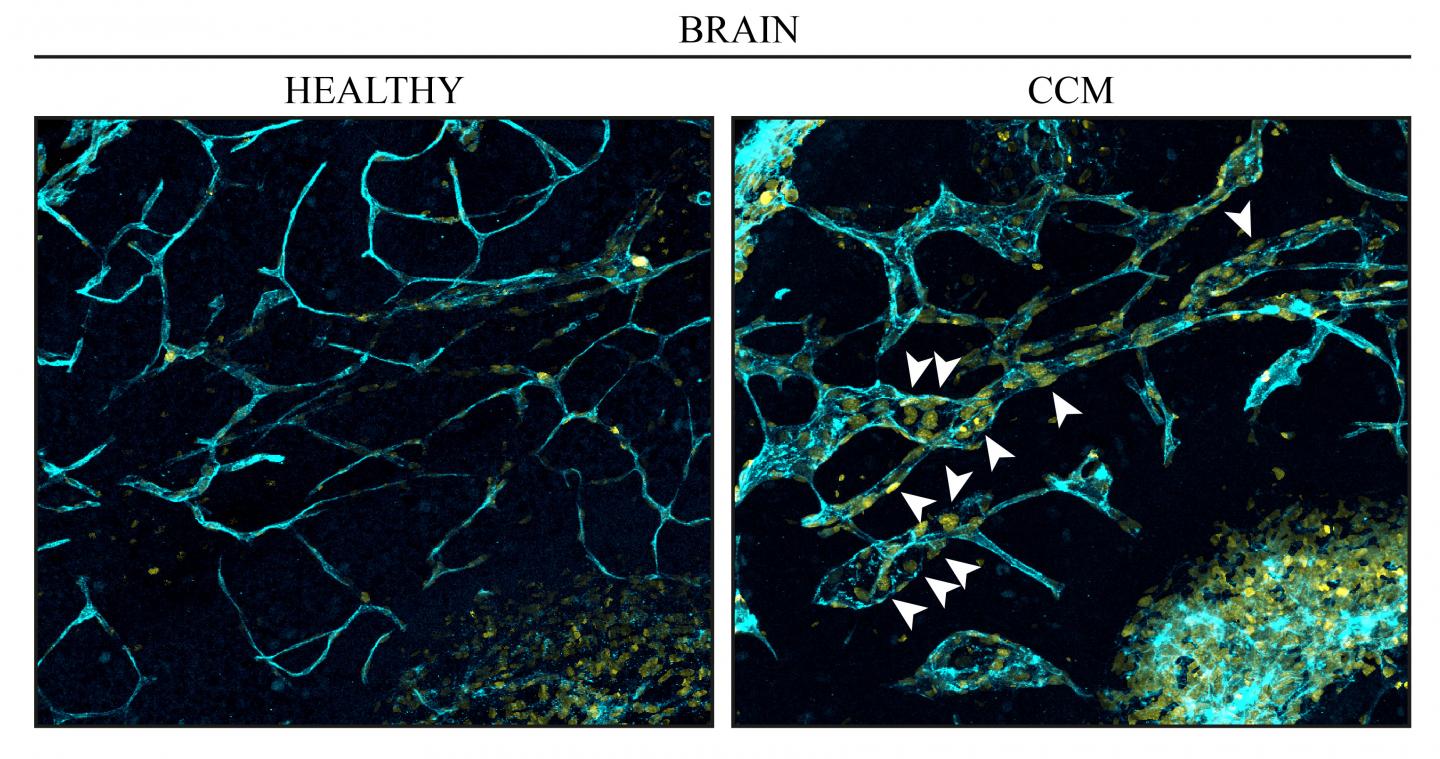
In the condition known as cavernoma, lesions arise in a cluster of blood vessels in the brain, spinal cord or retina. Researchers from Uppsala University can now show, at molecular level, that these changes originate in vein cells. This new knowledge of the condition creates potential for developing better therapies for patients. The study has been published in the journal eLife.

The vascular lesions, or blood-vessel malformations, that appear in a cerebral cavernoma – also known as a cerebral cavernous malformation (CCM) or, in the US, cavernous angioma – resemble mulberries. They bleed easily, which may cause epileptic attack, neurological problems and stroke. The condition is due to genetic mutations that may be inherited or occur spontaneously, and is incurable at present. Surgery is an option but, in patients with the hereditary form in whom new CCMs arise constantly, only a temporary solution.

How, and in which kind of blood vessel, the mutations occur has not been entirely clarified to date. In the present study, the researchers at Uppsala University – in collaboration with IFOM, the FIRC Institute of Molecular Oncology, and the Mario Negri Institute of Pharmacological Research in Italy – investigated endothelial cells. The function of these cells, which line the interior of blood vessels, varies according to vessel type, contributing to the differing features of arteries, veins and capillaries. In all, the scientists have analysed more than 30,000 individual endothelial cells in detail to identify how, and in which vessels, CCMs appear.

“One of the genes that may mutate in the inherited form of CCM is called CCM3. We’ve examined mouse brain endothelial cells, after specific endothelial deletion of CCM3. The cells were clustered in venous and arterial endothelial cells, and we were able to see that venous endothelial cells were particularly sensitive to loss of the CCM3 gene,” says Peetra Magnusson of the Department of Immunology, Genetics and Pathology (IGP).

When CCM3 was lacking in mural endothelial cells of the venous type, the researchers observed increased cell division and abnormal growth of the vessels, leading to the characteristic mulberry-like lesions. The study thus confirms, at molecular level, that the vascular malformations of a cavernoma arise in veins. This had been seen previously only when the structure of the blood vessels had been studied in vessel fragments.

“Another interesting result from the study was that arterial endothelial cells were not affected at all in the same way by losing their CCM3. Although the CCM3 gene was also missing in these cells, they don’t contribute to development of the malformations,” says Elisabetta Dejana, who led the study.

“Summing up, our findings have brought new knowledge about cavernoma, which should improve the chances of developing improved clinical treatments.”

###

Fabrizio Orsenigo et al. (2020), Mapping endothelial-cell diversity in cerebral cavernous malformations at single-cell resolution, eLife. DOI: 10.7554/eLife.61413

Media Contact
Peetra Magnusson
[email protected]

Related Journal Article

http://dx.doi.org/10.7554/eLife.61413

Tags: Cell BiologyGenesGeneticsInternal MedicineMedicine/Health
Share12Tweet8Share2ShareShareShare2

Related Posts

HIV Blinds the Immune System to Lung Cancer Mutations, Study Suggests

HIV Blinds the Immune System to Lung Cancer Mutations, Study Suggests

October 5, 2026
A Simple Caliper Test May Outmeasure the Tape for Spotting Dangerous Belly Fat

A Simple Caliper Test May Outmeasure the Tape for Spotting Dangerous Belly Fat

October 5, 2026

Economic Crises Are Breaking Health Systems Across West Asia and North Africa, Review Finds

October 5, 2026

Blood Protein Surge Reveals Nerve Damage From Common Lymphoma Chemotherapy

October 5, 2026
Please login to join discussion

POPULAR NEWS

  • Alloys That Shrink Their Own Grains: New PIX Mechanism Refines Metals With Heat Alone

    Alloys That Shrink Their Own Grains: New PIX Mechanism Refines Metals With Heat Alone

    29 shares
    Share 12 Tweet 7
  • Endurance Exercise Reshapes the Liver in Males and Females Through Distinct Molecular Routes

    29 shares
    Share 12 Tweet 7
  • Single Transcription Factor PU.1 Rapidly Converts Fibroblasts into Macrophage-Lineage Cells

    29 shares
    Share 12 Tweet 7
  • New Scale Measures How Ready Nurse Educators Really Are for the AI Era

    29 shares
    Share 12 Tweet 7

About

We bring you the latest biotechnology news from best research centers and universities around the world. Check our website.

Follow us

Recent News

Alloys That Shrink Their Own Grains: New PIX Mechanism Refines Metals With Heat Alone

Endurance Exercise Reshapes the Liver in Males and Females Through Distinct Molecular Routes

Single Transcription Factor PU.1 Rapidly Converts Fibroblasts into Macrophage-Lineage Cells

Subscribe to Blog via Email

Success! An email was just sent to confirm your subscription. Please find the email now and click 'Confirm' to start subscribing.

Join 85 other subscribers
  • Contact Us

Bioengineer.org © Copyright 2023 All Rights Reserved.

Welcome Back!

Login to your account below

Forgotten Password?

Retrieve your password

Please enter your username or email address to reset your password.

Log In
No Result
View All Result
  • Homepages
    • Home Page 1
    • Home Page 2
  • News
  • National
  • Business
  • Health
  • Lifestyle
  • Science

Bioengineer.org © Copyright 2023 All Rights Reserved.