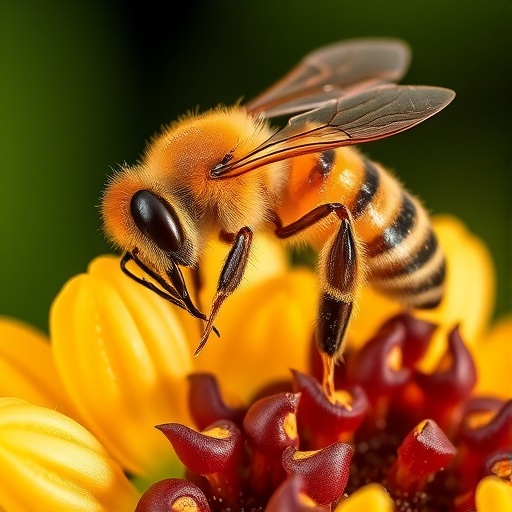

Honey bees, scientifically known as Apis spp., are indispensable to global ecosystems and agriculture, serving as critical pollinators for a vast array of crops. However, their survival is continually threatened by a formidable foe: the parasitic mite Varroa destructor. This tiny arachnid has emerged as one of the most significant contributors to honey bee population declines worldwide, triggering alarm among scientists, beekeepers, and environmentalists alike. The mite’s role extends beyond parasitism, as it acts as a vector for viruses that devastate bee colonies, warranting urgent research into its biological mechanisms and management strategies.
Varroa destructor’s parasitism is remarkably invasive and complex. Unlike many parasites, Varroa does not merely feed superficially but directly targets the fat bodies of immature and adult honey bees. These fat bodies are essential to bees’ immunity and overall physiology, and their destruction severely compromises the bees’ health. By embedding themselves in the brood cells of developing larvae, the mites ensure their progeny thrive on vulnerable hosts, making early infestation difficult to detect and control. This life cycle intricacy has positioned Varroa as a relentless and stealthy threat.
Beyond physical parasitism, Varroa destructor is notorious for its role in pathogen transmission. The mite serves as a vector for an array of debilitating viruses, including the Deformed Wing Virus (DWV) and Acute Bee Paralysis Virus (ABPV). These viruses, once merely benign in wild populations, are now highly potentiated due to Varroa’s efficient viral transmission. Infected bees exhibit deformities, paralysis, and premature death, precipitating the rapid collapse of entire colonies. The synergistic effect of mite infestation and viral proliferation accelerates colony mortality rates dramatically.
.adsslot_kIPQLY82eF{width:728px !important;height:90px !important;}
@media(max-width:1199px){ .adsslot_kIPQLY82eF{width:468px !important;height:60px !important;}
}
@media(max-width:767px){ .adsslot_kIPQLY82eF{width:320px !important;height:50px !important;}
}
ADVERTISEMENT
The burden of Varroa infestation is compounded by its capacity to evade host immune responses and develop resistance to chemical treatments. Over the past decades, numerous miticides have been developed and deployed, yet the mite’s rapid adaptability has led to widespread resistance. This resistance presents a daunting challenge, as chemical controls lose efficacy and threaten the sustainability of apiculture. Hence, understanding Varroa’s genetics and mechanisms of resistance is paramount to devising durable control measures.
Recent research has also focused on the mite’s interaction with honey bee genetics and behavior. Certain bee strains demonstrate hygienic behaviors, such as grooming and brood removal, that reduce Varroa populations within colonies. Breeding programs aimed at enhancing these traits show promise as a sustainable approach to mite management. Nonetheless, the variability in these behaviors across Apis species and geographic regions necessitates extensive research and field trials to optimize their application.
The environmental factors influencing Varroa destructor’s spread and virulence are another critical area of study. Climate change, habitat loss, and agricultural practices shape the dynamics of mite infestations. Warmer temperatures may accelerate the mite’s reproductive cycles and expand its geographic range, while pesticide exposure can weaken honey bee immune defenses, exacerbating infestations. Thus, integrating ecological perspectives into Varroa management is essential for holistic intervention strategies.
Innovative technologies, such as precision monitoring and molecular diagnostics, are revolutionizing Varroa detection and control. Real-time mite population tracking using sensor technology enables beekeepers to implement timely interventions, minimizing colony damage. Moreover, advancements in RNA interference (RNAi) techniques offer targeted disruption of mite gene expression, presenting a promising avenue for non-chemical control methods that could circumvent resistance issues.
Despite these advances, a unified global approach to combating Varroa destructor remains elusive. International collaboration on research, monitoring, and regulatory policies is vital to controlling the mite’s spread, especially in regions where beekeeping is crucial to local economies. Uniform standards in mite management and data sharing can facilitate rapid responses to emerging infestations and resistance patterns.
The economic implications of Varroa destructor infestation are staggering. Declines in honey bee populations directly impact crop yields and agricultural profitability. The increased costs of mite management further strain beekeepers, particularly smallholders who rely heavily on pollination services. The synergistic economic pressure necessitates governmental support and investment in apiculture research to safeguard food security and rural livelihoods.
Community education and awareness campaigns are fundamental to Varroa management success. Equipping beekeepers with knowledge about mite biology, transmission dynamics, and control methods empowers them to implement evidence-based practices. Likewise, public understanding of the ecological importance of bees and the threats they face fosters broader support for conservation initiatives.
The complex interplay between Varroa destructor, honey bees, and associated pathogens underscores the urgent need for multidisciplinary research. Entomologists, virologists, ecologists, and geneticists must collaborate to unravel the intricacies of this parasite-host-pathogen triangle. Such collaborative efforts are crucial to developing integrated pest management frameworks that balance efficacy, environmental safety, and sustainability.
Looking ahead, the future of apiculture hinges on innovative and adaptive strategies to mitigate Varroa destructor’s impact. Embracing biotechnological advances, leveraging natural host defenses, and promoting environmental stewardship form the triad of sustainable solutions. Continuous monitoring, rapid data exchange, and adaptive policy frameworks will enhance resilience against this parasitic menace.
Ultimately, the story of Varroa destructor is a cautionary tale of how a microscopic parasite can disrupt entire ecosystems and food systems. Its capacity to inflict harm on honey bees reverberates through agriculture and biodiversity, emphasizing the interconnectedness of species and environments. Addressing this challenge requires concerted, science-driven action aimed at restoring the balance between bees and their microscopic adversary.
As the scientific community intensifies research into Varroa destructor’s biology, transmission, and control, the broader public is reminded of the delicate balance underpinning global food security. The fight against this parasitic mite represents a critical front in safeguarding one of nature’s most vital services – pollination. Success in this battle will resonate far beyond apiaries, impacting ecosystems, economies, and our collective future.
Subject of Research: Parasitic mites of honey bees, specifically Varroa destructor, focusing on parasitism, pathogen transmission, and management strategies.
Article Title: Parasitic Mites of Honey Bees (Apis Spp.): A Detailed Review of Varroa destructor in Parasitism, Pathogen Transmission and its Management.
Article References:
Jeyapriya, G., Sumathi, E., Saminathan, V.R. et al. Parasitic Mites of Honey Bees (Apis Spp.): A Detailed Review of Varroa destructor in Parasitism, Pathogen Transmission and its Management. Acta Parasit. 70, 184 (2025). https://doi.org/10.1007/s11686-025-01124-w
Image Credits: AI Generated
Tags: challenges in honey bee conservationecological importance of honey beeshoney bee health and immunityimpact of Varroa destructor on pollinatorsparasitic mites in agriculturepest control in beekeepingresearch on honey bee parasitesstrategies for controlling Varroa infestationsustainable beekeeping practicesVarroa destructor management strategiesVarroa mite life cycleviral diseases in honey bee colonies