


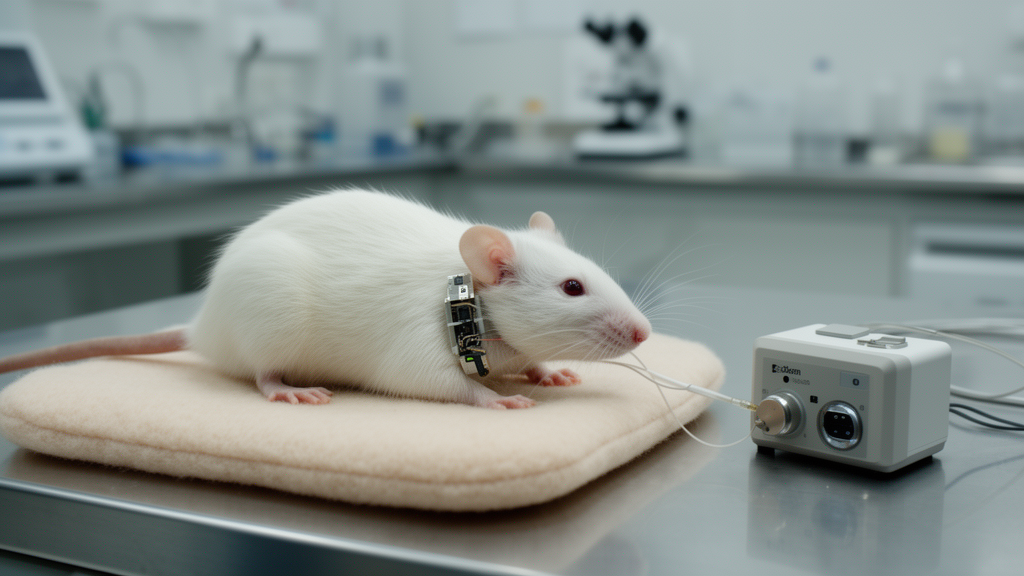
A single session of vagus nerve stimulation can sharpen memory and strengthen synaptic plasticity in female rats, but only when the animals are in a particular phase of their estrous cycle, according to a new study published in Bioelectronic Medicine. The finding, from researchers working with female Sprague–Dawley rats at Wright-Patterson Air Force Base, is among the first to systematically examine how the estrous cycle interacts with vagus nerve stimulation, or VNS, a neuromodulation technique already approved by the FDA for epilepsy and treatment-resistant depression and increasingly explored as a cognitive enhancer.
The research team, led by Laura K. Olsen and Candice N. Hatcher-Solis, surgically implanted electrode cuffs around the left cervical vagus nerve of healthy adult female rats. After at least ten days of recovery, the animals were divided into four groups: sham-stimulated or stimulated rats, each further classified by estrous cycle phase as either diestrus or estrus, determined daily by vaginal cytology. Proestrus and estrus were grouped together as an estrus phase, while metestrus and diestrus formed the diestrus phase. A total of 44 rats participated in the cognitive behavioral experiments and 68 in the electrophysiology experiments.
Stimulation consisted of a single 30-minute session of biphasic pulses, 100 microseconds in duration, delivered at 30 Hz and 0.8 mA, administered immediately after training on two learning tasks: the Novel Object Recognition test, which measures recognition memory, and the Passive Avoidance Task, which measures associative aversion learning. Testing took place 24 hours later. Across all female subjects, stimulated rats did not outperform sham controls in the Passive Avoidance Task. But when estrous cycle stage at the time of testing was taken into account, a striking pattern emerged: females in diestrus that received VNS showed significantly improved performance compared with sham controls, while females in estrus showed no such benefit.
The authors suggest this may reflect a ceiling effect rather than a failure of stimulation. Sham females in estrus tended to perform better on the passive avoidance task than sham females in diestrus, meaning their baseline performance was already high and left little room for VNS to demonstrate an advantage. Notably, when estrous cycle stage on the training day rather than the testing day was considered, the effect disappeared, indicating that the relevant interaction depends on the phase during the behavioral paradigm itself. In the Novel Object Recognition task, VNS produced no significant improvement at any cycle stage, and the Elevated Zero Maze showed no VNS-related changes in anxiety-like behavior.
Beneath the behavioral results, the electrophysiology told a more detailed story. In a separate cohort euthanized 90 minutes after stimulation, the researchers recorded from hippocampal slices, focusing on the Schaffer collateral–CA1 pathway, a well-characterized circuit in memory formation. Across all stimulated females, VNS increased the amplitude of evoked population spikes at stimulation intensities of 60 to 120 microamps, a general marker of enhanced neurotransmission efficacy. VNS also reduced paired-pulse facilitation, a form of short-term plasticity reflecting the probability of neurotransmitter release, and increased the frequency of spontaneous firing of CA1 neurons, an effect that held in both diestrus and estrus.
The estrous cycle, however, decisively shaped the longer-term plasticity measures. Long-term potentiation, the persistent strengthening of synapses widely regarded as a cellular substrate of learning, was induced experimentally using theta burst stimulation. Two-way analysis of variance across 30 minutes of post-induction recording revealed a significant main effect of VNS on population spike amplitude among all animals, but post-hoc comparisons showed the increase was significant only in females in diestrus. Among females in estrus, a main effect of group was present, yet no individual time point reached significance. Similarly, the reduction in paired-pulse facilitation persisted only among diestrus females and was absent in estrus.
Molecular evidence echoed this phase dependence. Immunohistochemistry performed on tissue collected 48 hours after stimulation showed that VNS increased expression of brain-derived neurotrophic factor, or BDNF, a key synaptic plasticity marker, in the CA1 subregion of the hippocampus across all females, with the effect maintained only among diestrus rats. In the CA2, a region associated with social memory, BDNF was elevated only among females in estrus. No changes appeared in the CA3 or dentate gyrus. The authors note that the CA1 BDNF increase coincides with improved passive avoidance performance in males studied previously and in diestrus females here, hinting that VNS-induced cognitive effects may be mediated through BDNF-dependent plasticity pathways.
The mechanistic rationale traces back to the locus coeruleus. Cervical vagus nerve stimulation activates afferent fibers that innervate brainstem regions including the nucleus of the solitary tract and the locus coeruleus, whose norepinephrine release into the hippocampus is thought to increase excitability in memory-formation pathways. Estrogen adds another layer: spine density and synaptic structure in the CA1 stratum radiatum fluctuate across the ovarian cycle, and prior work has shown that hippocampal neurons from diestrus rats undergo smaller high-frequency stimulation-induced LTP than those from estrus rats. The new findings are consistent with that literature, and the authors propose that VNS may effectively overcome the relatively lower baseline LTP seen in diestrus, allowing stimulation to push plasticity upward where it has more room to act.
The study has limitations the authors acknowledge directly. Hormone levels were not measured, estrous cycle stage could not be controlled between training and testing days, and the stimulation parameters were carried over from prior work in male rodents rather than optimized for females. A previous study using similar parameters found that VNS paired with training failed to improve learning across multiple paradigms in female rats, a result the authors now suggest may have been influenced by untracked estrous cycle phase. Whether hormonal fluctuations during the human menstrual cycle similarly modulate VNS effects in people remains entirely unstudied, though the authors consider it a reasonable hypothesis if the rodent mechanism is hormone-driven.
Overall, the results reframe how VNS cognitive research should be designed. Sex is not a binary variable but a dynamic biological context, and in females the estrous cycle stage at the moment of testing appears consequential for whether stimulation translates into measurable memory gains and hippocampal plasticity. The authors recommend that future studies either restrict testing to a single cycle phase or include cycle stage as an explicit variable, and suggest ovariectomized animals receiving controlled hormone replacement could help disentangle the underlying mechanisms. For a technique whose clinical memory effects have been inconsistent across human trials, accounting for this interaction may be a necessary step toward optimizing VNS efficacy.
Subject of Research: Effects of vagus nerve stimulation on cognition and hippocampal synaptic plasticity in female rats across estrous cycle phases
Article Title: Cognitive neurobehavior and synaptic plasticity after vagus nerve stimulation in female rats: Interaction between estrous cycle and neurostimulation
Article References: Olsen, L. K., Jones, K. A., Sharma, B., Ethridge, V. T., Gargas, N. M., Cunningham, S. D., Rohan, J. G., & Hatcher-Solis, C. N. (2026). Cognitive neurobehavior and synaptic plasticity after vagus nerve stimulation in female rats: Interaction between estrous cycle and neurostimulation. Bioelectronic Medicine, 12(1), Article 4. https://doi.org/10.1186/s42234-025-00196-3
Image Credits: AI Generated
DOI: 10.1186/s42234-025-00196-3
Keywords: vagus nerve stimulation, estrous cycle, hippocampus, long-term potentiation, BDNF, female rats, synaptic plasticity, passive avoidance, CA1, norepinephrine, neuromodulation, memory
News Source: Glenn Wilkins. (October 30, 2026). Vagus Nerve Stimulation Boosts Memory in Female Rats Only During Certain Estrous Phases. Scienmag.



