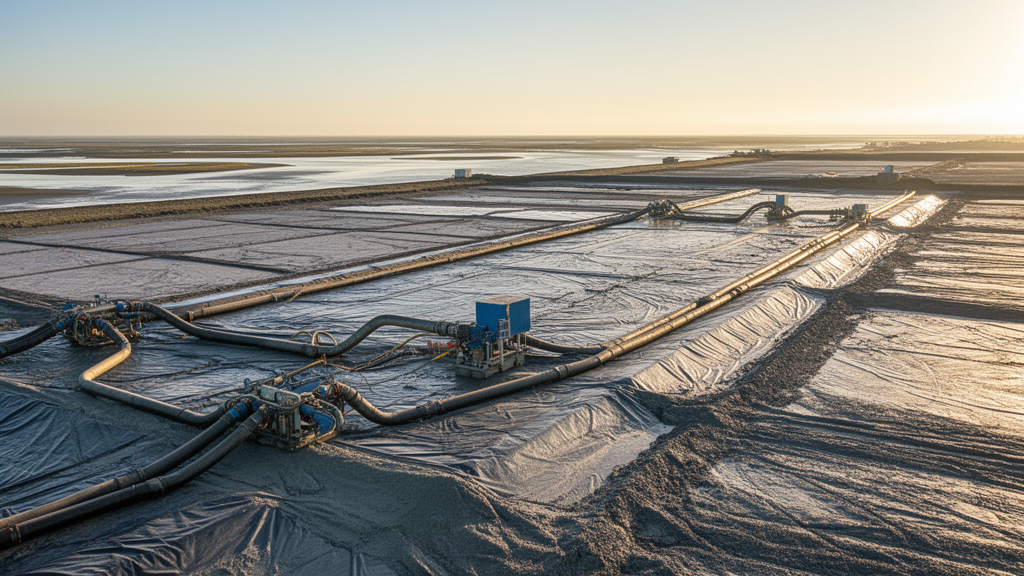
Physical model tests and numerical simulations demonstrate that a vacuum dewatering combined with preloading method can rapidly form a shallow hard-shell layer in newly-reclaimed dredged silt without requiring sand cushions or prolonged drying periods. Investigating the reinforcement mechanisms of this technique during the hard-shell formation stage, researchers established a three-dimensional horizontal-vertical drainage network that couples free-water extraction with negative-pressure consolidation. The experimental and modeling results show that this integrated drainage approach provides a workable foundation capable of supporting personnel and light equipment, addressing a critical accessibility problem that occurs immediately after hydraulic reclamation.
Newly-reclaimed dredged silt sites present a severe geotechnical challenge immediately following hydraulic filling because the ground surface remains in a state of fluidized mud. This fluidized condition prevents direct access by construction personnel and heavy machinery, creating a practical impasse for site development. Although conventional ground treatment methods exist for soft soil improvement, these traditional approaches typically assume that the project site is already accessible to operating crews and equipment.
To investigate the physical mechanisms governing the early hard-shell formation stage, the research team conducted laboratory physical model tests using dredged silt collected from Xiamen alongside Plaxis 2D finite element numerical simulations. The Xiamen dredged silt tested in the physical model exhibited an initial water content of 281 percent, representing an extremely soft, fluidized state. The experimental setup applied vacuum extraction to the soil through the three-dimensional drainage network, allowing the researchers to track changes in moisture content, soil structure, and mechanical bearing performance over extended continuous pumping intervals.
Following 1,188 hours of continuous vacuum extraction in the physical model tests, the average water content of the shallow dredged silt decreased substantially from 281 percent to 58 percent. Over the same operating duration, the void ratio of the treated soil was reduced from an initial value of 7.53 down to 1.49, reflecting substantial volumetric consolidation. These physical changes produced a notable gain in mechanical strength, as the ultimate bearing capacity of the ground rose from near zero to more than 40 kilopascals, successfully meeting the structural threshold required for personnel and light machinery to operate on the surface.
Complementary numerical comparisons carried out using Plaxis 2D simulations evaluated the efficiency of the three-dimensional drainage configuration against simpler channel layouts over a 1,200-hour period. The numerical analysis revealed that the combined three-dimensional horizontal-vertical drainage network achieved approximately 61.0 percent excess pore water pressure dissipation within 1,200 hours. By comparison, a drainage system relying solely on horizontal channels achieved only 22.4 percent dissipation, while a vertical-only layout reached 18.3 percent dissipation over the identical timeframe. These numerical findings confirm a synergistic consolidation effect from combining drainage channels, although the authors caution that these comparative dissipation ratios remain semi-quantitative.
The research also identified a consolidation coupling effect between the applied vacuum negative pressure and external surcharge preloading during ground reinforcement. However, the study emphasizes an important operational limitation: surcharge loading must not be applied prematurely, but should instead be introduced only after the underlying silt has developed sufficient shear strength to prevent instability. Based on these findings, the authors propose a phased treatment framework that designates shallow hard-shell formation as an independent preliminary engineering stage with explicit transition criteria, offering a viable technical pathway for reclamation projects that require stable working platforms prior to deep ground improvement.
Subject of Research: Vacuum dewatering combined with preloading for shallow hard-shell layer formation in dredged silt
Article Title: Mechanism of shallow hard-shell-layer formation for newly-reclaimed dredged silt using vacuum dewatering combined with preloading
Article References: Zeng, S.-P., Cui, C.-L., Zhang, Y., & Tu, H. (2026). Mechanism of shallow hard‑shell‑layerformation for newly‑reclaimed dredged silt using vacuum dewatering combined with preloading. Frontiers in Materials, 13, 2024114. https://doi.org/10.3389/fmats.2026.2024114
Image Credits: AI Generated
DOI: 10.3389/fmats.2026.2024114
Keywords: dredged silt, vacuum dewatering, preloading, shallow hard-shell layer, foundation treatment, fluidized mud, three-dimensional drainage network, negative-pressure consolidation, excess pore water pressure dissipation, ultimate bearing capacity, void ratio reduction, Plaxis 2D, physical model tests, Xiamen dredged silt, geotechnical engineering, hydraulic filling, working platform construction
News Source: Denise Maddox. (November 18, 2026). Vacuum Dewatering and Preloading Form Shallow Hard-Shell Layer on Dredged Silt. Scienmag.