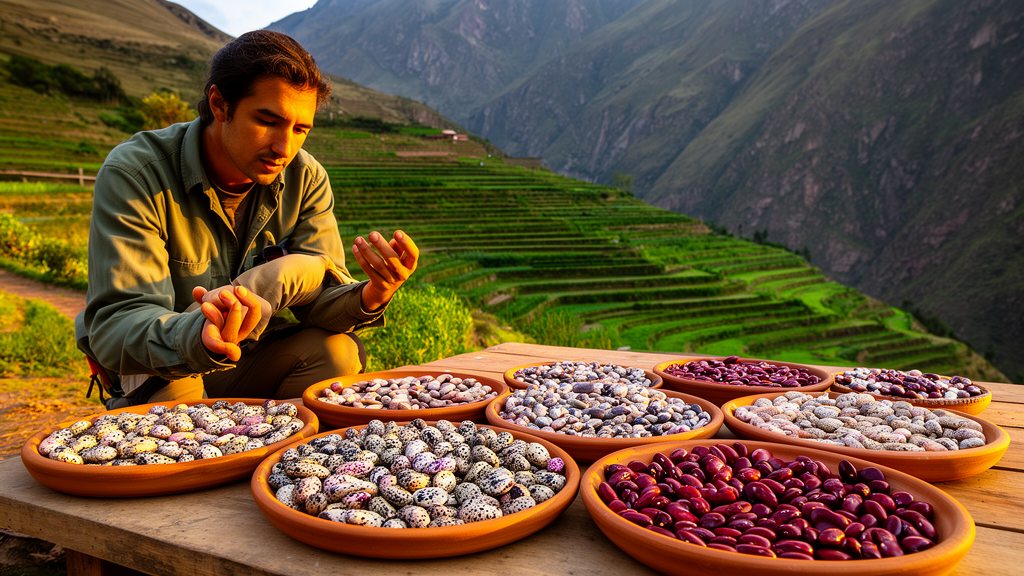
Researchers investigating agricultural biodiversity in the northeastern Peruvian Andes have characterized 80 common bean accessions, revealing extensive morphological variation and identifying four promising breeding candidates. Common bean, Phaseolus vulgaris, represents an essential food crop that harbors substantial agromorphological diversity across the Andean highlands. However, local germplasm remains insufficiently characterized, exposing these valuable plant genetic resources to the risk of genetic erosion. To address this issue, an investigative team at the Universidad Nacional Toribio Rodríguez de Mendoza de Amazonas in Chachapoyas, Peru, evaluated the accessions using 17 quantitative and 14 qualitative descriptors to establish baseline morphological data and identify superior materials for plant breeding programs.
The agronomic evaluation was conducted under an augmented block design, an experimental layout required because of limited seed availability for many entries. Within the evaluated set of 80 total accessions, the researchers included check varieties alongside 78 non-check accessions. By utilizing an augmented block design, the team was able to evaluate numerous entries with restricted seed stocks while accounting for field variation through systematically positioned check plots. This field structure allowed the researchers to generate reliable phenotypic profiles across all qualitative and quantitative descriptors without exhausting scarce seed quantities of local Andean accessions.
Qualitative diversity was assessed across the 78 non-check common bean accessions using Nei’s diversity index and the Shannon–Weaver index. The resulting analyses demonstrated substantial qualitative variability among the evaluated plants, with Nei’s diversity index values ranging from 0.12 to 0.83 across the observed descriptors. Furthermore, the Shannon–Weaver index reached 1.99 for lighter seed coat color, demonstrating pronounced variation in seed coat appearance among the local collections. These qualitative variations highlight the breadth of morphological diversity preserved across traditional Andean agricultural systems.
To evaluate quantitative characteristics, the research team implemented mixed models to obtain best linear unbiased estimators and broad-sense heritability estimates. Across the evaluated quantitative traits, broad-sense heritability ranged from 0.00 to 1.00. The statistical analysis revealed high heritability values for several key developmental and reproductive parameters. Days to 50 percent flowering and the number of seeds per pod both showed heritability estimates of 1.00. High estimates were likewise observed for the number of pods per plant at 0.98, seed weight at 0.97, and yield per plant at 0.96.
The quantitative phenotypic assessment also demonstrated significant differentiation in plant architecture and reproductive output across the germplasm collection. The greatest quantitative variation among the bean accessions occurred in the number of pods per plant, yield per plant, number of floral racemes per plant, and stem diameter. These specific traits displayed notable dispersion among entries, indicating that local accessions differ substantially in both growth architecture and seed production. Identifying traits with marked variability provides plant breeders with reliable morphological indicators when screening regional germplasm for high-performing genetic lines.
To resolve the multivariate relationships underlying these physical differences, the authors applied principal component analysis and multiple factor analysis. The principal component analysis identified the primary sources of quantitative variation and separated the accessions into three phenotypically differentiated clusters. Concurrently, multiple factor analysis integrated morphological descriptors, phenology, and yield measurements, revealing complementary relationships across these distinct trait categories. This multidimensional statistical framework enabled the researchers to examine how vegetative growth and phenological timing related to final seed yield across the diverse bean collection.
Through this integrated screening framework, four specific common bean accessions—UNTRM-335-1019, UNTRM-335-1077, UNTRM-335-1058, and UNTRM-335-1016—met the selection criteria. Each of these four accessions achieved a yield per plant exceeding that of the best check while exhibiting favorable seed weight and harvest index values. The investigators noted that these four accessions represent preliminary candidates that require validation through replicated multi-environment trials across regional agroecological zones. Ultimately, this foundational characterization provides essential baseline data to support both the conservation and future breeding deployment of local Phaseolus vulgaris germplasm in the northeastern Peruvian Andes.
Subject of Research: Agromorphological diversity and breeding potential of common bean germplasm in northeastern Peru
Article Title: Agromorphological diversity and promising accessions of common bean (Phaseolus vulgaris) in the northeastern Peruvian Andes
Article References: Huanambal-Gálvez, J. L., Meza-Maicelo, W., Baldera-Chapoñan, V. H., Oliva-Cruz, M., Maicelo-Quintana, J. L., Leiva-Tafur, D., Vásquez-Garcia, J., & Lozano-Isla, F. (2026). Agromorphological diversity and promising accessions of common bean (Phaseolus vulgaris) in the northeastern Peruvian Andes. Frontiers in Horticulture, 5, Article 1966237. https://doi.org/10.3389/fhort.2026.1966237
Image Credits: AI Generated
DOI: 10.3389/fhort.2026.1966237
Keywords: common bean, Phaseolus vulgaris, Peruvian Andes, agromorphological diversity, germplasm characterization, plant breeding, augmented block design, phenotypic variation, heritability, yield per plant, pods per plant, genetic erosion, Shannon-Weaver index, Nei diversity index, multiple factor analysis, seed weight, harvest index
News Source: Alan Morgan. (November 18, 2026). Peruvian Andes Bean Study Identifies Diverse Traits and Promising Breeding Accessions. Scienmag.