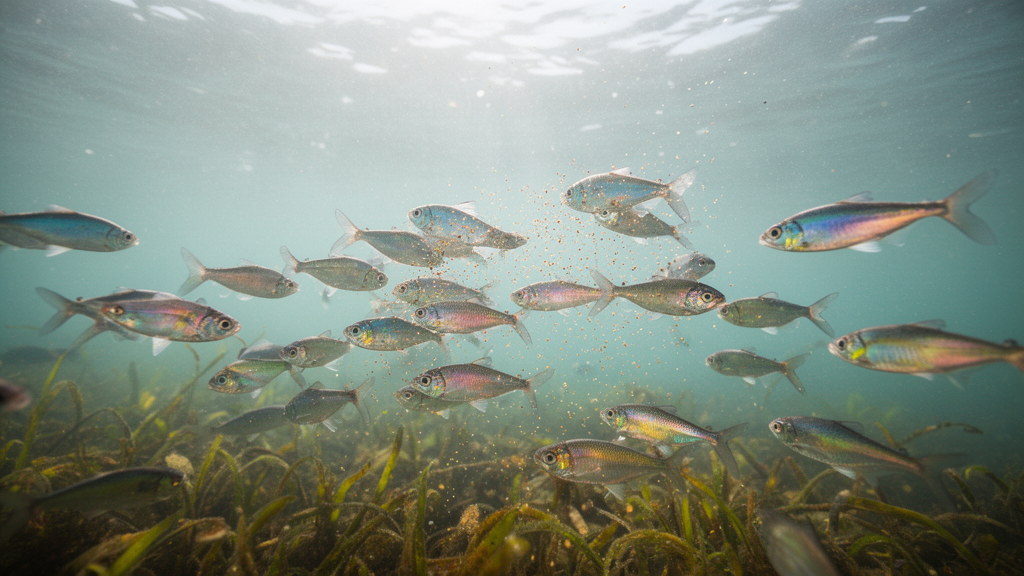
A newly developed computational framework discriminates fish feeding-related activity patterns without requiring manual behavioral labels by integrating ensemble object detection, multi-object tracking, trajectory-based feature engineering, and domain-adapted contrastive representation learning. In experimental evaluations, the self-supervised methodology achieved a clustering Silhouette Score of 0.6547 across 847 valid trajectories. The reported findings demonstrate that adapting contrastive representation learning specifically to the temporal and social relationships of swimming trajectories substantially enhances the separability of fish activity patterns compared to unencoded trajectory measurements as well as standard generic contrastive baselines.
Monitoring fish feeding behavior is recognized as a vital predictor of overall swimming activity and animal well-being within precision aquaculture facilities. Despite its operational significance, conventional manual assessment of feeding activity is time-consuming, subjective, and difficult to standardize or generalize across diverse aquatic environments. To eliminate the dependence on labor-intensive human annotations, the research team designed an automated, label-free computational framework capable of discerning distinct behavioral states directly from raw video sequences without requiring pre-labeled behavioral categories or supervisory signals.
To validate the automated pipeline, the investigators conducted experiments using video recordings drawn from the Fish4Knowledge dataset. The experimental test collection comprised 18 distinct video sequences and approximately 8,427 extracted video frames representing diverse underwater conditions. Fish detection within each frame was performed using two lightweight convolutional models, YOLOv8n and YOLOv8s, both pre-trained on the DeepFish dataset. The spatial bounding box predictions generated by the two complementary detectors were systematically merged using Weighted Box Fusion, establishing consistent and reliable detections of individual fish across the video sequence.
Continuous fish identification across consecutive frames was managed through the ByteTrack multi-object tracking system to preserve the spatial and temporal continuity of individual swimming paths. From the resulting valid fish trajectories, the researchers engineered five specific quantitative behavioral descriptors to represent different functional aspects of fish locomotion and group dynamics. Specifically, the framework computed the mean distance traveled to gauge the intensity of movement, the standard deviation of distance to capture movement variability, direction entropy to characterize the randomness of orientation, surface occupancy to quantify vertical water-column location, and the physical distance between fish to measure social behavior.
Following trajectory feature extraction, the multi-dimensional descriptors were transformed into lower-dimensional representations through a domain-adapted contrastive pretext task styled after SimCLR. Rather than relying on generic data transformations, the domain-adapted architecture generated positive and negative sample pairs by exploiting temporal relationships along individual movement paths as well as relational dynamics across multiple fish. This tailored self-supervised encoding process guided the neural network to capture salient behavioral structures embedded in the trajectory data without relying on predefined activity labels or human guidance.
The resulting contrastive representations were ultimately partitioned using K-means clustering to identify discrete, unannotated states of fish activity. Across a total of 847 valid trajectories analyzed in the study, the proposed framework partitioned the data into three separate activity clusters containing 788, 40, and 19 trajectories, respectively. Quantitative evaluation demonstrated that the domain-adapted representations achieved a Silhouette Score of 0.6547. In comparison, direct clustering of the raw engineered features yielded a Silhouette Score of 0.4733, while a generic contrastive baseline achieved a score of only 0.2728, underscoring the improved cluster separability achieved through domain-specific contrastive learning.
These comparative clustering outcomes prove that domain-adapted contrastive representation learning effectively enhances the separability of trajectory-based fish activity patterns without depending on annotated behavioral datasets. By eliminating the necessity for manual behavioral annotation while significantly outperforming generic contrastive models, the framework demonstrates an automated pathway for tracking feeding-related activity and well-being indicators. The researchers conclude that integrating ensemble object detection, robust tracking, and domain-adapted representation learning offers a viable foundation for precision aquaculture monitoring systems operating under label-free conditions.
Subject of Research: Label-free discrimination of fish feeding behavior using contrastive learning
Article Title: A domain-adapted contrastive learning framework for label-free fish feeding related activity discrimination using ensemble detection and trajectory-based behavioral features
Article References: N., A., P., K., & Chellamani, G. K. (2026). A domain-adapted contrastive learning framework for label-free fish feeding related activity discrimination using ensemble detection and trajectory-based behavioral features. Frontiers in Sustainable Food Systems, 10, Article 1984206. https://doi.org/10.3389/fsufs.2026.1984206
Image Credits: AI Generated
DOI: 10.3389/fsufs.2026.1984206
Keywords: precision aquaculture, fish feeding behavior, contrastive representation learning, ensemble object detection, multi-object tracking, ByteTrack, YOLOv8n, YOLOv8s, Weighted Box Fusion, DeepFish, Fish4Knowledge, SimCLR, K-means clustering, Silhouette Score, direction entropy, surface occupancy, trajectory-based feature engineering
News Source: Alan Morgan. (November 18, 2026). Domain-Adapted Contrastive Learning Identifies Fish Feeding Activity Without Manual Labels. Scienmag.