• HOME
  • NEWS
  • EXPLORE
    • CAREER
      • Companies
      • Jobs
    • EVENTS
    • iGEM
      • News
      • Team
    • PHOTOS
    • VIDEO
    • WIKI
  • BLOG
  • COMMUNITY
    • FACEBOOK
    • INSTAGRAM
    • TWITTER
Monday, August 17, 2026
BIOENGINEER.ORG
No Result
View All Result
  • Login
  • HOME
  • NEWS
  • EXPLORE
    • CAREER
      • Companies
      • Jobs
        • Lecturer
        • PhD Studentship
        • Postdoc
        • Research Assistant
    • EVENTS
    • iGEM
      • News
      • Team
    • PHOTOS
    • VIDEO
    • WIKI
  • BLOG
  • COMMUNITY
    • FACEBOOK
    • INSTAGRAM
    • TWITTER
  • HOME
  • NEWS
  • EXPLORE
    • CAREER
      • Companies
      • Jobs
        • Lecturer
        • PhD Studentship
        • Postdoc
        • Research Assistant
    • EVENTS
    • iGEM
      • News
      • Team
    • PHOTOS
    • VIDEO
    • WIKI
  • BLOG
  • COMMUNITY
    • FACEBOOK
    • INSTAGRAM
    • TWITTER
No Result
View All Result
Bioengineer.org
No Result
View All Result
Home NEWS Science News Chemistry

USask computer-based simulator tests insects for effects of new pesticide

Bioengineer by Bioengineer
February 24, 2020
in Chemistry
Reading Time: 2 mins read
0
IMAGE
Share on FacebookShare on TwitterShare on LinkedinShare on RedditShare on Telegram

IMAGE

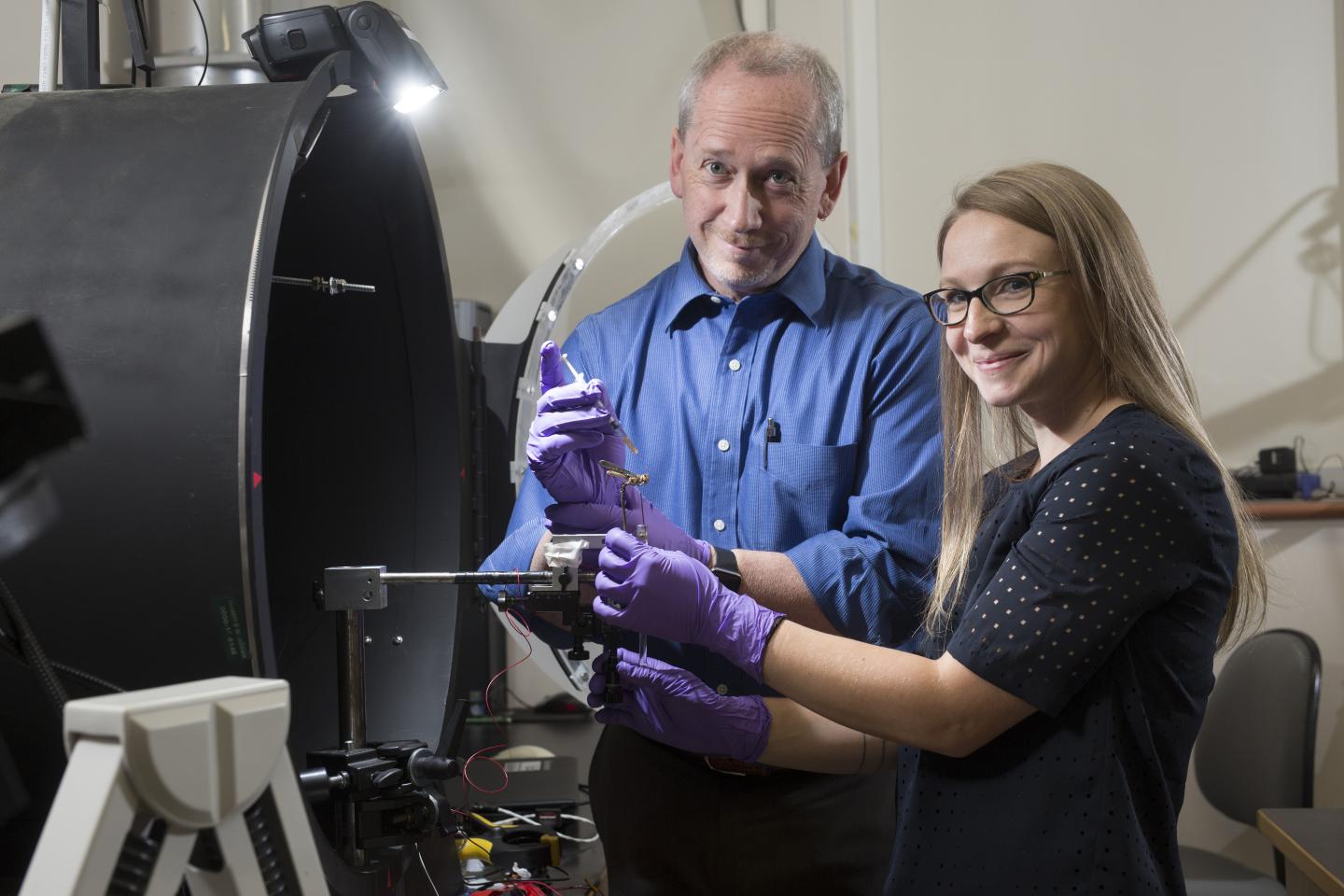
Credit: David Stobbe for University of Saskatchewan

SASKATOON–University of Saskatchewan (USask) researchers have used a novel combination of techniques to compare the effects of two families of pesticides used in agriculture, and found that at low dosages the newer pesticide is less toxic than a currently used neonicotinoid one.

USask biology professor Jack Gray’s research on locusts, published in the Proceedings of the National Academy of Sciences (PNAS), may have implications for understanding the link between these pesticides and mortality in other species such as the “colony collapse disorder” responsible for the deaths of millions of bees worldwide.

“There is controversy over neonicotinoid pesticides,” said Gray. “Their development suggested they were safer than other pesticides, but it is more complicated because their effects at non-lethal doses on insects and other species needed to be investigated further.”

From his previous studies with locusts, Gray designed a virtual flight simulator where he tested how non-lethal doses of pesticides can affect the insects’ ability to visually detect moving objects such as trees and predators. He and his team found that the newer sulfoxamine pesticide, sulfoxaflor (SFX), does not impair the insects’ motion detection ability, while the current neonicotinoid imidacloprid (IMD) does.

“Even though this suggests that SFX isn’t as toxic as the other pesticide at low dosages, more testing is needed to establish whether it a safer, preferable option for agriculture use,” said Gray.

Gray and his team used an approach that looks at behaviour and neurophysiology, which have seldom been applied together for studying pesticide effects.

The results confirmed that IMD had negative effects on the locusts’ ability to jump and escape dangers, while SFX did not. A potential explanation may be that SFX does not bind as strongly to the same receptor that determines the insects’ sensitivity to the pesticides.

The USask team chose locusts because their nervous system is well studied, and the neurons that regulate their motion detection are common to a variety of other species including birds, and likely even humans.

“These findings may be applicable to other species to understand how these pesticides affect how fast the nervous system can send information,” said Gray.

By using small electrodes in the insect’s thorax, former USask PhD student Rachel Parkinson, first author of the paper, measured the electrical signals directly from a neuron in the insect’s nervous system that detects visual motion and controls flight.

“The reaction time of locusts treated with the IMD pesticide slows down, impairing their ability to avoid objects,” said Parkinson, now a post-doctoral fellow at the University of Oxford. The USask team also includes PhD student Sinan Zhang.

###

The research is funded by Natural Sciences and Engineering Research Council (NSERC), the Canada Foundation for Innovation, and USask.

Media Contact
Victoria Dinh
[email protected]
306-966-5487

Related Journal Article

http://dx.doi.org/10.1073/pnas.1916432117

Tags: BiologyBiotechnologyEcology/EnvironmentEntomologyEnvironmental HealthFertilizers/Pest ManagementneurobiologyNeurochemistryToxicology
Share12Tweet8Share2ShareShareShare2

Related Posts

Butterfly-Inspired Technology Could Transform Air Quality Monitoring

August 15, 2026
Artesunate Targets GBA, Triggering Apoptosis in Liver Cancer Cells

Artesunate Targets GBA, Triggering Apoptosis in Liver Cancer Cells

August 15, 2026

New molecule may enable cleaner, more efficient metal recovery

August 15, 2026

Controlled sulfidation enhances supercapacitor electrode performance

August 15, 2026
Please login to join discussion

POPULAR NEWS

  • GLP-1 Drugs Raise Treatment-Related Stigma Concerns, Researchers Call for Conceptual Clarity

    29 shares
    Share 12 Tweet 7
  • Bar-Ilan Study Finds Attention Can Regulate Acute Inflammation in Humans

    29 shares
    Share 12 Tweet 7
  • Scientists find fast-spreading genetic variants causing parasites to resist malaria drugs

    29 shares
    Share 12 Tweet 7
  • VRK2 Drives Gemcitabine Resistance in Pancreatic Cancer Through TPI1-Mediated Aerobic Glycolysis

    29 shares
    Share 12 Tweet 7

About

We bring you the latest biotechnology news from best research centers and universities around the world. Check our website.

Follow us

Recent News

GLP-1 Drugs Raise Treatment-Related Stigma Concerns, Researchers Call for Conceptual Clarity

Bar-Ilan Study Finds Attention Can Regulate Acute Inflammation in Humans

Scientists find fast-spreading genetic variants causing parasites to resist malaria drugs

Subscribe to Blog via Email

Enter your email address to subscribe to this blog and receive notifications of new posts by email.

Join 85 other subscribers
  • Contact Us

Bioengineer.org © Copyright 2023 All Rights Reserved.

Welcome Back!

Login to your account below

Forgotten Password?

Retrieve your password

Please enter your username or email address to reset your password.

Log In
No Result
View All Result
  • Homepages
    • Home Page 1
    • Home Page 2
  • News
  • National
  • Business
  • Health
  • Lifestyle
  • Science

Bioengineer.org © Copyright 2023 All Rights Reserved.