• HOME
  • NEWS
  • EXPLORE
    • CAREER
      • Companies
      • Jobs
    • EVENTS
    • iGEM
      • News
      • Team
    • PHOTOS
    • VIDEO
    • WIKI
  • BLOG
  • COMMUNITY
    • FACEBOOK
    • INSTAGRAM
    • TWITTER
Friday, June 26, 2026
BIOENGINEER.ORG
No Result
View All Result
  • Login
  • HOME
  • NEWS
  • EXPLORE
    • CAREER
      • Companies
      • Jobs
        • Lecturer
        • PhD Studentship
        • Postdoc
        • Research Assistant
    • EVENTS
    • iGEM
      • News
      • Team
    • PHOTOS
    • VIDEO
    • WIKI
  • BLOG
  • COMMUNITY
    • FACEBOOK
    • INSTAGRAM
    • TWITTER
  • HOME
  • NEWS
  • EXPLORE
    • CAREER
      • Companies
      • Jobs
        • Lecturer
        • PhD Studentship
        • Postdoc
        • Research Assistant
    • EVENTS
    • iGEM
      • News
      • Team
    • PHOTOS
    • VIDEO
    • WIKI
  • BLOG
  • COMMUNITY
    • FACEBOOK
    • INSTAGRAM
    • TWITTER
No Result
View All Result
Bioengineer.org
No Result
View All Result
Home NEWS Science News Biology

US and Japanese researchers identify how liver cells protect against viral attacks

Bioengineer by Bioengineer
April 15, 2019
in Biology
Reading Time: 3 mins read
0
IMAGE
Share on FacebookShare on TwitterShare on LinkedinShare on RedditShare on Telegram

Results have implications for cellular responses to hepatitis, dengue and Zika
IMAGE

Credit: Daisuke Yamane, D.V.M., Ph.D., Tokyo Metropolitan Institute of Medical Science

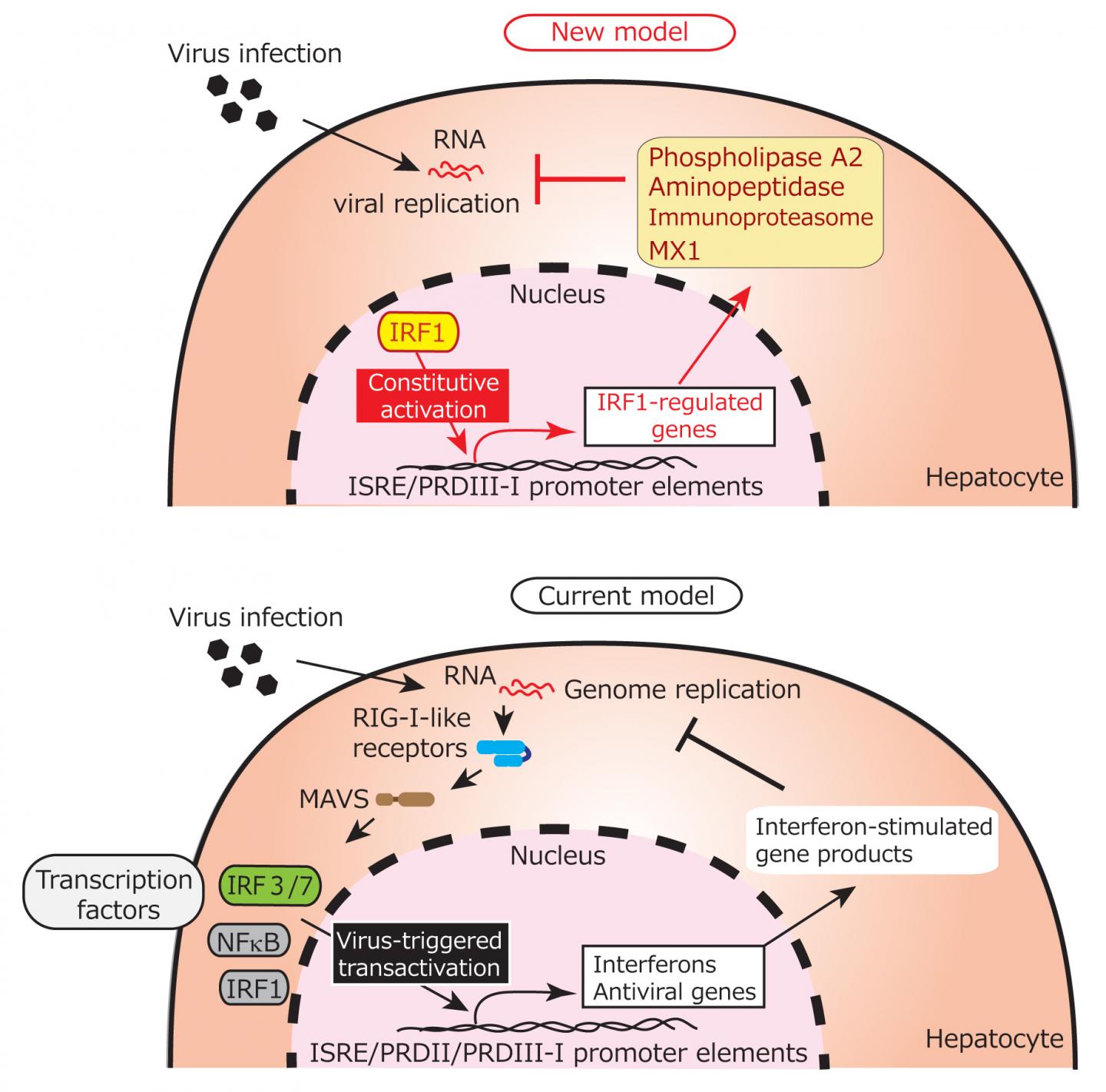
Chapel Hill, NC – Liver cells have an innate resistance to RNA viral infections like hepatitis A, dengue and Zika thanks to a protein called IRF1, according to researchers at the University of North Carolina at Chapel Hill (UNC) and Tokyo Metropolitan Institute of Medical Science (TMIMS). When present in liver cells, this IRF1 protein regulates RARRES3, an enzyme that when expressed in cells where hepatitis A virus is trying to set up shop, will attack the virus. These results were published in Nature Microbiology.

“We discovered that IRF1 is a master regulator of intrinsic resistance to viruses in liver cells,” said Stanley M. Lemon, M.D., the study’s co-author and a professor of medicine, microbiology and immunology in the UNC School of Medicine. “If present in liver cells, IRF-1 ensures that RARRES-3, an enzyme that acts on lipids, makes the cell hostile or restrictive to hepatitis A infection.”

In 2019 alone, there have been several outbreaks of hepatitis A throughout the United States, including Florida, Ohio and California. Hepatitis A infection occurs through consuming contaminated food and water, sex, and injection drug use. The infection can be fatal. There is a very effective and safe two-shot vaccine for hepatitis A virus. However, people who have not been immunized remain at risk for infection.

“We also found that while expressing RARRES3 is protective against hepatitis A infection, it does not help liver cells resist an attack from other RNA viruses like dengue,” said Daisuke Yamane, D.V.M., Ph.D., the study’s co-author who was previously a research associate at UNC and is now chief researcher at the Tokyo Metropolitan Institute of Medical Science’s Viral Infectious Diseases Project. “In future studies, we hope to further investigate this innate immunity of liver cells to regulate infection through IRF1 and to better understand why IRF1 sparks certain cellular functions to guard against particular RNA viruses.”

###

This research was funded by the Japan Society for the Promotion of Science (JSPS) through grant numbers JP16H07462, JP17H05070, JP18K05987 and JP15K19109; the Program for Basic and Clinical Research on Hepatitis from the Japanese Agency for Medical Research and Development through grant numbers 16fk0210108h0001 and JP18jk0210014; and the U.S. National Institutes of Health’s National Institute of Allergy and Infectious Diseases (NIAID) through grant numbers AI103083, AI109965 and AI131685.

The mission of UNC’s Institute for Global Health & Infectious Diseases is to harness the full resources of the University and its partners to solve global health problems, reduce the burden of disease, and cultivate the next generation of global health leaders. Learn more at http://www.globalhealth.unc.edu.

Media Contact
Morag MacLachlan
[email protected]

Original Source

https://globalhealth.unc.edu/2019/04/researchers-identify-liver-cells-protect-viral-attacks/

Related Journal Article

http://dx.doi.org/10.1038/s41564-019-0425-6

Tags: Cell BiologyDisease in the Developing WorldImmunology/Allergies/AsthmaInfectious/Emerging DiseasesMedicine/HealthPublic HealthVirology
Share12Tweet8Share2ShareShareShare2

Related Posts

Natural Hallucinogens: Evolution’s Ecological Tools, Not Mere Chemical Byproducts

June 25, 2026

This Famous Butterfly Revealed: Three Distinct Species Hidden in One

June 25, 2026

Scientists Attack Soybean Cyst Nematode by Starving Its Food Source

June 25, 2026

Decoding the Secret Code of a Crucial Immune Sensor

June 24, 2026
Please login to join discussion

POPULAR NEWS

  • Saying Goodbye to PGY-6: Pediatric Fellowship Realities

    103 shares
    Share 41 Tweet 26
  • Multi-Hospital Study Reveals Long Covid Burden Is Twice as High as Current Estimates

    92 shares
    Share 36 Tweet 23
  • Detection of EDCs in Breast Milk and Infant Urine Up to Six Months Highlights Early Exposure Risks

    77 shares
    Share 31 Tweet 19
  • New Drug Candidate Developed at McMaster Shows Potential for Treating Brain Cancer

    58 shares
    Share 23 Tweet 15

About

We bring you the latest biotechnology news from best research centers and universities around the world. Check our website.

Follow us

Recent News

Tracking Lanthanide-Labeled Microplastics in Plants

POSTECH Researchers Slash Cost of Reconstituted Cell-Free Systems by 95%

AI and Physics Collaborate to Design Advanced Hydrogen Storage Materials

Subscribe to Blog via Email

Success! An email was just sent to confirm your subscription. Please find the email now and click 'Confirm' to start subscribing.

Join 82 other subscribers
  • Contact Us

Bioengineer.org © Copyright 2023 All Rights Reserved.

Welcome Back!

Login to your account below

Forgotten Password?

Retrieve your password

Please enter your username or email address to reset your password.

Log In
No Result
View All Result
  • Homepages
    • Home Page 1
    • Home Page 2
  • News
  • National
  • Business
  • Health
  • Lifestyle
  • Science

Bioengineer.org © Copyright 2023 All Rights Reserved.