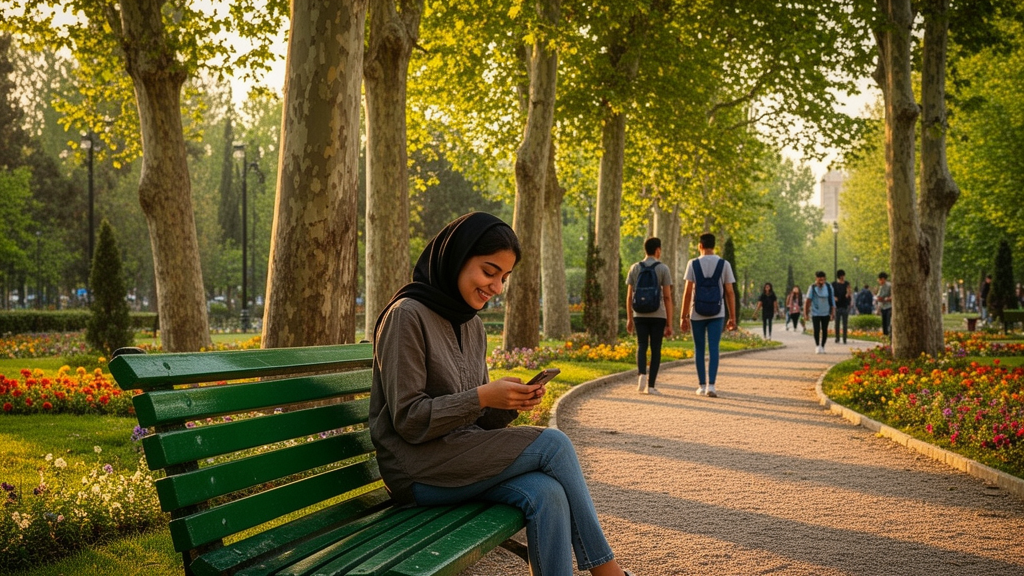
Young people who spend time in urban parks report feeling less lonely, and the kinds of park experiences that matter most appear to depend on the size and character of the city they live in, according to a new study of two Iranian cities. The research, published in Frontiers of Urban and Rural Planning, surveyed 1,000 park-visiting young people aged 15 to 24 in Tabriz, a metropolis of roughly 1.56 million in northwestern Iran, and Sanandaj, a smaller western city of about 413,000. Across both settings, every dimension of cultural ecosystem services that the researchers measured was statistically associated with lower reported loneliness, but the ranking of those dimensions shifted noticeably between the metropolitan and the small-city context.
The study, led by Zanyar Samadi-Todar, Ahmad Hami and Rojin Daneshparvar, focused on cultural ecosystem services, the non-material benefits that ecosystems provide, including recreation, aesthetic enjoyment, cultural identity, education, spiritual enrichment and social relationships. The team assessed six such dimensions: aesthetic value, cultural and heritage value, educational and knowledge value, recreational value, spiritual and religious value, and sense of place and social value. Participants rated their agreement with statements about each dimension on a five-point Likert scale, while loneliness was measured with an adapted version of the UCLA Loneliness Scale using a ten-point scale. The loneliness items were reverse-coded before analysis so that higher scores indicate lower loneliness.
Data collection took place over five months during late spring, summer and early autumn of 2025, when park use is at its highest. Surveys were administered on both weekdays and weekends during peak visitation hours, from 9 a.m. to noon and from 4 p.m. to 10 p.m., by three trained landscape architecture professionals. Parks with the highest visitor frequency were selected from different socio-economic districts in each city, and a systematic sampling method was used in which every tenth visitor was invited to participate. The sample was allocated as 544 participants in Tabriz and 456 in Sanandaj, a size determined with a sampling formula that set the error margin at 1.58 percent.
To analyse the relationships between the six service dimensions and loneliness, the researchers used partial least squares structural equation modeling, a statistical technique suited to exploratory research that aims to maximise explained variance. Separate models were estimated for each city rather than testing city type as a formal moderator, so the comparison should be read as a city-specific analysis rather than evidence of statistically significant group differences. The models showed strong explanatory power, with R-squared values of 0.853 for Tabriz and 0.852 for Sanandaj, meaning the six service dimensions accounted for roughly 85 percent of the variance in reported lower loneliness in each model. All variance inflation factors were well below the threshold of 3, indicating no problematic multicollinearity, and 10,000 bootstrap samples were generated to assess the precision of the estimates.
The headline result was consistent across both cities: sense of place and social value was the dimension most strongly associated with lower reported loneliness. In Tabriz it carried the highest path coefficient at 0.481, with a t-statistic of 20.029 and an effect size of 1.552, while in Sanandaj it reached a path coefficient of 0.451 with an effect size of 1.352. All six dimensions were statistically significant in both cities, with p-values reported as 0.000 and significance assessed at the 1 percent level. The authors interpret this shared pattern as suggesting that feelings of belonging, perceived social presence and emotional attachment to place are closely linked to youth well-being regardless of urban scale.
Beyond that common core, the two cities told different stories. In metropolitan Tabriz, cultural and heritage value and spiritual and religious value emerged as the second and third strongest dimensions associated with lower loneliness, while recreational and educational values showed comparatively weaker effects. The researchers suggest that in large urban settings, where social fragmentation and anonymity are more pronounced, culturally and spiritually meaningful green spaces may be linked to collective memory, cultural continuity and experiences of personal meaning. The relatively strong association for the spiritual and religious dimension was noted as particularly noteworthy in the socio-cultural context of Iran, where spiritual practices and symbolic landscapes are often embedded in everyday life.
In Sanandaj, the pattern was nearly reversed. Recreational value ranked second, with a path coefficient of 0.374, followed by aesthetic value, while spiritual and religious value and educational and knowledge value played a smaller role. The authors propose that in a smaller city with relatively strong social cohesion, opportunities for leisure, physical activity and engagement with attractive landscapes are more strongly related to youth well-being, and that cultural identity and spiritual practices may be more deeply embedded in everyday community structures, reducing the relative importance of parks as venues for those functions. Aesthetic experiences, they suggest, could contribute to feelings of comfort and attachment to place in settings where parks are less crowded and more socially familiar.
The findings carry practical implications for park planning. Because sense of place and social value dominated in both cities, the authors suggest that parks should generally prioritise opportunities for social interaction and place attachment, for example through community plazas, seating areas, youth-oriented meeting points and flexible open lawns, supported by recurring programmes such as cultural events and youth engagement workshops. In metropolitan contexts, they propose incorporating culturally meaningful and heritage-informed elements, including historical landscape features, local cultural symbols, heritage interpretation routes and quiet contemplative spaces. In smaller cities, the priorities may instead centre on recreational accessibility, sports courts, cycling paths, and landscape improvements such as increased vegetation and seasonal planting diversity. The authors also acknowledge real constraints, including financial limitations, limited land availability in dense urban areas, and the need for sustained maintenance commitments, and they recommend phased, low-cost interventions and participatory planning to reflect local preferences.
Important caveats temper these conclusions. The study is cross-sectional, so the results should be interpreted as statistical associations rather than causal relationships, a limitation the authors state explicitly. The sample consisted only of park-visiting youth recruited from selected parks in two cities, meaning non-park users, out-of-school youth and employed young people were likely underrepresented, and the findings should not be generalised beyond park-visiting youth in similar urban contexts. Data came from only two cities, which may not capture the regional, cultural or environmental diversity of Iran. The authors also note that the exploratory framework did not measure potential mediating factors such as social capital, place attachment, social interaction, emotional regulation or community belonging, so the mechanisms linking park experiences to loneliness remain untested.
Loneliness among young people is a growing public health concern, and the study situates itself within a broader body of evidence linking it to depression, cardiovascular disease, dementia and premature mortality, with meta-analytic evidence suggesting loneliness increases the risk of premature death by 26 percent. International surveys consistently report higher levels of loneliness among people aged 16 to 24, and the World Health Organization has identified loneliness as a global health priority. Within that landscape, the present findings suggest that urban parks may be associated with reduced loneliness by providing culturally meaningful and socially supportive environments, although the strength of these associations differs across contexts. The authors call for future research using longitudinal and mixed-method designs, broader demographic representation including non-park users, and exploration of diverse cultural settings, potentially aided by artificial intelligence and machine learning methods, to better understand the mechanisms underlying the observed relationships.
Subject of Research: Associations between cultural ecosystem services in urban parks and loneliness among young people in two Iranian cities
Article Title: Evaluation of cultural ecosystem services in urban green spaces and youth loneliness: evidence from Tabriz and Sanandaj, Iran
Article References: Samadi-Todar, Z., Hami, A., & Daneshparvar, R. (2026). Evaluation of cultural ecosystem services in urban green spaces and youth loneliness: evidence from Tabriz and Sanandaj, Iran. Frontiers of Urban and Rural Planning, 4(1), Article 24. https://doi.org/10.1007/s44243-026-00092-7
Image Credits: AI Generated
DOI: 10.1007/s44243-026-00092-7
Keywords: urban parks, loneliness, youth, cultural ecosystem services, Iran, Tabriz, Sanandaj, PLS-SEM, sense of place, social connectedness, green space planning, cross-sectional survey
News Source: Denise Maddox. (October 28, 2026). Urban parks linked to lower loneliness among young Iranians in two-city survey. Scienmag.