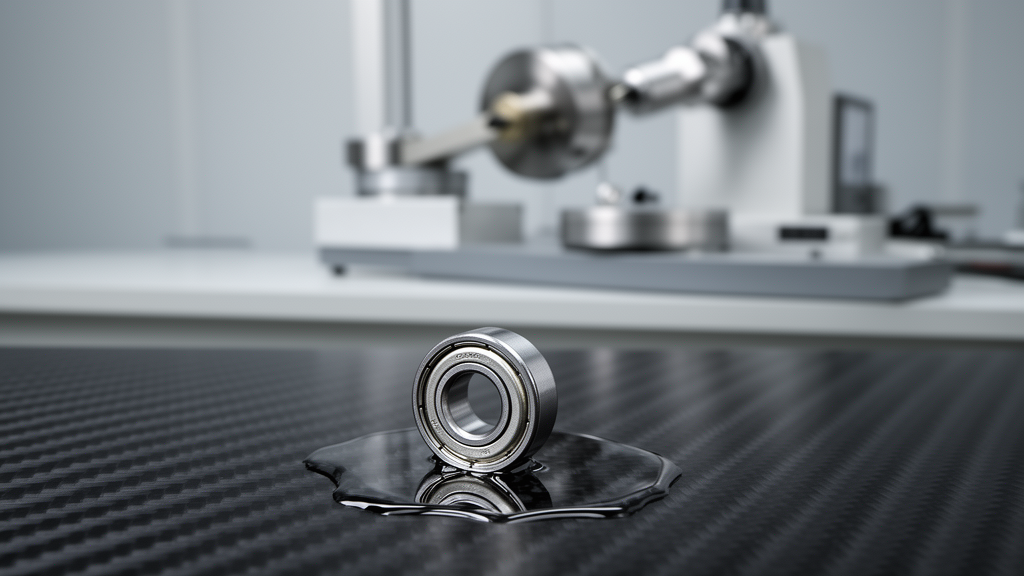
A team publishing in the Journal of Materials Science examined PEEK composites co-reinforced with carbon fiber (CF) and hexagonal boron nitride (h-BN), focusing on how far the material could be pushed before failure, expressed as its pressure–velocity (PV) limit, and on how the thin tribofilms that form on sliding surfaces evolve over time.
The researchers prepared composites containing 15 and 20 weight percent carbon fiber combined with 5 to 15 weight percent h-BN, then evaluated them across a range of PV conditions. The comparison revealed a clear divide. Neat PEEK and PEEK reinforced with h-BN alone showed inadequate load-bearing capacity under high PV conditions, meaning they could not withstand the combined stress of high pressure and high sliding speed. When carbon fiber and h-BN were used together, however, the composites gained significant enhancements in both mechanical strength and wear resistance.
The tribological analysis added a mechanistic layer to the results. The structure and continuity of the tribofilm, the transfer layer that develops between sliding surfaces, depended strongly on the applied PV conditions. Under severe sliding regimes, a dense and uniform tribofilm formed, and this film appears central to the composites’ improved performance.
The headline numbers are striking. At a load of 4 MPa, the co-reinforced composite achieved an ultra-low friction coefficient of 0.05 and a specific wear rate of 0.49 × 10⁻⁶ mm³/Nm. These values were reported under the specific test conditions described, so they should be read as performance at that load rather than a universal guarantee across all operating regimes.
Why does this matter beyond the laboratory? Extending the operational PV limit means such components can tolerate harsher combinations of load and speed before their performance degrades. The authors state that their findings provide mechanistic insights into the synergistic role of carbon fibers and hexagonal boron nitride, and that these insights offer direct guidance for designing high-performance PEEK composites for demanding dry sliding applications. In other words, the work is intended not just to report a material recipe but to explain why the recipe works, so that future formulations can be rationally tuned rather than found by trial and error.
The study, published in 2026, was led by Qingsong Li, Yang Zhang, Fangda Jing, Li Yang, Dongyan Liu, Na Ma, Guoming Lin and Guoxin Sui. Its central contribution is the pairing of performance data with tribofilm evolution analysis: by linking the dense, uniform tribofilm seen under severe sliding to the observed ultra-low friction and wear, the work connects a measurable microstructural phenomenon to the macroscopic engineering outcome. For designers weighing PEEK against alternatives in unlubricated service, the message is that combining carbon fiber with h-BN, rather than relying on either reinforcement alone, is what unlocks the material’s capacity to carry load and slide with minimal wear.
Subject of Research: Tribological performance of PEEK composites co-reinforced with carbon fiber and hexagonal boron nitride under dry sliding
Article Title: Synergistic effects of carbon fiber and hexagonal boron nitride on PV limit and tribofilm evolution of PEEK composites under dry sliding
Article References: Li, Q., Zhang, Y., Jing, F., Yang, L., Liu, D., Ma, N., Lin, G., & Sui, G. (2026). Synergistic effects of carbon fiber and hexagonal boron nitride on PV limit and tribofilm evolution of PEEK composites under dry sliding. Journal of Materials Science, 61(40), 30683-30700. https://doi.org/10.1007/s10853-026-13074-3
Image Credits: AI Generated
DOI: 10.1007/s10853-026-13074-3
Keywords: PEEK composites, carbon fiber, hexagonal boron nitride, tribology, PV limit, tribofilm, dry sliding, friction coefficient, wear rate, materials science, Synergistic, effects
News Source: Neil Sanderson. (October 28, 2026). Carbon fiber and boron nitride team up to push PEEK composites to ultra-low friction. Scienmag.