• HOME
  • NEWS
  • EXPLORE
    • CAREER
      • Companies
      • Jobs
    • EVENTS
    • iGEM
      • News
      • Team
    • PHOTOS
    • VIDEO
    • WIKI
  • BLOG
  • COMMUNITY
    • FACEBOOK
    • INSTAGRAM
    • TWITTER
Tuesday, May 12, 2026
BIOENGINEER.ORG
No Result
View All Result
  • Login
  • HOME
  • NEWS
  • EXPLORE
    • CAREER
      • Companies
      • Jobs
        • Lecturer
        • PhD Studentship
        • Postdoc
        • Research Assistant
    • EVENTS
    • iGEM
      • News
      • Team
    • PHOTOS
    • VIDEO
    • WIKI
  • BLOG
  • COMMUNITY
    • FACEBOOK
    • INSTAGRAM
    • TWITTER
  • HOME
  • NEWS
  • EXPLORE
    • CAREER
      • Companies
      • Jobs
        • Lecturer
        • PhD Studentship
        • Postdoc
        • Research Assistant
    • EVENTS
    • iGEM
      • News
      • Team
    • PHOTOS
    • VIDEO
    • WIKI
  • BLOG
  • COMMUNITY
    • FACEBOOK
    • INSTAGRAM
    • TWITTER
No Result
View All Result
Bioengineer.org
No Result
View All Result
Home NEWS Science News Chemistry

Ural Federal University scientists developed a new way of synthesis of high-purity zircon

Bioengineer by Bioengineer
February 5, 2021
in Chemistry
Reading Time: 2 mins read
0
IMAGE
Share on FacebookShare on TwitterShare on LinkedinShare on RedditShare on Telegram

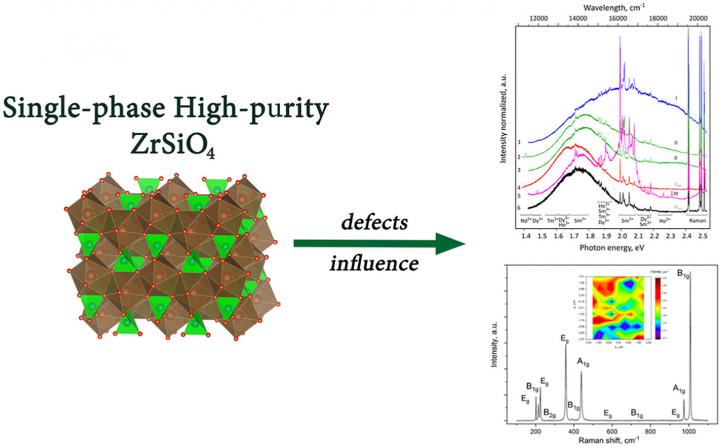
The synthesized zircon can be used for storage and disposal of radioactive waste; Furthermore, the unusual material, can be used as a reference sample in mineralogical studies
IMAGE

Credit: Ural Federal University

The scientific novelty of the work of scientists from Ural Federal University, Institute of Solid State Chemistry and Geology and Geochemistry of the Ural Branch of the Russian Academy of Sciences lies in the fact that for the first time scientists solved the task of creating zircon with certain spectral properties. To this end, they have worked out the so-called sol-gel method.

It is distinguished by its technological simplicity, controllability of processes and allows synthesizing a larger volume of products with high purity than with other methods.

First, from carbonate of zirconium metal and an organosilicon compound, they obtained a sol – a dispersed medium with the presence of small solid particles, from it – a colloidal system, then, after drying and grinding, a precursor powder of a high degree of homogeneity, which was subjected to further grinding and calcination.

Second, it was found that upon mechanical stirring and sequential annealing – heating to 1550 ° C and further cooling the precursor to room temperature – the number of defects in the synthesized sample decreases and its high purity is achieved.

The range of applications of zircon obtained by the scientists from Yekaterinburg is very wide. Due to its high melting point (above 2000 ° C), chemical resistance, mechanical strength, low expansion coefficient at high temperatures and low thermal conductivity, zircon is useful as a refractory material (for example, for the manufacture of industrial furnaces) and a pigment for the production of heat-resistant paints. The presence of impurities and defects in the structure allows us to consider it as a standard for studying the mechanisms of defect formation in natural zircon crystals.

“Even a small concentration of impurities, such as iron, manganese, titanium, rare earth elements, significantly affects the luminescent properties of zircon, in some cases, the impurities enhance the glow in a certain range of electromagnetic waves. In other words, with the help of impurities, you can give zircon the necessary luminescent properties and use it as a phosphor or to detect the level of radiation damage, since the structure of zircon well “remembers” the radiation dose that it received, ” says Dmitry Zamyatin, senior researcher, Research Laboratory “EXTRA TERRA CONSORTIUM”, UrFU Institute of Physics and Technology.

Furthermore, the synthetic zircon matrix is able to contain large amounts of uranium and thorium. This allows the synthesized zircon to be used as a container for long-term storage and disposal of radioactive elements.

###

Media Contact
Evgeniya Saburova
[email protected]

Related Journal Article

http://dx.doi.org/10.1016/j.jssc.2020.121783

Tags: Chemistry/Physics/Materials SciencesGeology/SoilIndustrial Engineering/ChemistryParticle Physics
Share12Tweet8Share2ShareShareShare2

Related Posts

Humans and Zebra Finches Share Similar Speech Learning Techniques #ASA190 — Chemistry

Humans and Zebra Finches Share Similar Speech Learning Techniques #ASA190

May 11, 2026
Unveiling Dark Matter Through Molecular Insights — Chemistry

Unveiling Dark Matter Through Molecular Insights

May 11, 2026

From Touch to Sight: A Bioinspired Multisensory Framework Endows Robots with Human-Like Perception

May 11, 2026

Announcing the 2026 Carbon Future Young Investigator Award Winners

May 11, 2026
Please login to join discussion

POPULAR NEWS

  • Research Indicates Potential Connection Between Prenatal Medication Exposure and Elevated Autism Risk

    841 shares
    Share 336 Tweet 210
  • New Study Reveals Plants Can Detect the Sound of Rain

    728 shares
    Share 290 Tweet 182
  • Salmonella Haem Blocks Macrophages, Boosts Infection

    62 shares
    Share 25 Tweet 16
  • Breastmilk Balances E. coli and Beneficial Bacteria in Infant Gut Microbiomes

    57 shares
    Share 23 Tweet 14

About

We bring you the latest biotechnology news from best research centers and universities around the world. Check our website.

Follow us

Recent News

Humans and Zebra Finches Share Similar Speech Learning Techniques #ASA190

New Study Uncovers How Fungal Parasites Attack Strawberries and Raspberries

City of Hope Researchers to Present Groundbreaking Immunotherapy and Precision Medicine Advances Across Multiple Cancer Types at ASCO 2026

Subscribe to Blog via Email

Enter your email address to subscribe to this blog and receive notifications of new posts by email.

Join 82 other subscribers
  • Contact Us

Bioengineer.org © Copyright 2023 All Rights Reserved.

Welcome Back!

Login to your account below

Forgotten Password?

Retrieve your password

Please enter your username or email address to reset your password.

Log In
No Result
View All Result
  • Homepages
    • Home Page 1
    • Home Page 2
  • News
  • National
  • Business
  • Health
  • Lifestyle
  • Science

Bioengineer.org © Copyright 2023 All Rights Reserved.