• HOME
  • NEWS
  • EXPLORE
    • CAREER
      • Companies
      • Jobs
    • EVENTS
    • iGEM
      • News
      • Team
    • PHOTOS
    • VIDEO
    • WIKI
  • BLOG
  • COMMUNITY
    • FACEBOOK
    • INSTAGRAM
    • TWITTER
Monday, May 11, 2026
BIOENGINEER.ORG
No Result
View All Result
  • Login
  • HOME
  • NEWS
  • EXPLORE
    • CAREER
      • Companies
      • Jobs
        • Lecturer
        • PhD Studentship
        • Postdoc
        • Research Assistant
    • EVENTS
    • iGEM
      • News
      • Team
    • PHOTOS
    • VIDEO
    • WIKI
  • BLOG
  • COMMUNITY
    • FACEBOOK
    • INSTAGRAM
    • TWITTER
  • HOME
  • NEWS
  • EXPLORE
    • CAREER
      • Companies
      • Jobs
        • Lecturer
        • PhD Studentship
        • Postdoc
        • Research Assistant
    • EVENTS
    • iGEM
      • News
      • Team
    • PHOTOS
    • VIDEO
    • WIKI
  • BLOG
  • COMMUNITY
    • FACEBOOK
    • INSTAGRAM
    • TWITTER
No Result
View All Result
Bioengineer.org
No Result
View All Result
Home NEWS Science News Chemistry

Upgrade of a research IceCube

Bioengineer by Bioengineer
July 16, 2019
in Chemistry
Reading Time: 2 mins read
0
IMAGE
Share on FacebookShare on TwitterShare on LinkedinShare on RedditShare on Telegram

IMAGE

Credit: IceCube/NSF

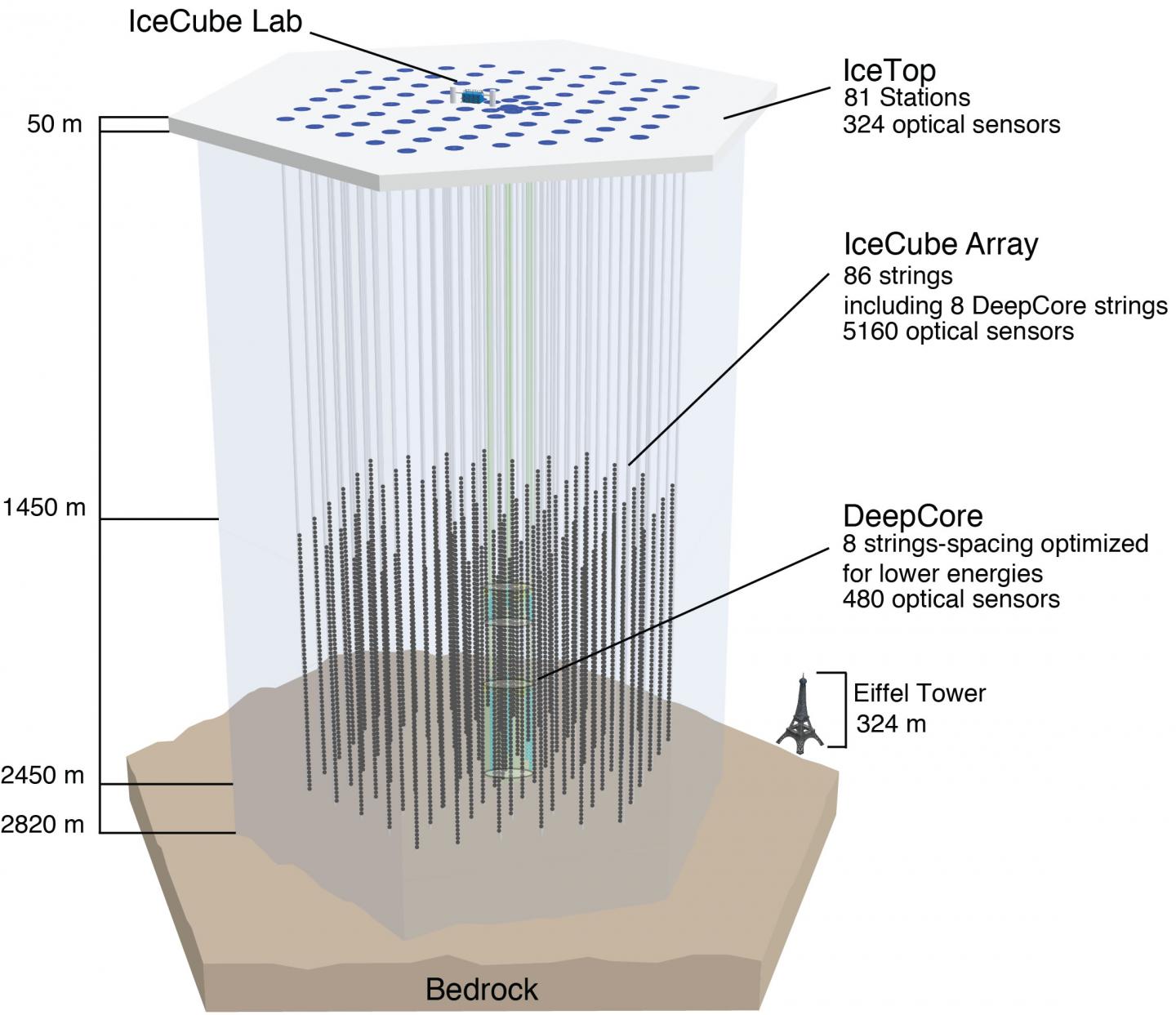
The IceCube Neutrino Observatory in Antarctica is about to get a significant upgrade. This huge detector consists of 5,160 sensors embedded in a 1x1x1 km volume of glacial ice deep beneath the geographic South Pole. The purpose of this huge installation is to detect neutrinos, the “ghost particles” of the Universe. The IceCube Upgrade will add more than 700 new and enhanced optical sensors in the deepest, purest ice, greatly improving the observatory’s ability to measure low-energy neutrinos produced in the Earth’s atmosphere. The research in neutrinos at the Niels Bohr Institute, University of Copenhagen is led by Associate Professor Jason Koskinen

The upgrade is necessary for the development of a new field of research

“The current IceCube detector is providing leading results in astrophysics and particle physics, specifically measurements of neutrino oscillations by researchers in Copenhagen, but can only take us so far. When neutrinos “oscillate”, they change “flavour” – and actually change properties. Through a truly international effort, this new detector is going to be a huge leap forward in our ability to understand the fundamental properties of the neutrino in ways that no other project in the world can do now”, says D. Jason Koskinen, Associate Professor and leader of the local IceCube research group at the Niels Bohr Institute.

Neutrino oscillations – creating a new neutrino vision

The principal goal of this first IceCube extension is to perform precision studies of the strange phenomenon known as ‘neutrino oscillation’, where neutrinos produced as one type may ‘oscillate’ to another as they travel. The sensitivity of the upgraded detector will allow scientists at NBI and worldwide to test if neutrinos only oscillate between the three known types, or if there are also new and as yet undiscovered neutrino types participating. These new neutrino types are predicted by the leading theories seeking to explain the unimaginably tiny masses neutrinos possess.

Additionally, the upgrade will include an advanced suite of the calibration devices, designed to better characterise the properties of the glacier ice. This will allow scientists to more accurately pin-point the distant and violent sources of the high energy astrophysical neutrinos IceCube has discovered.

This upgrade will not only offer huge advances in fundamental neutrino physics and astrophysics, but will pave the way for a future expansion of the entire observatory to 10 times the size, opening a new era in neutrino astronomy.

###

Links to further information here:

https://icecube.nbi.ku.dk/

Media Contact
Jason Koskinen
[email protected]

Tags: AstrophysicsAtomic/Molecular/Particle PhysicsChemistry/Physics/Materials SciencesGeophysicsParticle PhysicsSpace/Planetary Science
Share12Tweet8Share2ShareShareShare2

Related Posts

Miniature Sensor Uses Light to Detect Touch — Chemistry

Miniature Sensor Uses Light to Detect Touch

May 8, 2026
Iron Minerals Determine Whether Dissolved Organic Matter Fuels Microbes or Becomes Long-Term Carbon Storage — Chemistry

Iron Minerals Determine Whether Dissolved Organic Matter Fuels Microbes or Becomes Long-Term Carbon Storage

May 8, 2026

Kate Evans Appointed Associate Lab Director for Biological and Environmental Systems Science at ORNL

May 8, 2026

Advancing Multiscale Modeling and Overcoming Operational Challenges in Autothermal COâ‚‚-to-Methanol Reactors

May 8, 2026
Please login to join discussion

POPULAR NEWS

  • Research Indicates Potential Connection Between Prenatal Medication Exposure and Elevated Autism Risk

    841 shares
    Share 336 Tweet 210
  • New Study Reveals Plants Can Detect the Sound of Rain

    728 shares
    Share 290 Tweet 182
  • Salmonella Haem Blocks Macrophages, Boosts Infection

    62 shares
    Share 25 Tweet 16
  • Breastmilk Balances E. coli and Beneficial Bacteria in Infant Gut Microbiomes

    57 shares
    Share 23 Tweet 14

About

We bring you the latest biotechnology news from best research centers and universities around the world. Check our website.

Follow us

Recent News

Global City Growth Decouples from Fossil Fuels

ACAD8 Deficiency Drives Cardiac Hypertrophy via Histone Modification

CRISPRi Screening Identifies Fungal-Specific Drug Targets

Subscribe to Blog via Email

Enter your email address to subscribe to this blog and receive notifications of new posts by email.

Join 82 other subscribers
  • Contact Us

Bioengineer.org © Copyright 2023 All Rights Reserved.

Welcome Back!

Login to your account below

Forgotten Password?

Retrieve your password

Please enter your username or email address to reset your password.

Log In
No Result
View All Result
  • Homepages
    • Home Page 1
    • Home Page 2
  • News
  • National
  • Business
  • Health
  • Lifestyle
  • Science

Bioengineer.org © Copyright 2023 All Rights Reserved.