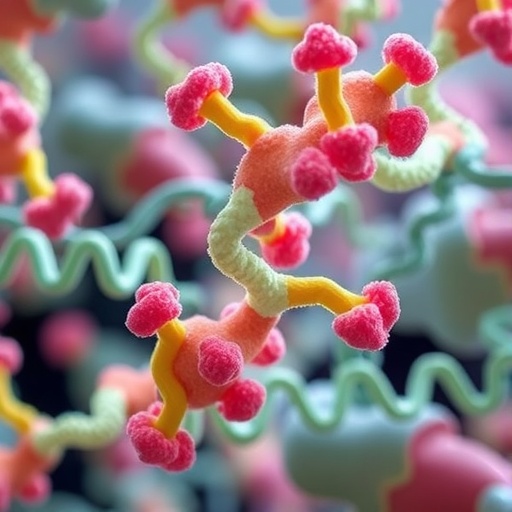
In a groundbreaking study that promises to reshape our understanding of cellular signal transduction, researchers have unveiled the pivotal role of the intrinsically disordered N-terminal segment of the neuropeptide Y2 (Y2) receptor in modulating cellular responses. This research elucidates how transient interactions between this flexible region and the hormone neuropeptide Y (NPY) govern the recruitment of the cellular partner protein arrestin-3, which critically influences the receptor’s downstream signaling pathways.
G protein-coupled receptors (GPCRs) constitute one of the largest and most versatile families of membrane proteins, instrumental in transducing extracellular signals into cellular responses. These receptors are central to myriad physiological processes and serve as primary targets for a significant proportion of therapeutic drugs addressing conditions such as hypertension, pain, allergies, and obesity. Despite their biomedical importance, the dynamic mechanisms underlying GPCR activation and signaling remain incompletely characterized. This latest investigation targets the Y2 receptor, a bonafide GPCR activated by NPY, a peptide hormone integral to regulating brain functions including stress, circadian rhythm, and most notably, satiety signals that control hunger.
A distinctive feature of the Y2 receptor, shared by many GPCRs, is the presence of a highly flexible and unstructured N-terminal region. Unlike typical protein domains that adopt defined three-dimensional conformations, this segment is classified as an intrinsically disordered region (IDR). IDRs lack stable secondary or tertiary structure, exhibiting a dynamic ensemble of rapidly interconverting conformations akin to a diffuse protein “cloud.” This structural plasticity, while essential for function, poses substantial experimental challenges, complicating efforts to assign specific roles to individual conformers within the receptor activation process.
Addressing this challenge head-on, an interdisciplinary team within the Collaborative Research Centre (CRC) 1423 developed and applied an innovative experimental approach marrying light-induced cross-linking with highly sensitive mass spectrometry techniques. This methodology allowed the precise mapping of direct contact points between the receptor’s N-terminal IDR and its ligand, NPY, under near-physiological conditions. The findings revealed that transient yet functionally significant interactions occur between negatively charged clusters in the disordered N-terminus and the peptide hormone, thereby stabilizing hormone binding and modulating signal transmission fidelity.
Intriguingly, detailed mutational analyses uncovered that abolishing these short-lived contacts within the N-terminal motif does not universally impair receptor signaling but selectively attenuates the recruitment of arrestin-3. Arrestin-3 functions as a pivotal cellular effector that mediates receptor desensitization, internalization, and initiates alternative signaling cascades. The altered interaction dynamics diminish arrestin-3 binding, consequently reshaping the balance and spectrum of cellular responses elicited by Y2 activation. This nuanced modulation exemplifies an emergent paradigm in receptor biology where flexible regions fine-tune signal specificity and intensity.
Complementing the experimental observations, computational structural modeling and molecular dynamics simulations performed by collaborating groups from Leipzig University substantiated and extended mechanistic insights. These in silico approaches provided atomistic snapshots and time-resolved mappings of the transient ligand-receptor interface, elucidating how dynamic electrostatic interactions govern the stability and kinetics of hormone engagement. The simulations revealed the indispensable role of N-terminal disorder in facilitating adaptable binding modes that underpin functional versatility, a feature likely conserved across other GPCR family members.
Beyond advancing fundamental receptor biology, these pioneering revelations hold profound therapeutic implications. The Y2 receptor, though not yet specifically targeted by approved drugs, represents a promising candidate for novel pharmacological intervention strategies in metabolic disorders and neuropsychiatric conditions. Understanding how intrinsically disordered domains contribute to ligand recognition and downstream effector recruitment equips drug developers with crucial knowledge to design molecules that leverage or modulate this flexibility to achieve selective signaling outcomes.
The interdisciplinary nature of this research exemplifies the power of collaborative science, integrating cutting-edge biochemical techniques, mass spectrometry, mutagenesis, and computational modeling to tackle a longstanding biological question. Over four years of rigorous investigation have culminated in a comprehensive mechanistic framework that not only sheds light on Y2 receptor function but also sets the stage for exploring intrinsic disorder as a general principle in receptor-mediated signaling paradigms.
Intrinsically disordered regions in proteins have increasingly been recognized for their functional significance across biological systems, yet their roles remain enigmatic due to experimental intractability. This study underscores the importance of transient, multivalent interactions within disordered segments as critical modulators of receptor activity, challenging classical structure-function dogmas and proposing new dimensions for biochemical regulation.
Looking ahead, the researchers advocate for extending this integrative methodology to other GPCRs and membrane proteins, hypothesizing that flexible N-terminal tails and related IDRs serve as dynamic hubs that diversify and refine cellular communication. Such knowledge expansion could unlock previously inaccessible targets within the proteome, propelling drug discovery toward novel classes of allosteric modulators and biased agonists with superior efficacy and reduced side effects.
In sum, this milestone investigation reconstructs our molecular perspective on how subtle and ephemeral contacts within the flexible N-terminus of the neuropeptide Y2 receptor choreograph the selective recruitment of arrestin-3, thereby dictating receptor signaling outcomes. These insights converge to illuminate a sophisticated layer of regulation encoded within protein disorder itself—a frontier ripe for exploration with transformative potential for biology and medicine alike.
Subject of Research: Human tissue samples
Article Title: Transient ligand contacts of the intrinsically disordered N-terminus of neuropeptide Y2 receptor regulate arrestin-3 recruitment
News Publication Date: 19-Sep-2025
Web References: DOI:10.1038/s41467-025-64051-4
Image Credits: Asat Baischew
Keywords: neuropeptide Y2 receptor, Y2 receptor, intrinsically disordered region, N-terminal flexibility, G protein-coupled receptor, arrestin-3 recruitment, peptide hormone interaction, mass spectrometry, cross-linking, molecular dynamics simulations, receptor signaling, cellular response
Tags: arrestin-3 recruitmentcellular signal transductiondownstream signaling pathwaysflexible protein regionsGPCR activation mechanismshunger and satiety signalsintrinsically disordered proteinsneuropeptide Y2 receptorpeptide hormone functionsphysiological processes regulationtherapeutic drug targetsunstructured protein segments