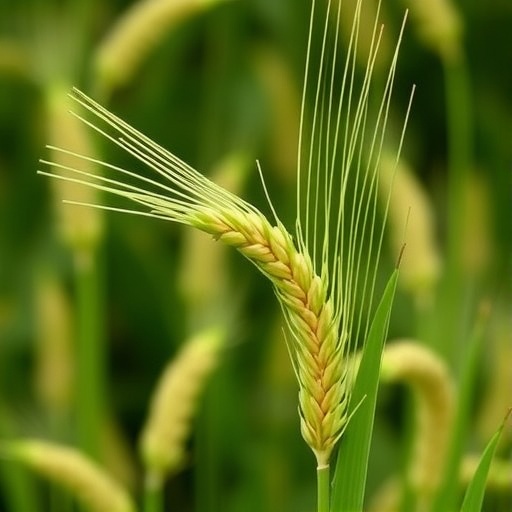
The genetic architecture of wheat may be more flexible than previously thought. Researchers from China Agricultural University and the Chinese Academy of Agricultural Sciences have identified and cloned a previously unknown gene that sharply reduces plant height while producing denser, more compact spikes. Named Sdd1, for “semi-dwarf and dense-spike 1,” the gene could provide breeders with a new way to redesign wheat plants without relying exclusively on the limited dwarfing genes that powered the Green Revolution.
The discovery addresses a longstanding challenge in modern wheat improvement. Semi-dwarf varieties transformed agriculture during the twentieth century because their shorter stems were less likely to collapse under the weight of grain or heavy fertilizer applications. However, many widely used dwarfing genes interfere with gibberellin signaling, a hormonal system that promotes stem elongation and influences seedling vigor, grain filling, and nitrogen-use efficiency. These linked effects can limit yield gains in environments where early growth and efficient nutrient use are essential.
The new study, published in The Crop Journal, began with AS34, a somatic mutant derived from the wheat line Lankao 906, also known as Yumai 66. The researchers compared the mutant with its wild-type counterpart through field experiments, genetic analysis, microscopy, hormone-response assays, and whole-genome resequencing. AS34 plants reached an average height of only 45 centimeters, compared with 77 centimeters in Lankao 906, representing a reduction of 41.6 percent. The mutant also produced spikes that were 44 percent shorter, but their spikelet density increased by 60.3 percent.
This unusual combination of short stature and compact spike structure points to a developmental mechanism different from simple suppression of overall growth. Microscopic examination showed that stem cells in AS34 were shorter and broader than those in the wild type. The observations indicate that the reduced height is primarily caused by restricted longitudinal cell elongation rather than a general failure of cell production. At the same time, changes in the organization of spike tissues appear to compress the developing inflorescence, allowing more spikelets to occupy a shorter rachis.
Genetic mapping placed both the semi-dwarf and dense-spike characteristics under the control of a single major locus on chromosome 3B. By analyzing a segregating population and applying newly developed molecular markers, the team narrowed the region to a 5.7-megabase interval. Within that interval, the strongest candidate was TraesCS3B02G260400, which encodes a small protein whose biochemical function is not yet known. The gene was designated Sdd1 after independent mutant lines carrying different lesions in the same gene reproduced changes in plant height and spike development in the Jing 411 genetic background.
The findings also reveal that Sdd1 operates through a distinctive hormonal profile. Compared with Lankao 906, AS34 plants showed markedly reduced sensitivity to brassinosteroid, a group of steroid hormones involved in cell expansion and plant architecture. In contrast, the mutant responded more strongly to gibberellin and auxin. Gibberellin generally promotes stem elongation, while auxin coordinates cell division, elongation, and tissue patterning. The combined response suggests that Sdd1 is not a conventional switch in one hormone pathway, but a regulatory node that helps integrate signals from several growth systems.
That mechanism is particularly significant because the researchers found that Sdd1 remains functional in a genetic background carrying the previously described r-e-z large-fragment deletion haploblock. Their earlier work showed that this naturally occurring deletion promotes compact growth and improves plant architecture by altering brassinosteroid and gibberellin signaling. Because Sdd1 acts independently of that deletion, the two resources could potentially be combined. Such stacking might allow breeders to adjust height and spike form more precisely than is possible with a single dwarfing allele.
Professor Jie Liu of China Agricultural University said the discovery expands the molecular framework for understanding how wheat dwarfing genes influence development. In his view, the contrasting hormone responses of AS34 distinguish Sdd1 from established semi-dwarfing genes and may offer a route around some of their unwanted effects. The researchers caution, however, that the gene’s practical value cannot yet be assumed. Reduced height and dense spikes may perform differently depending on genetic background, soil fertility, climate, and cultivation conditions, and the interaction between compact spike architecture and grain number will require detailed evaluation.
The next stage will focus on determining what the small Sdd1 protein actually does inside wheat cells. The team is investigating whether it perceives hormonal signals, modifies their transmission, or regulates downstream components that control cell elongation and inflorescence development. Researchers will also test the gene across diverse wheat varieties and environments to assess its effects on yield, grain filling, seedling vigor, lodging resistance, and nitrogen-use efficiency. If those trials confirm that the allele can be combined with existing dwarfing resources without major penalties, Sdd1 could become a valuable addition to the genetic toolkit used to engineer shorter, stronger, and more productive wheat plants.
Subject of Research: Experimental study of semi-dwarfism and spike architecture in bread wheat
Article Title: Map-based cloning and functional analysis of the semi-dwarf and dense-spike gene Sdd1 in bread wheat
Web References: https://doi.org/10.1016/j.cj.2026.06.008
References: Song et al., 2023, Nature 617:118–124
Image Credits: Professor Jie Liu, et al.
Keywords: wheat, Sdd1, semi-dwarfing gene, dense spikes, plant height, chromosome 3B, gibberellin, auxin, brassinosteroid, wheat breeding, crop genetics, plant architecture
Tags: crop yield optimization through geneticsdense spike wheat varietiesgenetic basis of wheat height reductiongibberellin signaling in wheathormonal regulation of wheat growthnovel wheat dwarfing genessemi-dwarf wheat gene Sdd1sustainable wheat production techniqueswheat breeding for yield enhancementwheat genetic engineeringwheat mutant analysiswheat plant architecture improvement