• HOME
  • NEWS
  • EXPLORE
    • CAREER
      • Companies
      • Jobs
    • EVENTS
    • iGEM
      • News
      • Team
    • PHOTOS
    • VIDEO
    • WIKI
  • BLOG
  • COMMUNITY
    • FACEBOOK
    • INSTAGRAM
    • TWITTER
Thursday, September 24, 2026
BIOENGINEER.ORG
No Result
View All Result
  • Login
  • HOME
  • NEWS
  • EXPLORE
    • CAREER
      • Companies
      • Jobs
        • Lecturer
        • PhD Studentship
        • Postdoc
        • Research Assistant
    • EVENTS
    • iGEM
      • News
      • Team
    • PHOTOS
    • VIDEO
    • WIKI
  • BLOG
  • COMMUNITY
    • FACEBOOK
    • INSTAGRAM
    • TWITTER
  • HOME
  • NEWS
  • EXPLORE
    • CAREER
      • Companies
      • Jobs
        • Lecturer
        • PhD Studentship
        • Postdoc
        • Research Assistant
    • EVENTS
    • iGEM
      • News
      • Team
    • PHOTOS
    • VIDEO
    • WIKI
  • BLOG
  • COMMUNITY
    • FACEBOOK
    • INSTAGRAM
    • TWITTER
No Result
View All Result
Bioengineer.org
No Result
View All Result
Home NEWS Science News Chemistry

Unprecedented ground-based discovery of 2 strongly interacting exoplanets

Bioengineer by Bioengineer
July 2, 2020
in Chemistry
Reading Time: 2 mins read
0
IMAGE
Share on FacebookShare on TwitterShare on LinkedinShare on RedditShare on Telegram

IMAGE

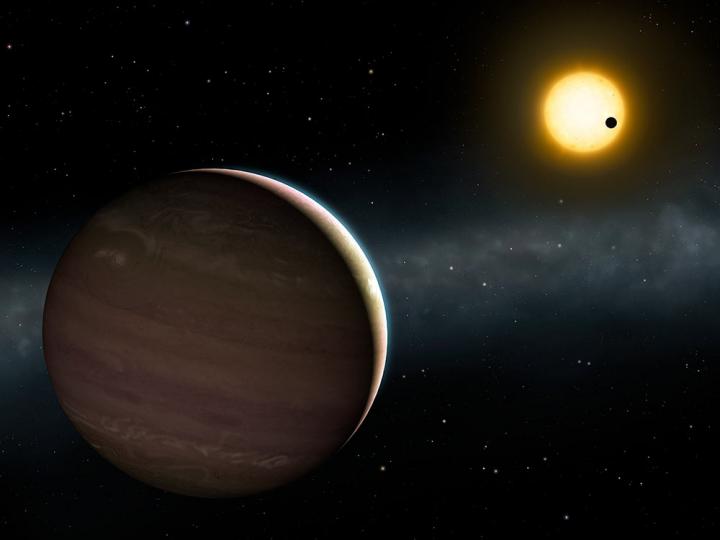
Credit: Institut d’astrophysique de Paris, Mark A. Garlick

Several interacting exoplanets have already been spotted by satellites. But a new breakthrough has been achieved with, for the first time, the detection directly from the ground of an extrasolar system of this type. An international collaboration including CNRS researchers* has discovered an unusual planetary system, dubbed WASP-148, using the French instrument SOPHIE at the Observatoire de Haute-Provence (CNRS/Aix-Marseille Université;). The scientists analysed the star’s motion and concluded that it hosted two planets, WASP-148b and WASP-148c. The observations showed that the two planets were strongly interacting, which was confirmed from other data**. Whereas the first planet, WASP-148b, orbits its star in nearly nine days, the second one, WASP-148c, takes four times longer. This ratio between the orbital periods implies that the WASP-148 system is close to resonance, meaning that there is enhanced gravitational interaction between the two planets. And it turns out that the astronomers did indeed detect variations in the orbital periods of the planets. While a single planet, uninfluenced by a second one, would move with a constant period, WASP-148b and WASP-148c undergo acceleration and deceleration that provides evidence of their interaction. Their study will shortly be published in the journal Astronomy & Astrophysics.

###

Notes

* French scientists work in the following laboratories : Institut d’astrophysique de Paris (CNRS/Sorbonne Université;) ; Observatoire de Haute-Provence (CNRS/Aix-Marseille Université;) ; Institut de mécanique céleste et de calcul des éphémérides (CNRS/Observatoire de Paris-PSL/Sorbonne Université;) ; Institut de planétologie et d’astrophysique de Grenoble (CNRS/Université; Grenoble Alpes) ; Laboratoire d’astrophysique de Marseille (CNRS/Aix-Marseille Université) ; Laboratoire d’études spatiales et d’instrumentation en astrophysique (CNRS/Observatoire de Paris-PSL/Sorbonne Université/Université; de Paris). They also colaborated with amateur astronomers from Hubert-Reeves Observatory.

** Mesures made with Hubert-Reeves telescope, France, and using SuperWASP, RISE, Carlos Sanchez and Liverpool, Canary Islands, Spain.

Media Contact
Clara Barrau
[email protected]

Original Source

http://www.cnrs.fr/en/unprecedented-ground-based-discovery-two-strongly-interacting-exoplanets

Related Journal Article

http://dx.doi.org/10.1051/0004-6361/202038296

Tags: AstronomyAstrophysicsPlanets/MoonsSpace/Planetary Science
Share12Tweet8Share2ShareShareShare2

Related Posts

Bismuth Tungstate Wrapped in Conductive Polymer Yields Supercapacitor Electrode That Barely Fades Over 1,000 Cycles

Bismuth Tungstate Wrapped in Conductive Polymer Yields Supercapacitor Electrode That Barely Fades Over 1,000 Cycles

September 24, 2026
New Sum-Connectivity Descriptors Give Molecular Graphs a Sharper Predictive Edge

New Sum-Connectivity Descriptors Give Molecular Graphs a Sharper Predictive Edge

September 24, 2026

Ball-Milled and CVD Silicon Anodes Face Off in All-Solid-State Batteries

September 24, 2026

Induction-Heating PCR Chip Cracks Worm Genes in 30 Minutes

September 24, 2026
Please login to join discussion

POPULAR NEWS

  • Sleep Experts Urge Routine Classification of Central Hypopneas to Unlock Precision Therapy

    29 shares
    Share 12 Tweet 7
  • Bismuth Tungstate Wrapped in Conductive Polymer Yields Supercapacitor Electrode That Barely Fades Over 1,000 Cycles

    29 shares
    Share 12 Tweet 7
  • How Plant Polyphenols May Rewrite the Epigenetic Damage That Drives Cancer

    29 shares
    Share 12 Tweet 7
  • High Entropy Alloys Emerge as Powerful New Materials for Absorbing Electromagnetic Radiation

    29 shares
    Share 12 Tweet 7

About

We bring you the latest biotechnology news from best research centers and universities around the world. Check our website.

Follow us

Recent News

Sleep Experts Urge Routine Classification of Central Hypopneas to Unlock Precision Therapy

Bismuth Tungstate Wrapped in Conductive Polymer Yields Supercapacitor Electrode That Barely Fades Over 1,000 Cycles

How Plant Polyphenols May Rewrite the Epigenetic Damage That Drives Cancer

Subscribe to Blog via Email

Enter your email address to subscribe to this blog and receive notifications of new posts by email.

Join 85 other subscribers
  • Contact Us

Bioengineer.org © Copyright 2023 All Rights Reserved.

Welcome Back!

Login to your account below

Forgotten Password?

Retrieve your password

Please enter your username or email address to reset your password.

Log In
No Result
View All Result
  • Homepages
    • Home Page 1
    • Home Page 2
  • News
  • National
  • Business
  • Health
  • Lifestyle
  • Science

Bioengineer.org © Copyright 2023 All Rights Reserved.